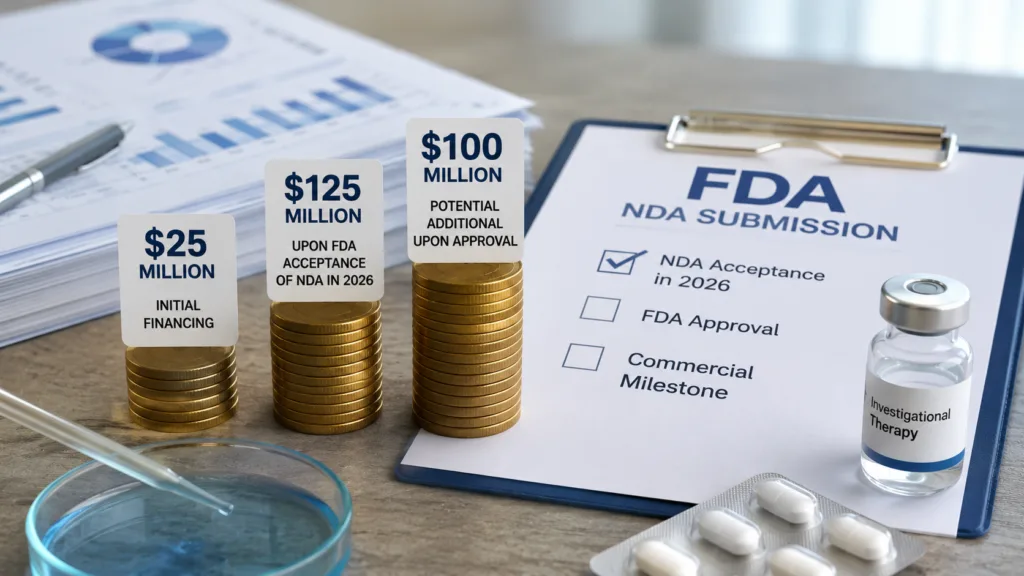
Gossamer Bio, Inc. (NASDAQ: GOSS) has arranged a private placement worth as much as $250 million to finance seralutinib through a planned US regulatory filing and potentially into commercialization, using a structure in which most of the capital becomes available only if the pulmonary arterial hypertension programme reaches predefined Food and Drug Administration milestones. Approximately $25 million is expected at the initial closing, another $125 million is committed if FDA accepts a seralutinib New Drug Application during 2026, and warrants issued at that second closing could generate another approximately $100 million if FDA ultimately approves the medicine. The August 21 transaction is particularly notable because investors are committing capital around a programme whose Phase 3 primary analysis produced evidence of activity but missed its prespecified statistical threshold, leaving regulatory review more complicated than a conventional unequivocally positive pivotal trial.
Gossamer plans to submit the seralutinib NDA for pulmonary arterial hypertension in September 2026 after a pre-NDA meeting at which FDA characterized the degree of statistical significance and magnitude of treatment effect in the Phase 3 PROSERA study as potential review issues rather than filing issues. That distinction is central to the financing thesis: FDA has not indicated that seralutinib is approvable, but Gossamer believes the agency is prepared to receive and formally evaluate an application supported by PROSERA as one adequate and well-controlled study together with confirmatory evidence from the earlier Phase 2 TORREY trial and additional analyses. If the application is accepted, the company has said a regulatory decision could potentially occur during the third quarter of 2027.
Why is the seralutinib Phase 3 result more complicated than a simple win or failure?
PROSERA reported a placebo-adjusted improvement of 13.3 meters in six-minute walk distance at week 24, with a P value of 0.0320. That ordinarily sounds statistically significant under the frequently used 0.05 threshold, but the trial had prespecified a more stringent alpha of 0.025, meaning its primary analysis technically failed the statistical criterion established before the data were examined. Patients receiving seralutinib nevertheless improved by a median 28.2 meters from baseline compared with 13.5 meters for placebo, creating a measurable treatment signal even though the formal primary endpoint was not met according to the study’s statistical plan.
The dataset becomes more encouraging in the prespecified intermediate- and high-risk subgroup of 234 participants, where the placebo-adjusted six-minute walk distance improvement reached 20 meters with a P value of 0.0207. Gossamer also reported that three of four key secondary endpoints in this higher-risk population achieved P values below 0.0125, while the North American subgroup showed a 25.9-meter placebo-adjusted improvement, albeit with a P value of 0.0573 in a much smaller population. These subgroup findings can strengthen an argument that seralutinib has clinically relevant biological activity, but regulators generally treat subgroup analyses more cautiously than an unequivocally successful prespecified primary endpoint because multiplicity, population size and consistency all influence interpretation.
This explains why FDA’s characterization of the Phase 3 result matters so much. Calling the statistical result a review issue rather than a filing issue indicates that the agency may evaluate the totality of evidence instead of refusing to file the application because PROSERA missed its alpha threshold, but it does not prejudge whether that totality will satisfy the standard for approval. Gossamer itself has emphasized that the agency’s final determination will occur only after review of the complete NDA, making the September submission a genuine regulatory test rather than a procedural formality.
Why are investors committing $150 million before FDA decides whether seralutinib works well enough?
The financing has been engineered to reduce the amount of capital exposed before the next regulatory milestone. Investors including EcoR1 Capital, RA Capital Management, Samsara BioCapital, Rock Springs Capital, Coastlands Capital and 683 Capital Partners are funding approximately $25 million initially through pre-funded warrants, while another $125 million becomes mandatory only if FDA accepts the NDA during 2026 and customary closing conditions are satisfied. This effectively allows Gossamer to finance the submission immediately while linking the much larger second tranche to an external regulatory event demonstrating that the application has at least passed FDA’s filing threshold.
The final potential $100 million is even more contingent. Investors participating in the second closing will receive FDA approval warrants at no additional consideration, with an exercise price of $0.187 per share; if seralutinib reaches the specified approval milestone and those warrants are exercised in full for cash, Gossamer would receive approximately $100 million in additional gross proceeds. The widely reported $250 million headline therefore should not be interpreted as money Gossamer has already raised: only approximately $25 million is associated with the initial closing, $125 million depends on NDA acceptance during 2026, and the remaining $100 million depends on both approval and warrant exercise.
Gossamer expects the initial and committed second-closing capital, together with existing resources, to support operations into 2028. Proceeds are intended to advance seralutinib in pulmonary arterial hypertension and pulmonary hypertension associated with interstitial lung disease, while also supporting potential commercialization and general corporate requirements. That runway could become particularly valuable during FDA review because commercial manufacturing, medical affairs and launch planning must progress before a company knows with certainty whether approval will arrive.
What is seralutinib trying to change in pulmonary arterial hypertension?
Pulmonary arterial hypertension is characterized by progressive remodeling and narrowing of small pulmonary arteries, increasing pulmonary vascular resistance and forcing the right side of the heart to work against progressively higher pressure. Existing therapies largely target pathways regulating vasodilation and vascular tone, while seralutinib is being developed as an inhaled tyrosine kinase inhibitor intended to influence pathological vascular remodeling more directly through inhibition of platelet-derived growth factor receptors alpha and beta, colony-stimulating factor 1 receptor and c-KIT.
The inhaled formulation is an important component of the design rather than merely a delivery convenience. Earlier systemic development of kinase inhibition in pulmonary arterial hypertension demonstrated biological potential but also encountered substantial tolerability problems, leading Gossamer to design seralutinib for high pulmonary exposure with relatively limited systemic exposure. Preclinical work showed inhibition of the target kinases in lung tissue alongside improvements in pulmonary hemodynamics and vascular remodeling in animal models, while the Phase 2 TORREY study subsequently demonstrated a significant reduction in pulmonary vascular resistance after 24 weeks.
That biological argument will form part of the confirmatory evidence accompanying PROSERA, but FDA will have to decide whether mechanistic support, Phase 2 evidence, secondary endpoints and subgroup consistency compensate sufficiently for the pivotal trial’s miss against its prespecified statistical threshold. This is precisely the kind of regulatory situation where an NDA can be accepted for review without approval being predictable from the filing decision itself.
Why did reacquiring worldwide seralutinib rights change the economics of the financing?
Gossamer recently reacquired worldwide development and commercialization rights to seralutinib from Chiesi Farmaceutici S.p.A., ending the companies’ earlier collaboration and concentrating the programme’s global economics back inside Gossamer just before the planned NDA. The transaction gives Gossamer greater control over regulatory, development and commercialization decisions and increases its exposure to potential long-term revenue if seralutinib succeeds, but it also means the company assumes more of the financial responsibility required to get the asset through review and onto the market.
The August financing effectively addresses that second consequence. A company regaining worldwide rights to its principal asset only months before a potentially lengthy FDA review needs sufficient capital to avoid approaching the regulator with a deteriorating balance sheet or being forced into an emergency financing during the application process. By matching funding tranches to NDA acceptance and potential approval, Gossamer has created a financing architecture that expands alongside regulatory de-risking.
The risk remains unusually concentrated because Gossamer’s future is heavily dependent on seralutinib. If FDA determines that PROSERA and TORREY do not provide sufficient evidence, additional clinical work could be required and the $100 million approval-related tranche would not become available under the currently described structure. Conversely, NDA acceptance would trigger $125 million of committed funding at precisely the stage when commercial preparation and regulatory review expenditures accelerate.
The financing therefore says something more interesting than simply that healthcare investors are prepared to put up to $250 million behind another late-stage biotech. Investors have structured the commitment around the regulatory uncertainty itself, putting limited capital at risk before filing, considerably more behind FDA acceptance and the final portion behind actual approval. Seralutinib still has to overcome an unconventional Phase 3 statistical profile, but Gossamer now has a financial framework explicitly designed to carry the company through each successive regulatory gate rather than requiring all of the uncertainty to be financed upfront.