Wellvii Inc. has received US Food and Drug Administration 510(k) clearance for BP Go, a compact device that measures non-invasive blood pressure and pulse rate from the finger rather than using the traditional inflatable upper-arm cuff, potentially giving remote patient monitoring programmes and home users a substantially more portable way to collect one of medicine’s most frequently used vital signs. FDA records show that the agency received the traditional 510(k) application on March 31, 2026 and issued its substantial-equivalence decision on August 13 under K261061, while Wellvii announced the clearance publicly on August 18. The device is classified as a Class II non-invasive blood-pressure measurement system under cardiovascular product code DXN, making this an FDA clearance rather than an FDA approval.
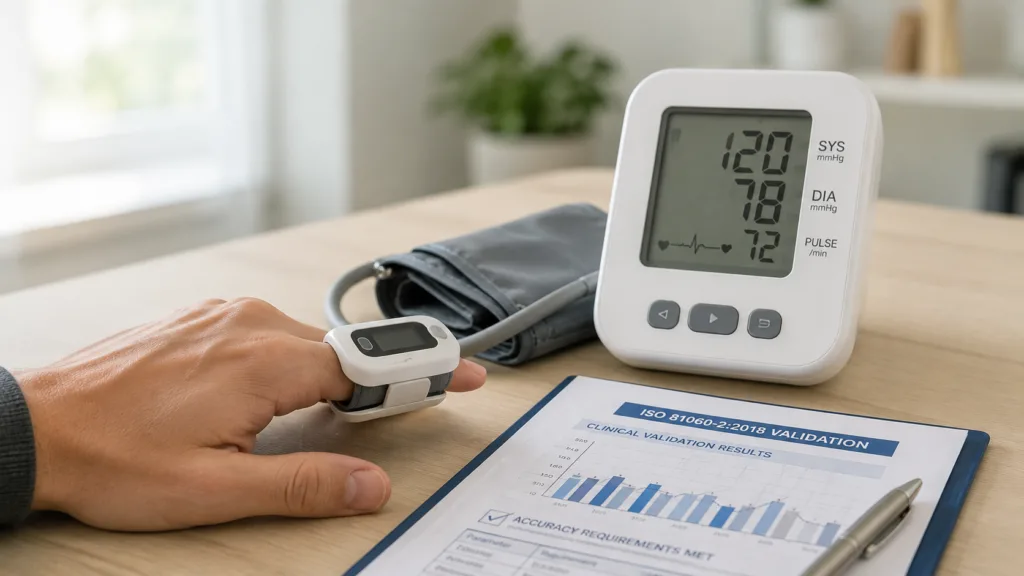
The development is more interesting than simply shrinking an electronic sphygmomanometer because finger-based blood pressure measurement has historically faced questions around accuracy, positioning and vascular differences relative to conventional brachial measurements. Wellvii’s approach uses an inflatable finger cuff and a stabilizing strap intended to keep the finger relatively still during measurement, while the company says the device does not require calibration against a conventional arm cuff before use. The regulatory decision follows a peer-reviewed clinical validation in 85 participants that compared the device with reference sphygmomanometer measurements under the ISO 81060-2:2018 protocol and concluded that BP Go met the standard’s accuracy requirements for self and home blood pressure measurement in a general population.
How accurate was Wellvii BP Go in the published validation study?
The validation included 85 eligible participants and generated 255 paired comparisons using a same-arm/finger sequential measurement approach against a standard mercury sphygmomanometer. For the first ISO validation criterion, the mean difference between BP Go and reference systolic blood pressure was 2.12 mmHg with a standard deviation of 7.33 mmHg, while the mean diastolic difference was 1.30 mmHg with a standard deviation of 6.35 mmHg. Under the second criterion, the standard deviation of participant-level averaged systolic and diastolic differences was 6.58 mmHg and 5.60 mmHg respectively, leading the investigators to conclude that the device passed ISO 81060-2:2018 validation requirements.
Those numbers are important because a compact design has little clinical value if portability comes at the expense of reliable measurement. Small systematic errors in blood pressure can influence hypertension classification, medication adjustments and longitudinal trend interpretation when repeated across millions of measurements, making validation against recognized standards a fundamental requirement rather than a marketing detail. The published study supports use in the general population, but it does not establish equally strong performance in every specialized subgroup, such as patients with arrhythmias, severe peripheral vascular disease or other conditions capable of affecting peripheral circulation.
Medaval’s independent device database lists BP Go as passing a recognized validation protocol for general-population home measurement and assigns the device its corresponding accuracy assessment. The database identifies the technology as intended for finger-based self-measurement and cites the same 2026 Blood Pressure Monitoring publication, providing an additional external catalogue of the validation rather than relying solely on Wellvii’s corporate announcement.
Why would clinicians or patients want to move blood pressure measurement from the arm to the finger?
Traditional upper-arm monitors work well when the correct cuff is available, properly positioned and appropriately sized, but that apparently simple process introduces several practical failure points. Patients can struggle to wrap the cuff correctly with one hand, clothing may interfere with placement, large or very small arm circumferences require appropriate cuff sizes, and transporting conventional equipment can become inconvenient when devices are used by traveling clinicians, first responders or patients participating in remote monitoring programmes.
A finger device substantially reduces the physical footprint and could simplify repeated measurement, especially when the same patient is expected to collect readings frequently at home. Wellvii has designed BP Go around both Bluetooth and connected-care configurations, positioning the system for home monitoring, ambulatory use, remote patient monitoring and other settings where readings need to move digitally from the patient to a healthcare platform rather than remain stored on a standalone device.
The company’s broader argument is therefore partly about adherence. A clinically validated monitor produces no benefit when patients find it sufficiently inconvenient that they rarely use it, while a smaller device that can remain available during work, travel or daily activity could potentially increase measurement frequency. That hypothesis still needs real-world evidence because convenience does not automatically translate into adherence, and more frequent readings can create their own challenges if patients measure under inconsistent conditions or clinicians receive large volumes of low-quality data.
Does FDA clearance mean the finger cuff is clinically superior to standard arm monitors?
No. FDA determined BP Go to be substantially equivalent under the 510(k) pathway; the decision does not establish superiority over validated upper-arm devices and should not be described as FDA proving that finger measurements are more accurate. The clearance permits marketing of the device for its authorized non-invasive blood-pressure measurement function after FDA concluded that it met the relevant substantial-equivalence requirements.
Upper-arm measurement remains deeply embedded in clinical practice because brachial blood pressure has an enormous evidence base connecting readings with cardiovascular outcomes and treatment decisions. Finger-based systems therefore have to demonstrate not only laboratory accuracy but also reliability across repeated everyday use, where motion, temperature, hand positioning and peripheral perfusion may vary considerably.
Wellvii’s published validation is an important step because it addresses one of the obvious objections to finger measurement under standardized conditions. The next evidence layer is operational: whether large numbers of people can reproduce good measurements at home without professional supervision and whether remote-care programmes find the resulting data sufficiently reliable to change treatment decisions.
How does BP Go fit into Wellvii’s broader connected-health platform?
BP Go builds on Wellvii’s earlier VitalDetect system, which has already been cleared for finger-based non-invasive blood pressure, pulse rate and temperature measurement. The company says BP Go uses the same underlying blood-pressure algorithm while placing the measurement capability into a smaller dedicated form factor, supported by a strap designed to stabilize the finger during inflation. Wellvii’s wider technology environment includes Bluetooth connectivity, cellular options and cloud-based infrastructure intended to allow health measurements to be transmitted into remote-care workflows.
The company is also working with B-Secur on integrating single-lead electrocardiography into a future BP Go configuration, illustrating a common direction in connected medical devices where one compact home platform gradually absorbs several cardiovascular measurements. That broader ECG-enabled version would need to be considered according to its own regulatory status and claims, however, and the August clearance should not be interpreted as FDA authorization of every planned future BP Go feature.
For healthcare providers, interoperability may prove almost as important as the cuff design. Remote blood-pressure monitoring becomes clinically useful only when data can be associated reliably with the correct patient, transmitted securely, displayed in a manageable form and escalated when readings require intervention. Devices that reduce friction during measurement but create a separate data silo can simply move the workflow burden from the patient to the clinician.
Could finger-based measurement expand remote hypertension monitoring?
Hypertension management is particularly well suited to home monitoring because blood pressure changes over time and can be influenced substantially by the clinical environment. Repeated out-of-office measurements can give physicians a more representative view than one reading obtained during an appointment, while connected monitoring may allow medication changes to be assessed without requiring repeated in-person visits.
A compact finger device could lower one practical barrier to that model, especially for older patients, people with limited dexterity or programmes distributing monitors across large populations. Wellvii is also targeting uses such as virtual clinical trials and long-term care, where portability and automated data transmission could simplify vital-sign collection across decentralized settings.
Commercial success will nevertheless depend on reimbursement, integration and real-world trust. Hospitals and remote-monitoring providers will want evidence that BP Go remains accurate under everyday conditions, that patients use it correctly and that finger readings remain dependable across the populations being monitored. Consumer users will compare price and simplicity against a mature market of inexpensive upper-arm monitors whose clinical interpretation is already familiar.
Wellvii has now cleared the most immediate regulatory obstacle. BP Go is an FDA-cleared Class II blood-pressure system supported by a published ISO validation study, giving the company considerably stronger footing than wellness devices making blood-pressure claims without regulated medical-device evidence. The more consequential test begins after launch: whether replacing the familiar arm cuff with a small finger cuff makes people sufficiently more likely to measure their blood pressure correctly and consistently that portability translates into better monitoring rather than simply a smaller piece of hardware.