Popular descriptions of robotic surgery can create the impression that the machine is already performing an operation while a physician merely supervises it. Most commercial surgical robots do nothing of the kind. The dominant systems are teleoperated or strongly surgeon-directed: a human decides where an instrument should move and the robot translates those decisions into precise actions while filtering tremor, enforcing virtual boundaries or assisting with navigation. A systematic review of 49 surgical robots cleared by FDA found that 42, or 86%, operated at the lowest meaningful level of robotic assistance, while only four provided task-level autonomy and three reached conditional autonomy; no Level 4 or Level 5 systems capable of high or full surgical autonomy were identified.
That picture is beginning to change as computer vision, reinforcement learning, simulation and foundation-model techniques move from image recognition into physical robotic control. Researchers can already automate individual steps such as needle placement, bone milling, suturing and other constrained tasks, and a 2026 systematic review described reinforcement learning as an increasingly important method for autonomous surgical subtasks. The gap between completing one controlled maneuver and performing a complete operation, however, is enormous because living tissue deforms, bleeds, moves and produces unexpected conditions that a robot must recognize before deciding how to respond safely.
What do the different levels of surgical robot autonomy actually mean?
Researchers have proposed a Levels of Autonomy in Surgical Robotics framework running from Level 0 through Level 5. At Level 0 there is no robotic autonomy at all, while Level 1 systems assist a surgeon who remains in continuous control, providing capabilities such as tremor filtration, tool tracking, passive support or haptic constraints. This is where most commercially familiar surgical robots sit.
Level 2 introduces task autonomy. The surgeon selects a specific preprogrammed action and supplies the parameters, after which the robot can execute and monitor that task without continuous manual instrument control. Orthopedic systems that automatically mill bone according to a defined plan or other robots carrying out constrained procedural steps can fall into this category.
Level 3 systems can generate patient-specific strategies from imaging or other data and automatically execute a surgeon-approved plan, adapting within defined limits. The 2024 review found three FDA-cleared systems reaching this conditional-autonomy level. Level 4 would allow a robot to select and execute the optimal plan while requesting human intervention only when uncertainty exceeds defined limits, while Level 5 would mean the machine could plan and execute an entire procedure independently without requiring surgeon approval. No FDA-cleared systems in the review occupied those two highest levels.
Why is autonomous surgery harder than autonomous driving?
Both environments involve perception, planning and physical action, but surgery presents a particularly unforgiving combination of small anatomical structures and continuously deforming material. A road is generally expected to remain in roughly the same geometric configuration while a car approaches it; tissue can stretch, collapse, swell, bleed or move immediately after an instrument touches it.
Computer vision therefore has to distinguish anatomical structures in real time despite blood, smoke, camera occlusion, variable illumination and tissue deformation. The robot must understand not merely where the structure is but what it is safe to do to it. A millimeter-scale mistake near a blood vessel, bile duct, nerve or ureter can have consequences entirely disproportionate to the distance involved.
Humans also use tactile and contextual information that current surgical robots capture imperfectly. An experienced surgeon can feel tissue resistance, recognize an unexpected plane and alter technique based on subtle visual cues acquired over thousands of procedures. Replicating that judgment requires more than precise motors.
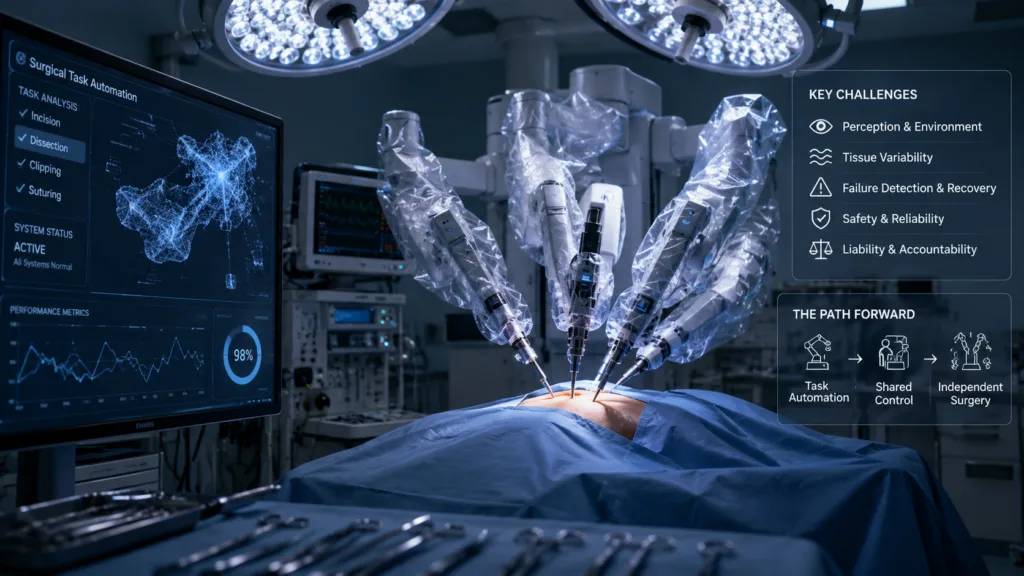
Why is suturing a useful test for surgical autonomy?
Suturing looks repetitive but contains many of the problems a general surgical robot eventually has to solve. The system must identify tissue edges, determine needle entry and exit points, control tension, account for tissue deformation and modify the next movement based on what happened during the previous stitch.
Research robots have demonstrated autonomous or highly automated suturing in experimental settings, making anastomosis a useful benchmark for progress. The broader significance is not that robots have therefore learned surgery; it is that a task involving perception, trajectory planning and physical interaction can be converted from continuous human control into a repeatable machine action under constrained conditions.
The next difficulty is dealing with failures. Tissue can tear, the needle can rotate unexpectedly, a vessel can bleed or anatomical geometry can differ from the training environment. A truly autonomous robot needs not only a policy for performing the intended task but a sufficiently robust model of the world to recognize when the task is going wrong.
How could reinforcement learning help a surgical robot adapt?
Traditional robotic programming works well when engineers can specify the precise sequence of movements required. Surgery contains too many variations to enumerate every possible trajectory manually, creating interest in reinforcement learning, where an agent learns which actions maximize performance through repeated interaction with simulations or physical environments.
A 2026 systematic review found reinforcement-learning applications across autonomous surgical subtasks, including manipulation and procedural control. Simulation is especially important because robots can perform millions of virtual training repetitions without exposing patients to risk.
The difficulty is transferring the learned behavior from simulation into a living patient. A simulated tissue model cannot reproduce every combination of elasticity, pathology, bleeding, anatomical variation and instrument interaction encountered clinically. This simulation-to-reality gap is one reason autonomy may arrive first in highly standardized procedures or tasks constrained by rigid anatomy rather than free-form soft-tissue surgery.
Why have orthopedic robots progressed further in autonomy?
Bone is comparatively predictable. Preoperative CT imaging can define three-dimensional anatomy, implants can be planned against fixed skeletal landmarks and a robot can mill or guide instrumentation within carefully defined geometric boundaries.
This explains why patient-specific planning and automated execution appeared relatively early in orthopedic surgical systems. The 49-device FDA review found orthopedic surgery to be the fastest-growing robotic specialty and identified conditional-autonomy systems capable of generating and executing patient-specific plans in constrained procedures.
Soft tissue creates a much harder problem because the organ changes shape continuously. A preoperative liver CT, for example, cannot describe the exact intraoperative geometry after the organ has been mobilized, compressed or partially dissected. Autonomous soft-tissue surgery consequently requires far richer real-time sensing.
Who is responsible if an autonomous surgical robot makes the wrong decision?
Liability is relatively straightforward when the robot functions as a tool continuously controlled by a surgeon: the physician remains responsible for procedural judgment while the manufacturer is responsible for the device operating according to specification. Higher autonomy blurs that separation.
If software generates a patient-specific plan, executes it correctly and the plan itself is wrong, responsibility could involve the surgeon who approved it, the manufacturer that built the planning algorithm or both. If a machine-learning system changes through an authorized update, another question emerges around which software version was responsible for a particular decision and whether the institution appropriately validated deployment.
This is one reason researchers argue that regulation should describe the division of decision-making responsibility explicitly rather than classify every surgical robot simply by mechanical function. As autonomy rises, the medical device is no longer only an instrument; it becomes an increasingly active participant in procedural judgment.
Could autonomy reduce variation between surgeons?
That is one of the most compelling arguments for the technology. Surgical outcomes can vary with operator volume, experience, fatigue and technique, and autonomous execution of highly standardized tasks could potentially reduce some of that variability.
Automation might first handle the portions of a procedure where consistency provides clear value, leaving the surgeon responsible for diagnosis, strategic decisions and management of unexpected anatomy. This resembles aviation more than science-fiction robotic replacement: automation performs progressively more routine functions while a highly trained human remains responsible for supervising the system and intervening when conditions fall outside normal parameters.
Such assistance could also extend high-quality procedures into settings with fewer specialist surgeons if systems eventually reproduce difficult technical tasks reliably. That potential remains far ahead of current evidence, particularly for complex soft-tissue operations.
Will the first autonomous operating room still have a surgeon in it?
Almost certainly. Full Level 5 autonomy requires a machine to recognize all relevant anatomy, select an appropriate operative strategy, manipulate tissue, detect complications, revise its plan and recover safely from unexpected events without requesting human help. Current clinical robots remain far from that threshold.
The more realistic near-term transition is from one surgeon controlling every instrument movement toward supervised autonomy. A surgeon might define the objective, approve an automatically generated plan and allow the robot to execute specific steps while monitoring progress and retaining immediate takeover capability.
That change could still be transformative. If robots eventually automate suturing, dissection boundaries, implant preparation or other reproducible tasks, surgeon attention could shift toward the parts of an operation that require the most judgment rather than continuous manual control.
The statistics show how early that transition remains. In the systematic FDA review, 86% of identified surgical robots were Level 1 and none reached high or full autonomy. Research is moving much faster than regulatory deployment, but the gap exists for a reason: a robot demonstrating an autonomous maneuver in a controlled experiment is very different from trusting the same system with the unpredictable sequence of decisions that begins after the first incision in a human patient.