A monoclonal antibody can contain the same therapeutic molecule whether it enters through an intravenous line or an injection under the skin, yet converting a large biologic from IV to subcutaneous administration is not simply a matter of putting the infusion into a syringe. Antibody doses can involve hundreds or even thousands of milligrams of protein, often requiring fluid volumes far larger than conventional subcutaneous tissue can comfortably accept. The extracellular matrix beneath the skin contains hyaluronan, a water-binding glycosaminoglycan that creates gel-like resistance to bulk fluid flow and limits how rapidly large injected volumes can spread and reach systemic circulation.
Recombinant human hyaluronidase changes that physical environment temporarily. The enzyme depolymerizes hyaluronan near the injection site, opening transient pathways through which a larger volume of a co-administered biologic can disperse before the extracellular matrix reconstitutes. The approach has become increasingly important in oncology, where therapies once associated with long infusion-chair appointments can now be administered subcutaneously in minutes. FDA-approved examples include Darzalex Faspro, Tecentriq Hybreza and Opdivo Qvantig.
Why can’t a large antibody dose simply be injected under the skin without hyaluronidase?
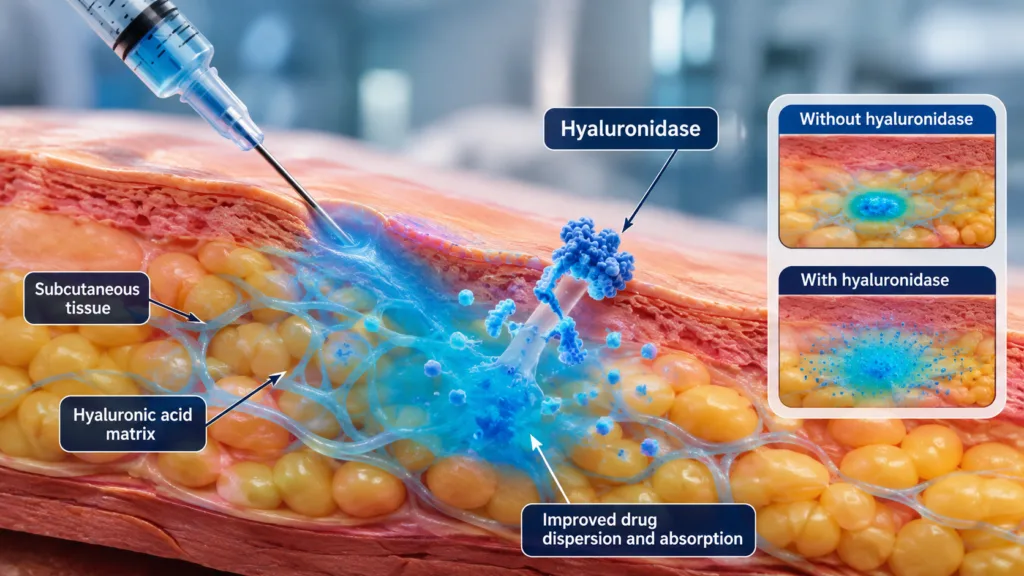
Traditional subcutaneous medicines are usually administered in relatively modest volumes because the tissue resists rapid expansion. Hyaluronan holds water and contributes to the viscoelastic character of the extracellular matrix, making the subcutaneous space behave less like an empty fluid reservoir and more like a dense hydrated meshwork. Trying to force a very large volume through that matrix can produce pressure, pain, leakage and slow or inconsistent dispersion.
This is a major problem for monoclonal antibodies because their therapeutic doses are often large. Increasing protein concentration can reduce injection volume only to a point before viscosity, stability and manufacturing constraints become difficult. Formulation scientists therefore have two broad levers: make the antibody solution dramatically more concentrated or change the tissue environment so it can accept more volume.
Hyaluronidase uses the second strategy. Instead of permanently altering the antibody, developers co-formulate it with an enzyme that temporarily reduces resistance around the injection site.
What does hyaluronidase actually do after injection?
Recombinant human hyaluronidase PH20 cleaves hyaluronan polymers within the local extracellular matrix. As those long chains are broken down, resistance to fluid flow falls and the co-administered therapeutic can spread through a larger subcutaneous area and enter local lymphatic and vascular pathways more efficiently. Clinical and nonclinical reviews describe the effect as localized and temporary rather than a permanent remodeling of the skin.
The temporary nature is important for repeated treatment. The objective is not to create a permanent defect in connective tissue but to open a short-lived delivery window, after which hyaluronan is regenerated and normal tissue structure returns.
Older mechanistic studies estimate restoration of the local hyaluronan barrier within hours, reflecting the naturally rapid turnover of the molecule. That ability to remodel and then reconstitute is what makes repeated dosing practical.
The enzyme therefore functions less like an active cancer treatment and more like delivery infrastructure. Its pharmaceutical value is created by allowing another high-value drug to reach systemic circulation through a route that would otherwise be physically difficult.
How large is the difference in treatment time for modern oncology antibodies?
Tecentriq Hybreza provides a clear example. FDA approved the combination of atezolizumab with hyaluronidase in September 2024 across the adult indications already covered by intravenous Tecentriq. The subcutaneous formulation delivers 1,875 mg of atezolizumab with 30,000 units of hyaluronidase in a 15 mL injection administered into the thigh over approximately seven minutes.
Opdivo Qvantig followed in December 2024, pairing nivolumab with hyaluronidase across approved adult solid-tumor settings. Depending on the indication and dosing interval, FDA labeling allows subcutaneous administration over approximately three to five minutes. Its pivotal CHECKMATE-67T programme focused principally on showing that subcutaneous exposure remained comparable with intravenous nivolumab rather than proving the active antibody had suddenly become more effective because the route changed.
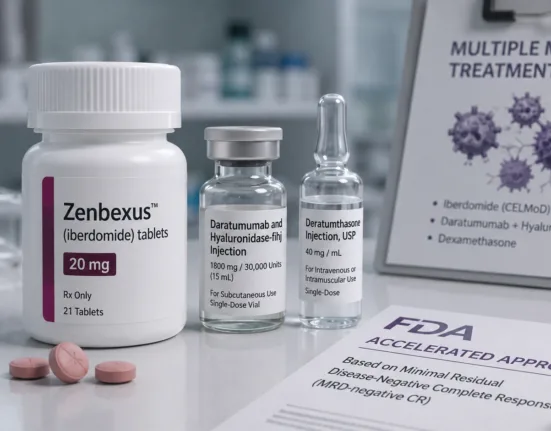
Darzalex Faspro similarly delivers 1,800 mg of daratumumab with 30,000 units of hyaluronidase subcutaneously over approximately three to five minutes. The formulation demonstrates how the strategy can become deeply embedded in a major hematology franchise rather than serving as an optional niche presentation.
The operational difference can therefore be substantial. An IV biologic may require venous access, preparation, infusion monitoring and chair occupation extending well beyond the actual drug-delivery period, whereas a subcutaneous injection can shift a larger proportion of the visit away from infusion infrastructure.
How can FDA approve a new route without repeating every efficacy trial from the beginning?
Formulation-switch programmes often rely heavily on pharmacokinetic comparability. Developers need to show that the subcutaneous formulation produces drug exposure sufficiently similar to the established intravenous product, while also evaluating safety and relevant clinical outcomes.
For Tecentriq Hybreza, the randomized IMscin001 study enrolled 371 patients with advanced or metastatic non-small cell lung cancer. The study met predefined pharmacokinetic comparability criteria for atezolizumab exposure, and FDA reported no notable differences in overall response rate, progression-free survival or overall survival between the subcutaneous and IV groups. Confirmed response rates were 9% and 8%, respectively.
CHECKMATE-67T used a similar regulatory logic for Opdivo Qvantig. Among 495 randomized patients with advanced or metastatic clear-cell renal cell carcinoma, the trial met prespecified pharmacokinetic acceptance margins. Overall response was 24% with subcutaneous nivolumab and 18% with IV nivolumab, while FDA described the overall safety profiles as similar.
These studies should not be interpreted as demonstrating that the subcutaneous versions are more effective. Their principal purpose is to establish that changing the delivery route preserves clinically acceptable exposure and performance.
Do patients actually prefer a subcutaneous injection?
Many do, although preference is not universal. IMscin002 directly tested patient preference by allowing participants with non-small cell lung cancer to experience both subcutaneous and intravenous atezolizumab in a randomized crossover design. Of 123 patients completing the preference questionnaire, 87, or 70.7%, preferred the subcutaneous route, while 26, or 21.1%, preferred IV administration. Among patients continuing treatment after the crossover period, 79.4% selected the subcutaneous formulation.
Healthcare professionals also reported operational advantages. About 75% said subcutaneous atezolizumab was more convenient than IV administration, while nearly 78% agreed that it could reduce time spent in the care unit.
The preference findings are informative rather than universal. Some patients may favor an IV infusion because they are already receiving another intravenous drug during the same visit, because they are uncomfortable with a relatively large-volume injection or because local injection-site reactions matter more to them than treatment time.
Why could the hospital economics matter as much as patient convenience?
Infusion chairs are finite healthcare infrastructure. Each appointment involves pharmacy preparation, nursing time, venous access, observation and physical treatment space. Moving appropriate drugs into several-minute subcutaneous administrations can potentially increase the number of patients a center can treat without constructing another infusion unit.
The economic calculation is not automatically favorable. A subcutaneous combination product can carry different acquisition costs, reimbursement rules and licensing economics from its IV predecessor. Savings in nursing and chair time therefore need to be evaluated against drug cost and local payment structures.
Still, infusion capacity becomes increasingly important as cancer survival improves and more patients receive long-duration maintenance antibodies. A treatment used every two, three or four weeks for months or years consumes a very different amount of health-system capacity when each administration takes minutes rather than a lengthy IV workflow.
This is why route-of-administration innovation can become commercially strategic despite leaving the antibody’s molecular target unchanged.
Does subcutaneous delivery mean patients can eventually inject these biologics at home?
Not automatically. Tecentriq Hybreza’s current US labeling specifies administration by a healthcare professional, and many oncology biologics require clinical monitoring because serious immune-mediated reactions or disease-specific complications can occur independently of the injection route.
Home administration demands additional evidence around patient selection, training, device design, storage, recognition of adverse reactions and the safety of treatment outside a clinical facility. Some biologic categories may move further toward self-administration than oncology antibodies.
The subcutaneous shift should therefore be understood as a continuum. The first step is replacing IV access with a short clinic injection. Later generations may use prefilled devices or home administration where pharmacology and safety allow it.
Why is hyaluronidase becoming strategically valuable to pharmaceutical companies?
A successful biologic can remain commercially important for many years, and introducing a more convenient route can extend the product’s relevance as competitors and biosimilars emerge. A subcutaneous formulation can differentiate the branded franchise, create new intellectual property and reduce the treatment burden without requiring discovery of another therapeutic target.
This has turned delivery technology into business-development infrastructure. Companies developing hyaluronidase platforms can partner with multiple pharmaceutical groups because the same basic extracellular-matrix mechanism can support many unrelated antibodies.
Competition is also expanding beyond one proprietary enzyme platform, with developers exploring alternative recombinant hyaluronidases and high-concentration formulation technologies. The strategic question is increasingly which delivery system can accommodate the largest dose, smallest volume, shortest administration time and most practical device while preserving exposure and safety.
Will IV antibodies eventually disappear?
No. Some patients require multiple intravenous drugs simultaneously, some biologics may be difficult to formulate subcutaneously, and infusion centers provide clinical supervision that remains valuable for treatments associated with acute reactions. Intravenous dosing can also offer precise control of administration and very predictable systemic availability.
The likely future is choice. Patients and clinicians may select IV or subcutaneous versions according to regimen, preference, treatment setting and reimbursement rather than assuming one route is universally better.
The deeper significance of hyaluronidase lies in what it changes about pharmaceutical engineering. A biologic once considered intrinsically tied to an infusion chair can now be redesigned around a temporary modification of the tissue beneath the skin.
The cancer antibody itself may be scientifically sophisticated, but one of the technologies changing how patients experience that medicine is an enzyme performing a remarkably physical task: clearing enough space in the extracellular matrix for a large dose to get through.