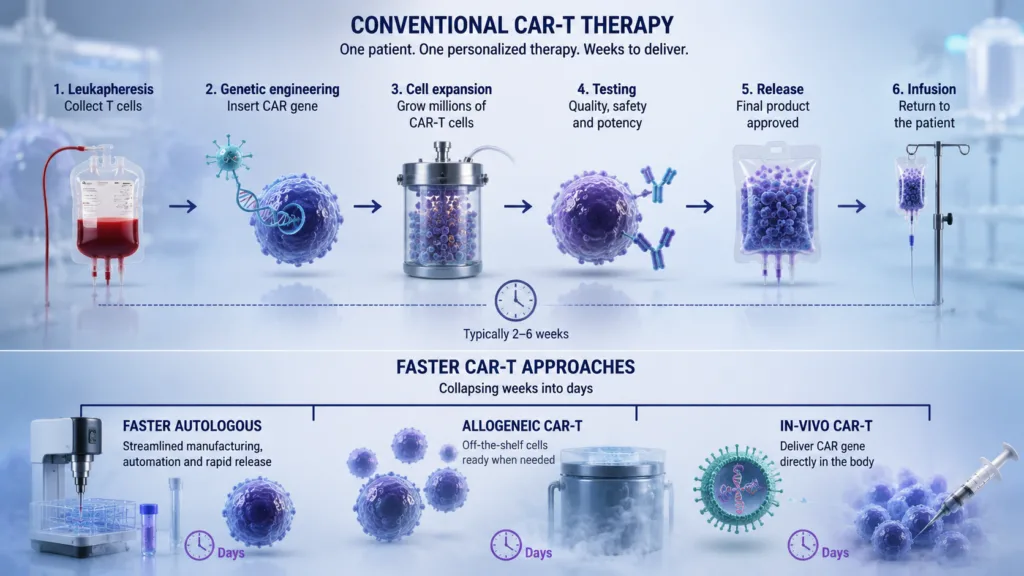
A conventional pharmaceutical company can manufacture thousands or millions of tablets before knowing which individual patients will eventually take them. Autologous CAR-T turns that industrial model upside down. A patient first has to become the raw-material supplier: T cells are removed through leukapheresis, transported to a manufacturing facility, genetically modified to express a chimeric antigen receptor, expanded to generate enough viable cells, tested against multiple quality specifications, released and shipped back to the treatment center before that specific patient can receive the product. Every manufactured batch is therefore simultaneously a drug product and an individualized biological chain of custody.
That personalization helped CAR-T produce extraordinary responses in selected leukemias, lymphomas and multiple myeloma, but it also created one of modern medicine’s most complicated supply chains. Recent bioprocess reviews estimate conventional autologous vein-to-vein times at roughly three to six weeks, depending on product and workflow. During that interval, patients with aggressive cancer can deteriorate, require bridging therapy or become too ill to receive the cells ultimately manufactured for them. Fast autologous platforms, donor-derived allogeneic CAR-T and in-vivo programming are all attempting to attack that delay from different directions.
What happens during leukapheresis before manufacturing even begins?
The patient is connected to an apheresis system that removes blood, separates selected white blood cells and returns the remainder of the blood components. This collection provides the T-cell starting material from which the personalized product will be created.
Collection quality can vary substantially because the patients undergoing CAR-T frequently have advanced cancer and have already received several treatments capable of altering T-cell number and function. Two manufacturing runs may therefore begin with biological materials that differ before a factory has done anything to them.
The collected cells must then be labeled, packaged and transported according to strict chain-of-identity procedures. A manufacturing error in an ordinary batch of tablets might affect many patients; a chain-of-identity error in autologous CAR-T could mean one person receives another person’s engineered cells.
That risk helps explain why cell-therapy logistics are inseparable from manufacturing quality.
How are T cells turned into cancer-targeting cells?
In a simplified conventional workflow, the collected T cells are enriched and activated before receiving genetic instructions encoding the CAR. Many commercial products use lentiviral or retroviral vectors to integrate the CAR sequence into T-cell DNA, allowing the modified cell and its descendants to continue expressing the synthetic receptor.
The CAR itself typically contains an extracellular antigen-binding domain, a membrane anchor and intracellular signaling components. When the engineered T cell encounters a cancer cell carrying the chosen target, such as CD19 or BCMA, receptor engagement activates the T cell and triggers killing.
Manufacturers then culture the modified cells so the population expands sufficiently for treatment. This ex-vivo growth phase requires careful control because manufacturers do not simply need a high cell count. They need cells with the appropriate identity, viability, potency and phenotype.
Excessively prolonged expansion can potentially drive cells toward differentiated or exhausted states, one reason rapid-manufacturing strategies increasingly try to shorten or eliminate long culture periods.
Why can quality testing consume so much time?
A living genetically modified cell product cannot be characterized exactly like a chemically defined small molecule. Manufacturers need evidence covering identity, purity, potency, viability, vector-related parameters and microbiological safety before releasing the batch.
Sterility testing is especially important because cells spend time in culture conditions that could allow contamination to expand. Manufacturers also need to establish that the genetic modification occurred appropriately and that the final cell population behaves according to product specifications.
Some tests can be accelerated and manufacturing technologies continue improving, but compressing release time cannot come at the cost of administering a contaminated, nonviable or incorrectly modified product.
FDA’s CAR-T development guidance consequently devotes extensive attention to chemistry, manufacturing and control requirements because manufacturing variability can directly become clinical variability in a living therapy.
Why does vein-to-vein time matter biologically rather than merely logistically?
Patients receiving CAR-T often have rapidly progressing hematologic malignancies. Three or four weeks can therefore represent a significant portion of the remaining treatment window.
Physicians may use bridging chemotherapy, radiation or other medicines to control disease between leukapheresis and CAR-T infusion. Those treatments can create their own toxicities and sometimes weaken the patient before cellular therapy begins.
Some patients never reach infusion after successful collection because their disease progresses or their medical condition worsens while the cells are being manufactured. An FDA description of Breyanzi’s marginal-zone lymphoma trial illustrates this difference between collection and treatment: 77 participants underwent leukapheresis while 66 ultimately received the study-specified CAR-T infusion.
Reducing manufacturing time can therefore improve more than convenience. It can increase the proportion of intended patients who remain able to receive the therapy.
How are rapid autologous CAR-T platforms cutting manufacturing time?
Conventional manufacturing commonly includes prolonged ex-vivo expansion intended to generate large numbers of cells. Rapid approaches try to shorten activation and culture dramatically, sometimes producing a treatment-ready population within days.
This can provide a second biological advantage. Less time outside the body may preserve greater proportions of naive and stem-like memory T cells capable of proliferating after infusion and persisting longer in the patient. Some developers therefore argue that reducing manufacturing time can improve both logistics and the functional phenotype of the resulting product.
Point-of-care or decentralized manufacturing takes another step by moving production closer to the hospital, reducing shipping delays between collection and infusion. That can compress logistics but transfers complex GMP manufacturing responsibilities into healthcare networks that may not historically operate as pharmaceutical factories.
The central trade-off is therefore standardization. Centralized production allows one company to control a relatively small number of highly specialized manufacturing sites, while decentralized production reduces transportation but requires highly reproducible processes across many locations.
Why is allogeneic CAR-T called “off the shelf”?
Allogeneic CAR-T begins with cells from healthy donors rather than the eventual recipient. One donor can potentially provide starting material for many treatment doses, allowing manufacturers to produce larger batches in advance and hold them in inventory until patients need them.
That fundamentally changes the economics and timing. The patient no longer waits while their own cells are collected, modified and expanded because an existing dose can theoretically be shipped from stock.
The immune system creates the major obstacle. Donor T cells naturally carry T-cell receptors capable of recognizing the recipient’s tissues and causing graft-versus-host disease, while the recipient’s immune system can recognize the donor cells as foreign and eliminate them. Developers therefore use gene editing or other engineering to remove or suppress molecules involved in these incompatible immune interactions.
Solving one manufacturing problem thus creates another biological problem. Autologous cells are expensive and slow but naturally matched to the patient. Allogeneic cells are scalable but must be engineered to behave as though they belong in a host from whom they did not originate.
Why has allogeneic CAR-T struggled with persistence?
The recipient’s immune system can attack and eliminate donor-derived CAR-T cells even after gene editing reduces obvious incompatibility signals. More extensive lymphodepleting chemotherapy can create a temporary window in which donor cells survive longer, but stronger conditioning increases infection and toxicity risks.
Autologous CAR-T cells can sometimes persist for months or years because they originate from the patient and do not face the same host-versus-graft barrier. Persistence is not equally necessary in every disease, but it can contribute to durable cancer control where continued immune surveillance matters.
Allogeneic developers are therefore engineering HLA molecules, T-cell receptors and other immune-recognition pathways while exploring repeated dosing, something difficult to contemplate economically with individually manufactured autologous therapy but potentially feasible for an off-the-shelf product.
The future may not require allogeneic cells to replicate autologous persistence perfectly if rapid availability and repeat dosing compensate for shorter survival.
What is in-vivo CAR-T and why could it eliminate manufacturing altogether?
In-vivo CAR-T attempts to perform the genetic modification inside the patient. Instead of collecting T cells and sending them to a factory, a viral vector or targeted nanoparticle carrying CAR-encoding genetic material is administered directly and engineered to reach the patient’s own T cells.
Those T cells then become CAR-expressing therapeutic cells without leaving the body. Recent reviews describe this as a potential path toward reducing effective manufacturing timelines to around a day at the patient level, excluding production and quality control of the vector or nanoparticle itself.
The concept could transform CAR-T from a personalized manufactured cell product into something much closer to an injectable gene medicine.
The delivery challenge is enormous. The vector has to reach enough T cells, avoid inappropriate cell populations, produce sufficiently controlled CAR expression and minimize unintended genetic modification. Once the genetic material has been administered, manufacturers cannot simply recall an incorrectly modified batch sitting in a freezer because the manufacturing is already happening inside the patient.
Why could in-vivo CAR-T matter beyond cancer?
If CAR-T can eventually be created reliably with an injection rather than an individualized manufacturing chain, diseases with much larger patient populations become more realistic targets.
Researchers are already exploring B-cell depletion through CAR-T in severe autoimmune disorders, where deep immune reset has generated highly encouraging early results. Fibrotic diseases, infectious diseases and other immune-mediated conditions are also being investigated conceptually or clinically.
The economics of conventional autologous manufacturing would make broad use across common chronic diseases difficult. In-vivo programming or highly scalable allogeneic manufacturing could change that calculation.
The technology therefore has the potential to evolve from a highly specialized oncology procedure into a programmable immune-cell platform.
Has the regulatory burden around existing CAR-T become easier?
To some extent. FDA eliminated the REMS programmes for approved CD19- and BCMA-directed autologous CAR-T therapies in June 2025, concluding that the additional restricted-distribution framework was no longer necessary to ensure benefits outweighed the risks. The change removed requirements including special hospital certification under the REMS and immediate on-site access to tocilizumab specifically through that programme.
The underlying safety risks have not disappeared. Cytokine release syndrome, neurologic toxicity, prolonged cytopenias, infection and secondary malignancy remain important considerations, and FDA labeling for the class includes warnings around T-cell malignancies.
The regulatory evolution instead reflects increasing clinical familiarity and healthcare-system capability after years of commercial CAR-T use.
That maturation is important because manufacturing innovation can only increase access if treatment delivery itself becomes easier to scale at the same time.
Which model is most likely to win: autologous, allogeneic or in-vivo CAR-T?
There may not be one winner. Autologous products already have strong efficacy and regulatory validation in several hematologic cancers and may remain preferable when maximizing persistence and individualized potency is more important than manufacturing simplicity.
Rapid autologous processes could preserve those advantages while cutting waiting time substantially. Allogeneic products could dominate settings where immediate availability and repeat dosing matter, provided host rejection can be controlled. In-vivo CAR-T could ultimately create the largest expansion in patient access if targeted genetic delivery becomes sufficiently precise.
The crucial point is that all three approaches are attempting to solve the same industrial contradiction. CAR-T became one of oncology’s most powerful treatment concepts by turning the patient’s own immune cells into a drug, but that success also turned every patient into a separate manufacturing order.
The next generation is trying to preserve the biology while removing the factory bottleneck. If it succeeds, the defining advance in CAR-T may eventually be not a new cancer target but the moment producing the therapy stops taking longer than many patients can safely afford to wait.