Anixa Biosciences, Inc. (Nasdaq: ANIX), a San Jose, California-based biotechnology company developing cancer immunotherapies and vaccines, announced on October 13, 2026, that Jose Conejo-Garcia, the inventor of its investigational ovarian cancer CAR-T therapy liraltagene autoleucel, or lira-cel, will deliver a keynote address at the 2026 Ovarian Cancer Midwest Focus Conference. The event, hosted by Mayo Clinic and the University of Minnesota, is scheduled for November 2 and 3 in Rochester, Minnesota, with the presentation examining the mechanisms that allow ovarian tumors to resist immune-based treatments.
The announcement arrives as Anixa and its clinical partner Moffitt Cancer Center continue a Phase 1 dose-escalation trial of lira-cel in women with recurrent ovarian cancer. The company reports that four participants have survived more than one year following treatment, including one patient who lived beyond two years, while the first patient evaluated in the latest high-dose cohort had stable disease at the 90-day assessment. No dose-limiting toxicities have been observed in the programme to date, according to the latest company disclosures.
These observations provide a reason to continue investigating the treatment, but they should not be confused with evidence that lira-cel prolongs survival. The trial is small, uncontrolled and primarily designed to establish safety and an appropriate dose rather than compare treatment outcomes with standard care. Individual survival experiences can be influenced by patient characteristics, previous treatment and disease biology, making it impossible to assign the observed survival durations directly to the CAR-T therapy.
The November keynote represents a scientific visibility milestone rather than the release of a new clinical dataset. Its importance lies in drawing attention to an experimental approach that differs from conventional antibody-based CAR-T technology by targeting the follicle-stimulating hormone receptor on ovarian cancer cells. The programme must still demonstrate whether that strategy can produce confirmed and durable tumor responses in a patient population with substantial unmet treatment needs.
Why is Anixa targeting the follicle-stimulating hormone receptor in ovarian cancer?
Most approved CAR-T therapies have been developed for hematological malignancies, where engineered immune cells can recognize relatively accessible targets on blood cancer cells. Solid tumors present additional biological challenges, including heterogeneous antigen expression, restricted T-cell penetration and local immune suppression. Ovarian cancer is particularly difficult because tumor deposits can spread throughout the abdominal cavity and develop resistance to multiple successive treatments.
Anixa’s lira-cel programme targets the follicle-stimulating hormone receptor, or FSHR, which is expressed by certain ovarian cancer cells. The receptor is ordinarily involved in reproductive hormone signaling, but its expression in malignant tissue creates a potential recognition target for engineered T cells. The company believes this approach may allow immune cells to identify tumor tissue while limiting interactions with healthy cells.
However, the presence of FSHR on cancer cells is not sufficient by itself to establish a safe or effective treatment. Expression can vary between patients and tumors, while the receptor’s distribution in normal tissues must be considered when evaluating potential off-tumor effects. Appropriate antigen characterization and clinical monitoring are therefore important elements of the development programme.
Jose Conejo-Garcia, now a professor of immunology at Duke University School of Medicine, led the scientific work underlying the treatment technology. His research has investigated how ovarian cancer interacts with immune cells and how engineered immune recognition might address mechanisms of resistance. The forthcoming keynote will focus on the broader challenge of overcoming that resistance rather than announce a new regulatory decision.
How does lira-cel’s chimeric endocrine receptor differ from conventional CAR-T technology?
Lira-cel uses a chimeric endocrine receptor design, frequently abbreviated as CER-T, rather than the conventional antibody-fragment recognition structure used in many CAR-T treatments. The engineered receptor incorporates an element derived from the natural ligand associated with FSHR, enabling recognition of cells expressing that receptor. Once binding occurs, intracellular signaling domains are intended to activate the modified T cell.
The strategy differs from standard CAR designs that use an antibody-derived single-chain variable fragment to bind a tumor antigen. In principle, using a natural hormone-receptor interaction could provide a different method of tumor recognition. Nevertheless, that design distinction does not automatically translate into stronger binding, better tumor penetration or superior clinical activity.
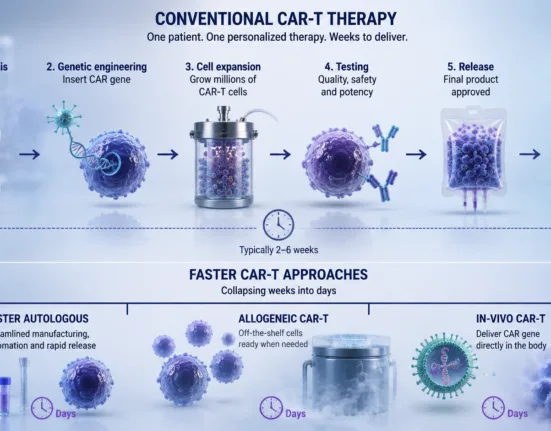
Lira-cel is an autologous cellular therapy, meaning that T cells are obtained from the patient and engineered before administration. This process creates manufacturing and logistical requirements involving cell collection, modification, expansion, quality testing and delivery back to the treatment center. Its commercial feasibility will eventually depend on whether reliable manufacturing can be achieved alongside sufficiently meaningful clinical benefit.
The trial also investigates routes of administration intended to address the anatomical characteristics of ovarian cancer. These include intraperitoneal administration into the abdominal cavity and intravenous delivery. The rationale for local administration is to position engineered immune cells near peritoneal tumor deposits, although improved clinical efficacy through one route has not yet been established.
What does the ongoing Phase 1 trial establish about lira-cel safety and tolerability?
The first-in-human study, registered as NCT05316129, is being conducted at Moffitt Cancer Center in Tampa, Florida. It includes women with recurrent or persistent ovarian, fallopian tube or primary peritoneal cancer who have previously received treatment. The primary objective is to characterize safety and determine an appropriate dose for subsequent evaluation.
The investigation uses successive cohorts receiving increasing numbers of engineered cells. Earlier patients were treated at lower dose levels, while the current fifth cohort receives 10 million CAR-positive cells per kilogram following lymphodepleting chemotherapy. This represents a substantial escalation from the initial dose levels and introduces additional treatment-related considerations because lymphodepletion can affect immune function.
Anixa reported that the first participant entered the fifth cohort in July 2026 and the second was treated by the beginning of October. According to the company’s latest disclosures, no dose-limiting toxicities have been observed across the programme. This is encouraging from a dose-escalation perspective because severe treatment-related toxicity can prevent investigators from increasing exposure.
However, the absence of dose-limiting toxicities does not mean that no adverse events occurred. It refers to specific events meeting the protocol’s criteria during the defined observation period. A comprehensive safety assessment would require the incidence and severity of cytokine release syndrome, neurotoxicity, infections, cytopenias and other clinically important complications.
The most recent dose level also involves lymphodepleting chemotherapy before cell administration. That creates a need to distinguish adverse effects caused by the conditioning regimen from those associated with the engineered cells. The current clinical experience is too limited to establish the full safety profile of high-dose lira-cel treatment.
Why are survival observations beyond two years not proof of treatment efficacy?
Anixa has highlighted several patients whose survival after treatment exceeded initial expectations based on their clinical circumstances. In its October announcement, the company reported that four participants had surpassed one year of survival and that one had lived beyond two years. Earlier updates provided individual survival durations, including a patient who had reached approximately 28 months following treatment.
These observations are potentially interesting because recurrent ovarian cancer can carry a poor prognosis after multiple treatment lines. However, prognosis varies considerably according to disease burden, tumor biology, platinum sensitivity, previous treatments, patient fitness and subsequent care. A survival duration that exceeds a historical estimate does not establish that an investigational treatment caused the difference.
The trial does not randomize patients to receive lira-cel or an appropriate comparator. Consequently, investigators cannot directly calculate a treatment-related survival benefit relative to standard care from these observations. Historical comparisons may help generate hypotheses, but they are vulnerable to differences between patient populations and other confounding factors.
Another limitation is the absence of a mature survival analysis covering a sufficiently large and consistently followed population. Individual cases can appear compelling but may not represent the experience of most patients receiving the treatment. Confirming a meaningful survival benefit would require substantially more evidence.
The company has appropriately described its earlier survival findings as encouraging observations rather than definitive proof of efficacy. Their immediate value is to support continued research while the programme advances to higher doses and collects additional clinical and biological data.
What does the first 90-day stable disease finding reveal about tumor control?
On October 5, 2026, Anixa announced that a patient treated in the fifth dose cohort had experienced stable disease at the 90-day evaluation. This was described as the programme’s first formal stable disease observation at that assessment point. The patient had received the current high-dose regimen following lymphodepletion.
Stable disease means that tumor measurements did not meet the criteria for sufficient shrinkage to be classified as a partial response or sufficient growth to be classified as progression. It can be clinically relevant in advanced cancer, especially when treatment options are limited. However, stable disease is not equivalent to objective tumor regression.
The duration of disease control is also important. A single 90-day observation provides limited information about whether tumor stabilization will persist or translate into improvements in symptoms or survival. Subsequent imaging and clinical assessments will be needed to establish whether the benefit is sustained.
Anixa has indicated that investigators are conducting correlative studies to examine the presence and persistence of engineered CAR-positive cells. These measurements could help determine whether the cells survive, expand or remain detectable after administration. Demonstrating persistence may support the proposed biological mechanism, but it does not independently establish antitumor efficacy.
The company has not reported a mature confirmed objective response rate for lira-cel. That distinction should remain central to interpretation of the programme: the current evidence supports continued early-stage investigation but does not establish a clinically validated treatment response profile.
What will Jose Conejo-Garcia discuss at the November ovarian cancer conference?
The Ovarian Cancer Midwest Focus Conference will take place in Rochester, Minnesota, on November 2 and 3. Conejo-Garcia’s keynote, titled Closing in: Cracking Ovarian Cancer’s Resistance to Immunotherapy, is scheduled for November 3 at 9 a.m. Central Time. The programme brings together researchers, clinicians, patient advocates and others involved in ovarian cancer research and care.
The event’s scientific focus is relevant because ovarian cancer has not experienced the same broad success with immune checkpoint inhibitor monotherapy seen in certain other malignancies. Its tumor environment can contain regulatory immune cells, suppressive signaling molecules and other mechanisms that restrict effective antitumor responses. These factors help explain continued interest in cellular therapies and combinations designed to alter immune recognition.
The keynote may provide insight into the scientific rationale underlying FSHR-targeted cell therapy and the broader challenges facing ovarian cancer immunotherapy. However, Anixa has not announced that the presentation will disclose a new dose cohort, confirmed response rate or updated survival analysis. It should therefore be treated as a scheduled scientific address rather than an upcoming formal clinical data readout.
For investors and clinicians, the event may increase awareness of the ongoing programme. Its importance will be determined by the scientific information actually presented, while the more consequential development milestones remain the clinical trial’s dose-escalation and efficacy findings.
How does lira-cel fit into Anixa Biosciences’ broader cancer development strategy?
Anixa operates through collaborations with research institutions, using externally developed scientific discoveries as the basis for investigational treatment programmes. Its ovarian cancer cellular therapy is being developed with Moffitt Cancer Center, while separate cancer vaccine programmes originated through Cleveland Clinic research. This model allows the company to participate in clinical development without building the entire underlying discovery infrastructure internally.
The portfolio includes an investigational breast cancer vaccine targeting alpha-lactalbumin, a protein associated with certain breast cancers. Anixa has completed Phase 1 investigation of that programme and is preparing additional development. The vaccine research is distinct from lira-cel and should not be treated as clinical validation of the cellular therapy.
Anixa’s financial position provides some context for its ability to continue development. At July 31, 2026, the company reported approximately $13.86 million in cash, cash equivalents and short-term investments. It also reported approximately $6.12 million in cash used in operating activities during the first nine months of its fiscal year.
Management stated in its September quarterly filing that available liquid resources were expected to support planned operations for at least another 12 months. The company also retained access to an at-the-market equity financing programme, although potential future capacity under that arrangement should not be confused with funds already received.
Anixa remains a clinical-stage business without reported product revenue. The commercial value of lira-cel therefore depends on future clinical outcomes, regulatory development, manufacturing feasibility and the capital required to advance the programme beyond Phase 1.
What evidence must Anixa generate before lira-cel can move beyond Phase 1?
The immediate priority is completing the current dose-escalation stage while maintaining appropriate patient safety. Investigators need to determine whether higher doses and conditioning chemotherapy influence cellular persistence, tumor control and adverse events. These findings will help establish an appropriate regimen for any expansion study.
The next efficacy measures should include confirmed objective responses, duration of disease control and standardized assessments of tumor progression. Survival outcomes will remain important, but a more complete dataset is required before meaningful comparisons with existing treatment strategies can be considered. Biomarker information may also help identify patients whose tumors are more suitable for FSHR-targeted therapy.
Longer-term safety monitoring will be necessary because engineered T cells can persist after administration and may produce delayed effects. Repeated dosing, treatment-related inflammation and interactions with subsequent cancer therapies may require additional evaluation. The existing Phase 1 experience cannot establish all these outcomes.
The October announcement places lira-cel in the scientific spotlight ahead of a major ovarian cancer conference, supported by early evidence of tolerability and individual survival observations. However, its clinical value remains unproven, with no mature randomized evidence demonstrating an improvement in survival or a substantial rate of objective tumor responses.
For Anixa Biosciences, the next significant advance would be consistent antitumor activity across additional patients at the current or subsequent dose levels. That evidence would be more consequential than the conference appearance itself, because it could determine whether FSHR-targeted chimeric endocrine receptor T-cell therapy has a credible path toward larger studies in recurrent ovarian cancer.