Abbott has reported 12-month data from the FlexPulse Global IDE study showing that 92.6% of patients treated with the investigational TactiFlex Duo Ablation Catheter had no documented recurrence of atrial fibrillation, atrial flutter or atrial tachycardia when assessed using standard-of-care monitoring. Under more rigorous protocol-driven rhythm monitoring, 77.4% remained free of documented recurrence, while 74.6% met the study’s primary effectiveness endpoint requiring freedom from documented arrhythmia, medication changes or repeat procedures. Abbott also reported a 98.3% primary safety performance with no major safety events in the late-breaking analysis presented at European Society of Cardiology Congress 2026.
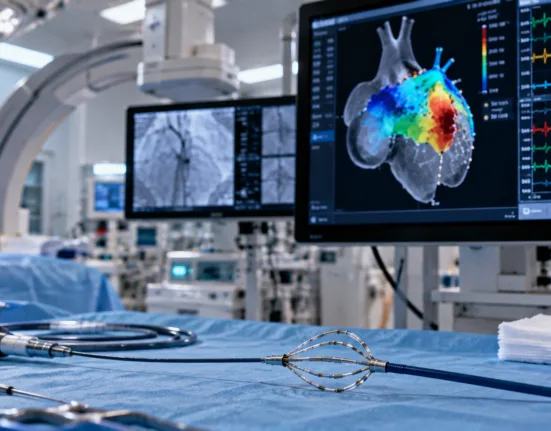
The device is unusual because one focal catheter can deliver both pulsed field ablation and conventional radiofrequency energy. Most of the current excitement around atrial fibrillation ablation has centered on pulsed field systems because they use electrical pulses rather than heat to destroy arrhythmogenic tissue, potentially reducing injury to certain surrounding structures. Abbott’s approach preserves that nonthermal option while giving electrophysiologists access to established radiofrequency energy through the same catheter when a different lesion strategy is needed.
How does TactiFlex Duo combine two different ablation technologies?
Radiofrequency ablation creates heat at the catheter tip to destroy targeted myocardial tissue responsible for abnormal electrical conduction. Pulsed field ablation instead delivers high-voltage electrical pulses that irreversibly disrupt cell membranes, producing tissue death through electroporation rather than thermal injury. Each approach has characteristics that can be advantageous depending on lesion location, anatomy and the physician’s treatment strategy.
TactiFlex Duo allows the electrophysiologist to switch between these energy modes without exchanging the focal ablation catheter. The device also integrates with Abbott’s EnSite X electrophysiology mapping system and a PFA Index intended to provide real-time information relevant to lesion creation. Abbott is therefore competing not merely on a new energy source but on flexibility within an established mapping and catheter ecosystem.
What did the 12-month FlexPulse data actually show?
Standard-of-care monitoring found no documented AFib, atrial flutter or atrial tachycardia recurrence in 92.6% of patients during follow-up. More intensive protocol-defined monitoring produced a lower but still substantial recurrence-free rate of 77.4%, demonstrating why monitoring method matters when interpreting ablation studies. The study’s broader primary effectiveness measure, which also accounted for medication changes and repeat procedures, was achieved by 74.6% of patients.
The difference between standard monitoring and protocol-driven monitoring is clinically important rather than contradictory. More frequent rhythm surveillance is more likely to detect asymptomatic or short arrhythmia episodes that routine care might miss. Device companies and clinicians therefore need to be precise about which recurrence figure they cite, particularly when comparing outcomes between competing ablation platforms that may use different monitoring intensity.
Why is first-year recurrence important after AFib ablation?
Catheter ablation is intended to interrupt the abnormal electrical circuits that allow atrial fibrillation to recur, but successful pulmonary-vein isolation during the procedure does not guarantee that arrhythmia will never return. Tissue can reconnect, new arrhythmogenic pathways can emerge and underlying disease can continue progressing. Twelve-month outcomes therefore provide a more meaningful view of durability than simply reporting whether the pulmonary veins were electrically isolated when the procedure ended.
The consequences of recurrence matter because patients can return to antiarrhythmic medication, undergo cardioversion or require repeat ablation. A device that reduces repeat procedures could improve patient experience and lower healthcare utilization, although longer follow-up is required to determine whether the one-year FlexPulse results persist over several years.
How does the new result compare with Abbott’s six-month data?
Earlier FlexPulse IDE results reported 87.1% freedom from documented AFib, atrial flutter or atrial tachycardia recurrence at six months under the study’s specified analysis, alongside a 97.8% rate of freedom from repeat ablation. Abbott also reported 100% acute pulmonary-vein isolation in the treated patients and 93.9% first-pass isolation across evaluated veins.
The new 12-month analysis advances the evidence from immediate procedural performance and early follow-up toward longer durability. Differences between six- and twelve-month percentages should not be interpreted simplistically because endpoint definitions, monitoring periods and statistical populations can vary, but the overall program continues to support the catheter’s safety and effectiveness profile as Abbott builds its U.S. regulatory package.
Is TactiFlex Duo already commercially available?
The catheter received CE Mark in Europe earlier in 2026 and is commercially available there. In the United States, however, TactiFlex Duo remains investigational and is limited by federal law to investigational use. Abbott states that the FlexPulse Global IDE study was designed to support U.S. Food and Drug Administration approval.
That distinction matters because positive trial data do not constitute FDA authorization. Abbott still needs the agency to review the full evidence package, manufacturing information and device controls before the product can be marketed for the investigated U.S. indication. The 12-month dataset is therefore a regulatory milestone rather than a U.S. product launch.
Why are companies racing to expand pulsed field ablation?
Pulsed field ablation has become one of the most competitive areas in cardiology devices because it can create cardiac lesions rapidly while using tissue-selective nonthermal energy. Major manufacturers are investing heavily as electrophysiologists gain experience and as clinical evidence expands from paroxysmal atrial fibrillation into more complicated persistent disease and additional ablation targets.
Abbott’s strategic differentiator is the dual-energy architecture. Rather than arguing that PFA should replace radiofrequency in every situation, the company is giving physicians access to both within one focal system. Whether that flexibility becomes clinically valuable enough to influence purchasing decisions will depend on procedure efficiency, long-term recurrence, safety, workflow and comparison with increasingly mature PFA-only platforms.
What should the medtech industry watch next?
The obvious catalyst is U.S. regulatory review. TactiFlex Duo already has European authorization, and the FlexPulse IDE program was specifically constructed to support FDA approval, making the latest 12-month results central to Abbott’s next commercial step. Competitors will also be watching how physicians use the two energy modes in practice and whether dual-energy capability reduces catheter exchanges or improves outcomes in anatomically complex cases.
The broader trend is that AFib ablation technology is moving beyond a competition over one “best” energy source. Mapping, lesion assessment, catheter design, procedural workflow and the ability to tailor energy to individual anatomy are becoming part of the value proposition. Abbott’s 92.6% standard-monitoring recurrence-free result provides a strong headline, but the more consequential question is whether one catheter capable of delivering two very different forms of ablation becomes the preferred architecture for increasingly personalized electrophysiology procedures.