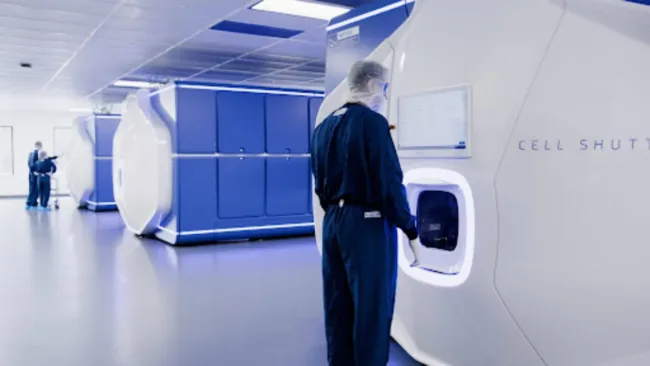
CARsgen Therapeutics Holdings Limited announced that it has signed strategic cooperation agreements to establish a commercial manufacturing base for CAR T-cell therapies in Jinshan District, Shanghai, with total planned investment not exceeding RMB370 million. The facility is intended to support commercialization of zevorcabtagene autoleucel, advance near-term launch readiness for satricabtagene autoleucel, and prepare for future allogeneic CAR T-cell programs as regulatory and market access milestones approach.
The significance of this move lies less in square footage and more in timing. CARsgen Therapeutics is making a deliberate shift from development-heavy execution toward infrastructure that signals confidence in regulatory progression, particularly for satricabtagene autoleucel, one of the most closely watched CAR-T candidates targeting solid tumors. Manufacturing decisions at this stage are rarely speculative. Industry observers typically read them as a forward indicator that internal expectations around approval probability and launch sequencing have crossed a practical threshold.
Why manufacturing scale has become a strategic lever rather than an operational afterthought for CAR-T developers
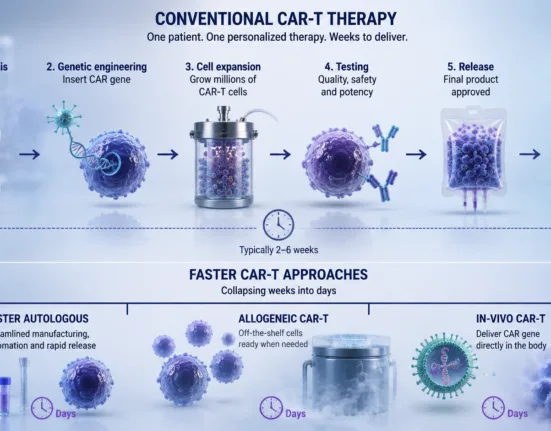
Over the past five years, CAR-T commercialization has revealed manufacturing to be one of the most stubborn bottlenecks in cell therapy economics. Autologous production requires tight chain-of-identity controls, predictable turnaround times, and redundancy against batch failure. For solid tumor indications, where treatment volumes could expand beyond niche hematologic populations, manufacturing reliability becomes existential rather than incremental.
CARsgen Therapeutics’ decision to establish a dedicated base aligned with international standards suggests recognition that solid tumor CAR-T programs cannot rely indefinitely on flexible pilot facilities or outsourced capacity. Clinicians tracking CAR-T adoption increasingly focus on logistics, not just response rates, because delays, manufacturing failures, or constrained slots directly affect patient eligibility and institutional willingness to offer therapy.
By committing to a purpose-built facility tied directly to its commercial and late-stage pipeline, CARsgen Therapeutics is attempting to de-risk one of the most common post-approval failure points seen in earlier CAR-T launches globally.
What this investment signals about confidence in satricabtagene autoleucel and solid tumor CAR-T viability
Satricabtagene autoleucel has drawn attention as a CAR-T candidate advancing into regulatory review for solid tumors, an area where CAR-T therapies have historically struggled due to antigen heterogeneity, immunosuppressive tumor microenvironments, and safety constraints. Manufacturing scale alone does not solve these scientific challenges, but it does reflect internal conviction that the therapy has achieved a level of clinical consistency that warrants commercial preparation.
Regulatory watchers often view manufacturing commitments as a credibility filter. Companies uncertain about durability of response, safety margins, or approval timing typically delay capital-intensive buildouts. CARsgen Therapeutics’ move suggests that internal data review, regulator engagement, and launch modeling have converged sufficiently to justify parallel execution rather than sequential risk taking.
If satricabtagene autoleucel secures approval, early manufacturing readiness could allow CARsgen Therapeutics to avoid the staggered rollout that has constrained uptake for several first-generation CAR-T therapies.
Why the Jinshan District location matters beyond incentives and policy alignment
Locating the facility in the Jinshan District Bay Area High-Tech Zone places CARsgen Therapeutics within an ecosystem increasingly optimized for advanced biologics manufacturing. Beyond government support, proximity to suppliers, skilled labor pools, and regulatory infrastructure reduces operational friction during scale-up.
China’s regulatory posture toward advanced therapies has shifted toward encouraging domestic manufacturing capability that meets global quality benchmarks. Industry analysts note that facilities built with international compliance in mind can serve both domestic demand and future global expansion, provided regulatory pathways align.
For CARsgen Therapeutics, the Jinshan facility appears designed not merely as a local production site but as a platform asset that could support multi-regional ambitions if clinical programs and partnerships evolve accordingly.
Financial structure reveals a cautious approach to capital preservation and long-term control
Notably, the arrangement allows CARsgen Therapeutics to expand manufacturing capacity without substantial upfront capital expenditure in the early stages. This structure reflects a broader trend among late-stage biotech firms attempting to balance infrastructure needs with cash runway discipline.
Cell therapy companies have learned hard lessons from overbuilding ahead of demand. Facilities that outpaced approvals or reimbursement clarity have weighed heavily on balance sheets. By preserving capital for research, development, and market expansion while retaining a repurchase mechanism for full asset control later, CARsgen Therapeutics is signaling financial prudence rather than aggressive overextension.
Industry observers often view such arrangements favorably, particularly in a capital environment where investors increasingly scrutinize fixed-cost exposure and asset utilization assumptions.
How this move positions CARsgen Therapeutics against global CAR-T competitors
Globally, CAR-T competition is shifting from proof-of-concept to execution quality. Major players with approved therapies have demonstrated that manufacturing excellence, not clinical novelty alone, determines real-world penetration.
CARsgen Therapeutics already holds a marketed CAR-T product, which places it ahead of many pipeline-only peers. Expanding manufacturing capacity now allows the company to leverage operational learning from zevorcabtagene autoleucel while preparing for a broader portfolio that includes allogeneic candidates such as CT0596 and CT1190B.
If allogeneic CAR-T programs mature, manufacturing strategy will become even more decisive. While allogeneic approaches promise scalability advantages, they introduce new complexity around consistency, immunogenicity, and regulatory scrutiny. A flexible, high-standard facility offers optionality as these programs evolve.
What clinicians and hospitals are likely to watch next
For clinicians, manufacturing expansion raises practical questions. Will expanded capacity translate into shorter vein-to-vein times. Will consistency improve across treatment centers. Will pricing pressure ease if throughput increases.
Hospitals evaluating whether to offer CAR-T therapies often weigh operational burden as heavily as clinical outcomes. Reliable manufacturing capacity can influence site activation decisions, particularly for solid tumor indications where patient volumes may be higher but margins narrower.
If CARsgen Therapeutics can demonstrate predictable delivery timelines and scalable support infrastructure, adoption barriers could fall more quickly than in earlier CAR-T launches.
Regulatory clarity remains the decisive variable despite manufacturing readiness
Despite the strategic logic of this expansion, regulatory outcomes remain the gating factor. Solid tumor CAR-T therapies continue to face heightened scrutiny around safety signals, durability, and patient selection.
Regulators will closely examine whether manufacturing scale introduces variability or compromises product consistency. Expansion does not eliminate regulatory risk, and in some cases can magnify it if quality systems are not robust.
Industry analysts will watch for inspection outcomes, post-approval commitments, and real-world evidence requirements that could affect how quickly capacity is fully utilized.
The broader implication for China’s CAR-T ecosystem
CARsgen Therapeutics’ move reinforces a broader maturation of China’s CAR-T sector from experimental innovation to industrial execution. As multiple programs approach commercialization, manufacturing infrastructure becomes a shared constraint rather than a differentiator.
Companies that invest early in compliant, scalable facilities may shape standards for the next wave of approvals. Those that delay may find themselves constrained by capacity or reliant on external partners under less favorable terms.
In that context, the Jinshan manufacturing base represents not just a corporate expansion, but a signal that CAR-T in China is entering a phase where operational credibility will increasingly determine leadership.