AstraZeneca has secured U.S. Food and Drug Administration accelerated approval for Etcamah, or camizestrant, in combination with a CDK4/6 inhibitor for adults with HR-positive, HER2-negative locally advanced or metastatic breast cancer whose tumors develop an ESR1 mutation while they remain on first-line aromatase inhibitor and CDK4/6 treatment. The approval moves an unusually important decision point earlier in the treatment course because eligible patients can switch endocrine therapy after molecular resistance becomes detectable in circulating tumor DNA, rather than waiting for conventional clinical or radiographic progression.
The distinction matters because this is not simply another oral endocrine medicine being inserted into a crowded metastatic breast cancer sequence. Etcamah effectively connects repeated molecular surveillance with a treatment intervention, making the blood test that detects resistance part of the therapeutic strategy rather than a diagnostic exercise performed after treatment failure. That creates a more demanding care pathway, but it also turns the period between biological resistance and visible disease progression into an actionable window.
AstraZeneca’s pivotal SERENA-6 trial gives that approach a substantial efficacy signal. Among 315 randomized patients with an emerging ESR1 mutation and no investigator-assessed progression, switching the aromatase inhibitor to camizestrant while continuing the same CDK4/6 inhibitor produced median progression-free survival of 16 months, compared with 9.2 months for patients who continued the aromatase inhibitor combination. The hazard ratio of 0.44 translates into a 56% reduction in the risk of progression or death, a result large enough to make the timing of intervention clinically consequential rather than merely biologically interesting.
Why does Etcamah change when clinicians may act on endocrine resistance in breast cancer?
The central innovation in SERENA-6 is the treatment trigger. Patients entered the randomized portion of the study only after an ESR1 mutation was detected in circulating tumor DNA while they were receiving an aromatase inhibitor plus a CDK4/6 inhibitor and remained free of conventional progression. The study therefore asked whether molecular progression should be treated as a meaningful event in its own right, rather than simply being observed until scans catch up.
That is a different proposition from using liquid biopsy after disease progression to choose the next therapy. ESR1 mutations can arise under the selective pressure of aromatase inhibitor therapy and are associated with endocrine resistance, so finding them before radiographic deterioration creates an opportunity to replace the weakening endocrine component while preserving the CDK4/6 inhibitor that may still be contributing disease control. In SERENA-6, patients continued palbociclib, ribociclib or abemaciclib and changed only the endocrine partner to camizestrant.
The follow-up evidence also matters because a concern with early switching is that a drug may simply move treatment forward without materially changing the subsequent course of disease. AstraZeneca subsequently reported median time to second disease progression of 25.7 months with the Etcamah combination versus 19.1 months for continued aromatase inhibitor therapy, with a hazard ratio of 0.63. Overall survival remained immature, however, which explains why the FDA used accelerated approval and why confirmation of longer-term clinical benefit remains important.
The regulatory history makes the final decision particularly notable. The application had undergone scrutiny at an Oncology Drugs Advisory Committee meeting, and the FDA later extended its review timeline to examine additional information. The eventual accelerated approval therefore should not be interpreted as regulatory acceptance of ctDNA-guided intervention without qualification. Instead, it indicates that the agency considered the progression-free survival evidence sufficient to support earlier access while leaving continued approval dependent on verification and description of clinical benefit.
Can serial ctDNA monitoring become the real bottleneck behind Etcamah adoption?
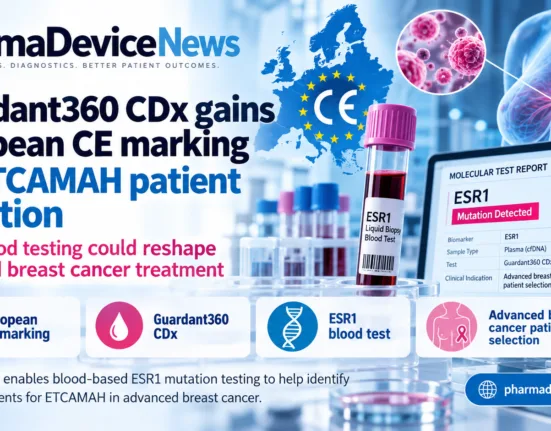
Etcamah cannot deliver the SERENA-6 strategy unless patients are tested while they still appear to be responding to first-line therapy. In the study, circulating tumor DNA testing accompanied routine tumor scans every two to three months, creating repeated opportunities to detect an emerging ESR1 mutation. The FDA simultaneously approved Guardant Health’s Guardant360 CDx as the companion diagnostic for identifying eligible patients, linking the medicine and testing pathway directly.
That requirement introduces an implementation challenge that a conventional drug approval does not face. Oncology practices must decide which patients should enter longitudinal molecular surveillance, how often testing is ordered, who tracks the results and how quickly a positive ESR1 result triggers a treatment change. Payers must also decide how broadly they will cover repeated testing in patients who have not yet shown clinical progression, because a one-time companion diagnostic and serial resistance monitoring represent different utilization patterns.
The economics of testing may therefore influence the addressable treatment population as much as the drug label itself. Large academic cancer centers and integrated oncology networks are generally better positioned to build recurring liquid-biopsy workflows, while fragmented community settings may require clearer reimbursement pathways and electronic ordering systems before testing becomes routine. A biologically elegant treatment strategy can lose effectiveness at scale if patients are not tested at the interval required to catch the molecular event.
There is also a behavioral component. Switching a therapy that appears to be controlling disease on imaging requires clinicians and patients to accept molecular evidence as sufficient justification for intervention. The SERENA-6 result provides randomized evidence supporting that decision, but routine clinical adoption will depend on confidence that the detected mutation represents meaningful resistance and that acting early produces a worthwhile advantage over waiting for conventional progression.
How strong is the SERENA-6 evidence, and what uncertainty remains after accelerated approval?
SERENA-6 was randomized, double-blind and placebo-controlled, which gives the efficacy comparison considerably more weight than a single-arm molecularly selected study. The treatment effect was also supported by a sizeable absolute improvement in median progression-free survival of 6.8 months, rather than a statistically significant hazard ratio attached to a marginal difference. The second-progression result further reduces the concern that early switching simply borrowed benefit from a later treatment line.
The unresolved issue is overall survival. At the primary analysis, survival data were not mature, and later results remained directionally favorable without establishing a definitive survival effect. That distinction is important because an earlier intervention should ideally demonstrate that changing treatment before radiographic progression improves more than the date on which first progression is recorded.
Safety also becomes part of the adoption calculation because a treatment started earlier exposes patients to a different risk profile before their disease has visibly worsened. The FDA prescribing information carries a boxed warning concerning arrhythmia from QTc prolongation when camizestrant is used with QTc-prolonging drugs, along with warnings relating to bradycardia and embryo-fetal toxicity. Those issues do not erase the progression benefit, but they reinforce the need to identify patients for whom the balance between earlier intervention and treatment risk is favorable.
Another important limitation is that the evidence is specifically tied to an emerging ESR1 mutation during first-line aromatase inhibitor plus CDK4/6 therapy. The approval should therefore not be interpreted as a general license to switch endocrine treatment whenever circulating tumor DNA changes. The clinical relevance comes from a defined resistance mechanism, a defined treatment setting and a randomized strategy that tested intervention before visible progression.
What could the Etcamah approval mean for future ctDNA-guided drug development?
The broader consequence may extend beyond camizestrant. Oncology has spent years improving the sensitivity of liquid biopsies, but the most commercially meaningful stage arrives when finding a molecular change early leads to an evidence-based action that improves outcomes. SERENA-6 connects those two steps in a registrational trial, providing a model for future studies in which molecular resistance is treated as an intervention point.
Drug developers may increasingly ask whether waiting for radiographic progression is unnecessarily late when resistance can be detected earlier in blood. That does not mean every molecular alteration will justify a treatment switch, because ctDNA findings differ in biological significance and some emerging clones may never become dominant. The regulatory bar will still require prospective evidence that acting on a molecular signal produces an outcome patients actually value.
For AstraZeneca, Etcamah also expands the role of oral selective estrogen receptor degraders at a moment when several developers are competing to reposition endocrine therapy around molecularly defined resistance. Its advantage in this specific setting is not simply that camizestrant is an oral SERD, but that the treatment has an approved first-line switching strategy linked to an FDA-authorized test and compatible with three widely used CDK4/6 inhibitors.
The near-term commercial question is therefore less about whether SERENA-6 produced a persuasive hazard ratio and more about whether real-world oncology systems can reproduce the trial’s surveillance discipline. If serial ESR1 monitoring becomes embedded alongside routine scans, Etcamah has a clear mechanism for reaching eligible patients before progression. If testing remains inconsistent, the FDA may have approved a new treatment window faster than the healthcare system can reliably identify it.