Intus Biosciences has received a $2.7 million National Cancer Institute Small Business Innovation Research Fast-Track award to develop a non-invasive diagnostic test using bacterial microbiome markers to detect early-onset colorectal cancer and precancerous colorectal lesions. The Connecticut biotechnology company will lead a consortium involving researchers from several major U.S. medical institutions and use its Titan-1 sequencing platform to identify bacterial DNA patterns that could support an algorithmic screening test.
The program is particularly relevant because early-onset colorectal cancer creates a screening problem that traditional age-based strategies cannot completely address. Routine screening in the United States generally begins at age 45 for average-risk adults, while cancers diagnosed before age 50 continue to attract concern because a meaningful proportion occur in people who have not yet entered routine screening or who present only after symptoms appear.
Intus Biosciences is proposing a different type of biomarker. Instead of detecting human tumor DNA, blood proteins or occult blood alone, the company wants to identify disease-associated bacterial signatures in stool. The biological rationale is supported by growing research connecting specific microbial communities and bacterial functions with colorectal tumor development, but translating those associations into a reliable clinical screening test remains considerably more difficult than identifying correlations in research cohorts.
The NCI award therefore finances development rather than validates the test. Intus Biosciences still has to demonstrate analytical performance, reproducibility, prospective clinical accuracy and whether its microbiome-based approach adds enough information to improve existing colorectal cancer screening pathways.
Why is early-onset colorectal cancer creating a different diagnostic challenge from conventional screening?
Colorectal cancer screening has historically focused heavily on older adults because incidence rises with age. Lowering the routine screening threshold to 45 expanded eligibility, but it does not address every patient who develops cancer earlier. People in their 20s, 30s or early 40s are generally not screened systematically unless family history, inherited syndromes, inflammatory bowel disease or other risk factors place them in a higher-risk category.
This creates a difficult balance. Screening the entire young adult population with colonoscopy would expose very large numbers of people with relatively low absolute cancer risk to an invasive and expensive procedure. Yet waiting for symptoms can delay diagnosis in the smaller group that is developing colorectal cancer unusually early.
A non-invasive risk or detection test could theoretically help bridge that gap if it accurately identifies younger people who warrant further evaluation. The clinical value would be even greater if the same test detects advanced adenomas or other precancerous lesions, because removing those lesions can prevent cancer rather than merely diagnose it earlier.
This is why Intus Biosciences’ project explicitly includes both early-onset cancer and precancerous colorectal lesions. A diagnostic that identifies only established cancer may improve stage at diagnosis, while a screening tool that reliably flags premalignant disease could have a preventive role.
The performance requirements are demanding. In a lower-prevalence population, even modest limitations in specificity can generate large numbers of false-positive results, potentially sending many healthy younger adults to colonoscopy. Sensitivity for advanced precancerous lesions is also important because several established non-invasive tests perform better for cancer than for precursor lesions.
What is Intus Biosciences measuring with its Titan-1 microbiome platform?
The intestinal microbiome contains a vast and diverse collection of bacteria whose composition and biological activity can change with diet, medication, inflammation, disease and numerous environmental factors. Researchers have repeatedly reported associations between colorectal cancer and particular microbial patterns, including enrichment of certain bacterial species or functions.
The difficulty is resolution. Many microbiome studies rely on technologies that identify organisms only at broad taxonomic levels or depend heavily on reference databases containing previously characterized bacteria. That can obscure strain-level differences or sequence features that may be more directly associated with disease.
Intus Biosciences says Titan-1 uses high-resolution bacterial DNA sequencing designed to capture sequence information across the bacterial population, including organisms that may not already have complete reference annotations. The company intends to identify specific bacterial sequence features associated with early-onset colorectal cancer and use those features to construct diagnostic algorithms.
Artificial intelligence and machine-learning methods can be useful in this setting because a clinically meaningful microbiome signature may involve combinations of many organisms rather than the presence or absence of one bacterium. Algorithms can search high-dimensional sequence datasets for patterns that distinguish cancer, precursor lesions and control samples.
That analytical power also creates overfitting risk. A model can appear highly accurate when developed using one dataset but lose performance when tested in a new population whose diet, geography, medications or demographic characteristics differ. External validation will therefore be essential.
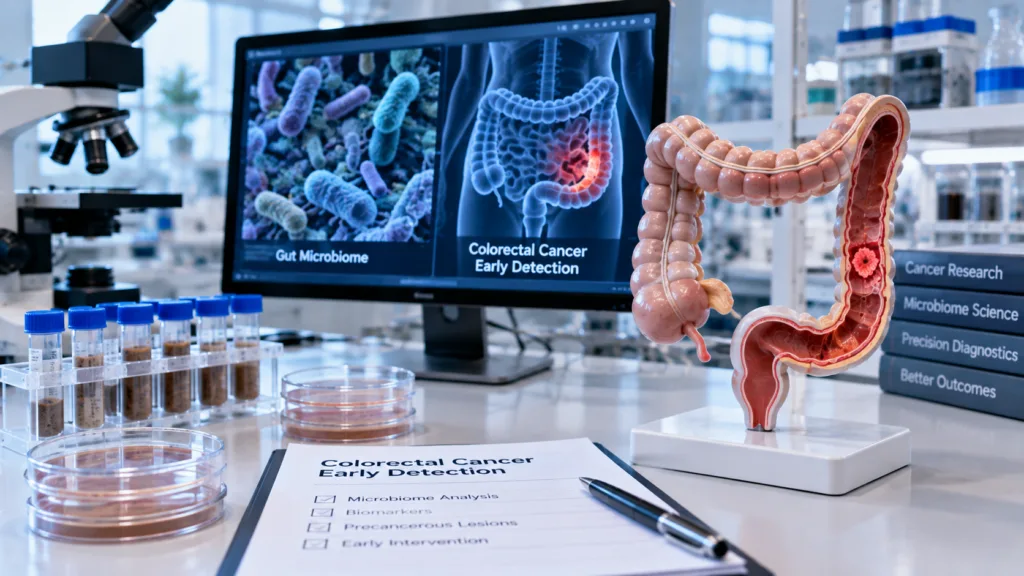
Why could microbiome-based screening offer something different from existing stool tests?
Existing non-invasive colorectal cancer screening already includes stool-based approaches. Fecal immunochemical tests detect human blood, while multitarget stool tests combine molecular markers with hemoglobin detection. These technologies have established clinical roles and large evidence bases, meaning any new microbiome test will need to demonstrate what incremental value it contributes.
Microbial biomarkers could potentially capture biology occurring earlier in tumor development. Certain bacteria may contribute to inflammation, genotoxicity or the tumor microenvironment before a lesion produces substantial bleeding or releases enough human tumor-derived material to be readily detected.
That possibility is particularly relevant for precancerous lesions. A microbiome pattern associated with advanced adenomas could provide a different biological signal from blood detection, potentially improving identification of patients who should undergo colonoscopy before invasive cancer develops.
The concept remains hypothetical until validated prospectively. Microbiome composition can shift after cancer develops, making it difficult to distinguish bacteria that contribute to tumor formation from bacteria that merely flourish in an environment created by an existing tumor.
A useful screening assay does not necessarily need to resolve that causal question. Biomarkers can be clinically valuable even if they are consequences rather than causes of disease, provided that the signal appears early enough, remains reproducible and distinguishes affected patients accurately.
However, confounding variables become extremely important. Antibiotic use, diet, gastrointestinal infection, inflammatory disease, proton pump inhibitors and geographic differences can all alter bacterial communities. Intus Biosciences will need to show that its algorithm remains robust after accounting for those factors.
What does the NCI Fast-Track award change for the development program?
The SBIR Fast-Track structure is intended to move a project through early feasibility work and into more advanced development if predefined milestones are achieved. Intus Biosciences therefore has access to funding intended not simply to generate another exploratory microbiome dataset but to advance toward a clinically useful screening product.
The consortium structure should help. Johns Hopkins University, Harvard Medical School, Massachusetts General Hospital, Dartmouth-Hitchcock Medical Center and Vanderbilt University Medical Center bring access to colorectal cancer expertise, patient cohorts and complementary research capabilities. A multi-institution approach can also improve the diversity of samples used during algorithm development and validation.
That diversity is particularly important for microbiome diagnostics because geography and lifestyle can strongly influence bacterial composition. An algorithm trained entirely at one academic center could accidentally learn characteristics of that local population rather than disease biology itself.
The award also puts clearer milestone pressure on the project. Intus Biosciences needs to demonstrate that its high-resolution sequencing approach can identify a diagnostic signature with sufficient analytical and clinical performance to justify continued development.
A grant award does not establish that those milestones will be reached. Many promising biomarker concepts fail between discovery and prospective validation because performance declines when the test is applied to previously unseen samples or real-world populations.
Why will detecting precancerous lesions be harder and potentially more valuable than detecting cancer?
An established colorectal tumor can produce pronounced changes in the surrounding intestinal environment. It may bleed, alter metabolism, change local inflammation and reshape microbial communities. Those features can make advanced cancer easier to distinguish biologically from a healthy colon.
A precancerous lesion is smaller and may create a much weaker signal. Yet detection at this stage can have greater preventive value because colonoscopic removal of an advanced adenoma or other high-risk lesion can interrupt progression before invasive disease develops.
For a microbiome assay, this creates an important sensitivity challenge. The bacterial signature associated with a small lesion needs to be strong enough to distinguish affected people despite the large background variation present in healthy microbiomes.
Specificity matters just as much. A test intended for adults younger than conventional high-risk age groups could be deployed in populations where cancer prevalence is very low. Even a false-positive rate that looks modest statistically could translate into many unnecessary colonoscopies if used broadly.
Clinical development will therefore need to define the intended-use population carefully. A test aimed at symptomatic younger adults or those with selected risk factors faces a different prevalence environment from a universal screening test offered to every adult under 45.
That choice will affect predictive value, regulatory strategy, payer economics and eventually the size of the commercial market.
What regulatory path could a bacteria-based colorectal cancer test face?
Intus Biosciences has described a development program rather than an FDA-authorized product, so the eventual regulatory pathway will depend on the final test configuration and intended use. A test marketed broadly for cancer screening would face a high evidence standard because false-negative and false-positive results can materially affect clinical decisions.
Analytical validation would need to establish that the sequencing method detects relevant bacterial features consistently across sample collection, transport, extraction and sequencing conditions. Stool is a biologically complex sample, and variations in handling can influence microbiome measurements.
Clinical validation would then need to compare the assay against an appropriate reference standard, likely involving colonoscopic findings and pathology. Investigators would need enough cancer and precancerous cases to estimate sensitivity with useful precision while also enrolling a large control population to characterize specificity.
Prospective validation is particularly important. Retrospective case-control studies can exaggerate diagnostic performance because cancer patients and controls may differ systematically in ways unrelated to the disease signature the assay is supposed to detect.
Clinical utility eventually becomes another question. Regulators may authorize a diagnostically accurate test, but payers and guideline bodies could still ask whether its use increases completion of screening, shifts cancers toward earlier stages or improves detection of advanced precursor lesions efficiently enough to justify cost.
Could Titan-1 become a broader diagnostics platform if colorectal cancer validation succeeds?
Intus Biosciences is positioning Titan-1 as a platform for identifying bacterial biomarkers rather than as a technology limited to colorectal cancer. The company already markets GutID, a microbiome profiling product, but a regulated cancer-screening application would represent a materially higher clinical and commercial standard.
Success could establish that high-resolution bacterial sequencing can produce reproducible disease biomarkers from a system often criticized for variability. That could encourage development in other gastrointestinal, inflammatory or metabolic disorders where microbiome changes have been repeatedly observed.
Each indication would still require independent validation. The microbiome is influenced by too many variables to assume that technical success in colorectal cancer proves diagnostic utility in another condition.
The colorectal program is therefore an important credibility test. Intus Biosciences has the sequencing platform, federal funding and a consortium of major research institutions. What it does not yet have is evidence that its bacterial signature can prospectively detect early-onset colorectal cancer and precursor lesions with the sensitivity and specificity required for clinical screening.
If the Fast-Track program produces that evidence, microbiome diagnostics could move one step closer to becoming a practical clinical category rather than predominantly a research field. If performance deteriorates during external validation, it would reinforce why the gap between interesting microbiome associations and deployable diagnostics has remained so difficult to cross.