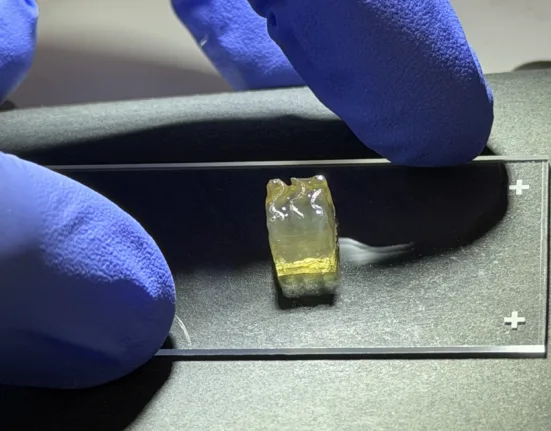
StimLabs, a U.S.-based regenerative medicine company focused on wound care and surgical applications, has received U.S. Food and Drug Administration 510(k) clearance for DermaForm, a collagen scaffold particulate wound care device developed in collaboration with Swiss regenerative medicine company Geistlich, positioning the product for commercial use across a broad range of acute and chronic wound indications in the United States.
The regulatory clearance formally allows DermaForm to enter a crowded but fast-evolving advanced wound care market, where extracellular matrix products, collagen scaffolds, and biologically derived materials are increasingly being evaluated as adjuncts or alternatives to traditional dressings, negative pressure wound therapy, and skin substitutes.
Why DermaForm’s 510(k) clearance matters more for market positioning than for clinical novelty
Industry observers tracking advanced wound care note that DermaForm’s FDA pathway is notable less for introducing a new clinical concept and more for how it strengthens StimLabs’ competitive positioning within the extracellular matrix and collagen-based scaffold segment. Collagen scaffolds are already well established in wound management, particularly for chronic wounds such as diabetic foot ulcers, venous leg ulcers, and pressure injuries, where structural support and modulation of the wound environment can influence healing trajectories.
What DermaForm adds to this landscape is not a radical departure in mechanism, but an incremental refinement in product format and portfolio breadth. As a particulate collagen scaffold derived from extracellular matrix principles, the device aligns with clinician familiarity while offering flexibility in application across irregular wound geometries. Regulatory watchers suggest that this kind of incremental innovation is often what enables faster adoption, because it minimizes changes to existing clinical workflows while still offering perceived benefits in handling and coverage.
How DermaForm fits into the evolving extracellular matrix wound care ecosystem
Extracellular matrix-based wound care products occupy a middle ground between traditional passive dressings and more complex cellular or tissue-engineered skin substitutes. Clinicians following the field highlight that ECM products are often favored when wound complexity increases but full biologic grafting is not yet indicated, particularly in outpatient or ambulatory settings.
DermaForm’s clearance reinforces the direction of travel for the segment, which has steadily moved toward scaffold-based solutions that aim to support tissue regeneration without introducing living cells. From a regulatory perspective, this approach tends to reduce complexity around manufacturing controls, storage, and shelf life, all of which are critical considerations for hospital supply chains and wound care centers.
By securing clearance through the 510(k) pathway, StimLabs has effectively positioned DermaForm as substantially equivalent to existing legally marketed devices, which lowers regulatory friction and accelerates commercialization. Industry analysts note that this strategy reflects a pragmatic understanding of how wound care products actually scale in the U.S. healthcare system.
What this clearance reveals about StimLabs’ broader portfolio strategy
The DermaForm clearance appears to be part of a broader portfolio expansion strategy rather than a standalone bet. StimLabs has been steadily assembling a range of regenerative medicine products targeting wound care and surgical use cases, and DermaForm strengthens the company’s ability to address clinicians managing complex wounds that do not respond adequately to standard care.
From a commercial perspective, portfolio depth matters in wound care. Purchasing decisions are often made at the system or group practice level, where vendors that can offer multiple solutions across the wound severity spectrum tend to gain an advantage. Industry observers believe DermaForm enhances StimLabs’ ability to compete for these bundled purchasing decisions, particularly against larger players with diversified advanced wound care catalogs.
The collaboration with Geistlich also adds credibility. Geistlich’s long-standing reputation in regenerative medicine, particularly in dental and orthopedic applications, provides scientific and brand validation that may resonate with clinicians who already trust the company’s materials science expertise.
Competitive comparisons and where DermaForm may face pressure
Despite the positive regulatory milestone, DermaForm enters a market with no shortage of alternatives. Collagen-based and ECM-derived wound products are offered by multiple established companies, many of which already have deep relationships with wound care clinics and integrated delivery networks.
Clinicians comparing products in this category often focus less on theoretical biological advantages and more on practical factors such as ease of use, consistency of supply, reimbursement alignment, and perceived reliability. Industry watchers suggest that DermaForm’s success will depend heavily on whether StimLabs can demonstrate clear handling or performance advantages in real-world use, even if those advantages are incremental rather than transformative.
Pricing and reimbursement will also be critical. While FDA clearance is necessary for market entry, it does not guarantee favorable reimbursement. Advanced wound care reimbursement remains fragmented, with coverage decisions varying by payer and site of care. Regulatory and reimbursement specialists note that demonstrating cost-effectiveness relative to existing collagen scaffolds could be as important as any clinical differentiation.
Regulatory clarity today does not eliminate downstream adoption risks
Although the 510(k) clearance provides regulatory certainty for market entry, it does not resolve all future risks. Wound care products often face post-market scrutiny related to real-world outcomes, particularly as payers increasingly demand evidence of value beyond basic safety and equivalence.
Clinicians tracking the space point out that chronic wound populations are heterogeneous, making it difficult for any single product to demonstrate consistent superiority across indications. This creates a risk that DermaForm could be perceived as interchangeable with competing products unless supported by robust post-market data or targeted clinical studies.
Manufacturing scale and quality consistency are another watchpoint. Collagen scaffold products rely on tightly controlled processing to ensure reproducibility. Any disruptions in supply or variability in product performance can quickly erode clinician confidence, particularly in a category where trust and familiarity drive repeat use.
What regulators, clinicians, and industry observers will watch next
Following the clearance, attention will likely shift to how aggressively StimLabs pursues market education and clinician engagement. Industry observers suggest that real-world case series, registry data, and targeted educational initiatives will be essential to differentiate DermaForm in a saturated market.
Regulatory watchers will also be alert to how the company positions DermaForm within its broader portfolio without overstating claims, particularly as the FDA continues to scrutinize regenerative medicine marketing practices more closely. Maintaining clear alignment between labeling, promotional messaging, and clinical evidence will be critical to avoiding regulatory friction.
From a strategic standpoint, the DermaForm clearance may signal further portfolio additions or expanded indications as StimLabs continues to build scale in wound care. Observers believe the company is likely to focus on incremental expansion rather than disruptive leaps, leveraging regulatory efficiency and clinician familiarity to grow steadily rather than rapidly.
The bigger picture for advanced wound care innovation
DermaForm’s FDA clearance underscores a broader reality in advanced wound care innovation. Progress in this field is often evolutionary rather than revolutionary. Products that succeed are those that integrate smoothly into existing care pathways, align with reimbursement realities, and offer just enough perceived improvement to justify adoption.
In that context, DermaForm appears well positioned as a commercially pragmatic addition rather than a paradigm shift. Its ultimate impact will depend less on its regulatory milestone and more on how effectively StimLabs and Geistlich translate that clearance into clinician confidence, system-level adoption, and sustainable differentiation in a competitive and cost-sensitive market.