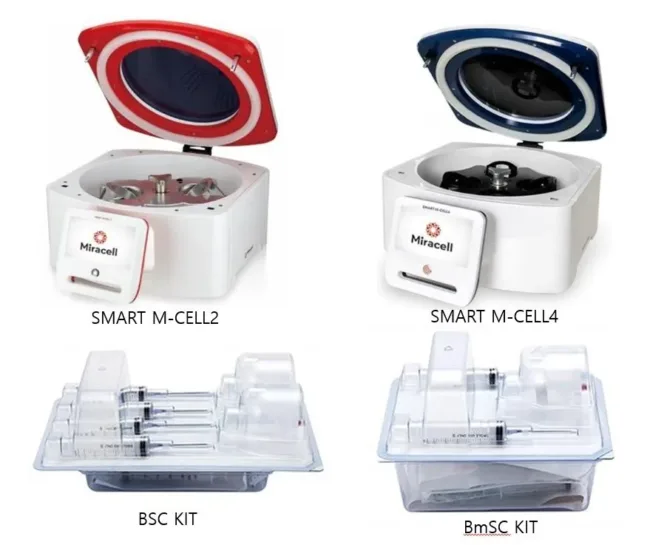
Miracell receives United States Food and Drug Administration 510(k) clearance for its SMART M-CELL PRP Concentration System and SMART M-CELL Bone Marrow Concentration System, marking a regulatory milestone for the South Korea-based regenerative medicine company’s blood- and bone marrow-processing platform. The clearance covers the integrated SMART M-CELL system and its dedicated BSC Blood Kit and BMSC Bone Marrow Kit, positioning the platform within the United States market at a time when clinicians and device makers are paying closer attention to procedural regenerative medicine tools built around autologous biologics.
Why this United States clearance matters far beyond a routine device commercialization update
This development matters because a 510(k) clearance in this category is not simply a sales passport. It is also a signal about how a regulator views device comparability, workflow integrity, and intended use within a field that often sits in an awkward space between standard medical devices and more ambitious regenerative medicine claims. Miracell said the clearance was based on substantial equivalence to SmartPReP, a known comparator system originally developed by the Institute for Immunological Research at Harvard Medical School. That framing is important because it tells industry observers that Miracell did not win clearance by persuading regulators to recognize a radically new clinical paradigm. It moved through a more familiar regulatory lane by showing that its system performs in line with an established benchmark.
For the regenerative medicine device market, that is both a strength and a limitation. The strength is obvious. Substantial equivalence gives hospitals, orthopedic practices, sports medicine providers, and procedural specialists a more legible adoption story. The limitation is subtler. Clearance under 510(k) does not by itself validate broader therapeutic superiority, nor does it settle the long-running debate over how much clinical value concentration systems actually add across different use settings. In other words, the regulatory box has been checked, but the real commercial and clinical argument is only beginning.
What this clearance reveals about the shift from low-complexity centrifuges to integrated biologics platforms
Miracell appears to be positioning SMART M-CELL not as just another centrifuge, but as an integrated extraction and concentration platform. That distinction is central to the company’s message. The press material stresses that the clearance applies to the combined centrifuge-and-kit system rather than to an isolated piece of hardware, and that the platform is designed to preserve cell viability while separating and concentrating what Miracell calls Efficient Growth Factors alongside white blood cells and SDF-1α.
That is strategically smart because the regenerative procedure market has become crowded with hardware-led differentiation claims that often blur together. A basic centrifugation story is no longer enough to command premium positioning. Device makers increasingly need to argue that cartridge design, workflow standardization, cell handling, biologic integrity, and reproducibility together create a superior procedural product. Miracell is clearly trying to climb into that higher-value category.
This also reflects a broader industry direction. In musculoskeletal and procedural biologics, buyers do not just purchase a machine. They purchase consistency, operator ease, throughput, and confidence that the product prepared at chairside will not vary wildly from case to case. The more a company can frame its system as a validated, end-to-end solution rather than a generic processing device, the more defensible its pricing and channel strategy can become. That may matter especially in the United States, where physician offices, ambulatory settings, and specialty clinics often assess these platforms through a combined lens of procedural workflow and reimbursement practicality.
Why the clinical promise remains interesting but still narrower than regenerative medicine marketing often suggests
Miracell’s release points to studies involving knee osteoarthritis, rotator cuff tears, cartilage defects, bone injury, wound healing, vascular regeneration, and other applications linked to concentrated blood- or bone marrow-derived biologics. That breadth reflects real scientific interest in autologous biologic approaches, but it also highlights a classic industry tension: biological plausibility and broad exploratory use are not the same thing as strong, indication-specific clinical evidence.
This is where the story becomes more nuanced. A concentration system can gain regulatory traction as a device while the evidence base for downstream treatment uses remains fragmented, heterogeneous, and highly dependent on protocol quality. In regenerative medicine, one of the biggest recurring problems is that clinicians may use similar terminology for products that are not truly standardized across sites, preparation methods, patient populations, or treatment settings. That makes cross-study interpretation messy. A system that claims higher purity, higher recovery, or better preservation of viability may indeed improve biologic consistency, but those attributes still have to translate into meaningful clinical outcomes under real-world treatment conditions.
For clinicians following this field, the next question will not be whether SMART M-CELL can produce a concentrated product. It will be whether procedural users can show more reproducible outcomes or workflow advantages than competing systems. For regulators, the next watchpoint is whether marketing language remains disciplined and does not overrun the boundaries of cleared device claims. For industry observers, the commercial test is whether providers view this as an efficiency upgrade, a quality upgrade, or just one more entrant in an already noisy market.
What this changes for adoption strategy in orthopedics, sports medicine, and cash-pay biologics clinics
The most immediate commercial opportunity is likely not in hospital-wide replacement of existing systems, but in specialist adoption where procedural biologics already have mindshare. Orthopedics, sports medicine, pain intervention, and some aesthetics and wound-healing practices are more plausible entry points than broad, institution-wide mainstream deployment. These settings are often more willing to experiment with biologic processing tools if the system offers operational simplicity and a differentiated output profile.
Miracell’s global footprint claim, with supply to about 40 countries and approvals in multiple geographies, may help reassure distributors and clinical partners that this is not a laboratory-stage concept. At the same time, United States market entry brings a different level of scrutiny. International presence can support credibility, but American buyers will still want domestic evidence generation, physician education, service capability, and defensible positioning against incumbent systems.
There is also the reimbursement problem, the uninvited guest that always shows up at regenerative medicine’s dinner table. Even when clinicians are intrigued by autologous biologics platforms, billing pathways can remain inconsistent, narrow, or dependent on procedural bundling and cash-pay models. A device may be technically sound and commercially available, yet still face slower uptake if economic incentives remain unclear. That does not make the platform nonviable. It simply means adoption may advance first in procedure-driven niches rather than through broad standard-of-care integration.
Why Miracell’s purity and viability argument could help commercially but still needs proof in practice
Miracell leans heavily on cell viability, purity, and extraction performance as differentiators. That is the right battlefield. In this market, claims of better biologic quality are more persuasive than generic claims of innovation. If a provider believes one system delivers a more functional final product with less operator variability, that can influence purchasing decisions. The company also points to a United States patent secured in February 2024 for its centrifuge container, which suggests an attempt to protect not just brand narrative but also the kit-level mechanics behind the platform.
But this is also where skepticism is healthy. Better purity or recovery on paper does not automatically produce better patient outcomes, and experienced buyers know that. Providers may ask whether the system’s performance advantage is clinically material or merely technically measurable. They may also ask whether processing gains are consistent across blood and bone marrow inputs, across patient populations, and across different operator environments. The more Miracell wants to move from regulatory credibility to premium market status, the more it will need post-clearance data, physician champions, and use-case-specific evidence that goes beyond comparator language.
This is not unusual. Many device stories look strongest at the point of clearance and then run into the hard realities of training, distribution, cost justification, and real-world repeatability. In regenerative medicine, the field is littered with platforms that sounded powerful in theory but struggled to define a durable clinical identity. Miracell now has the chance to avoid that fate, but only if it can convert engineering claims into routine procedural trust.
What regulators, clinicians, and competitors are likely to watch as SMART M-CELL enters the United States market
The next stage will likely be less about headlines and more about execution. Regulators will watch labeling discipline and how the system is promoted in connection with specific conditions. Clinicians will watch whether the platform is easy to integrate into existing workflows and whether the output appears meaningfully differentiated. Competitors will watch whether Miracell tries to win on premium biologic quality, broader indication storytelling, or distributor-led scale.
Industry observers will also watch how the South Korean regenerative medicine specialist balances ambition with restraint. The field is attractive precisely because it sits near some of medicine’s most compelling themes: autologous healing, reduced dependence on symptom management, and tissue repair rather than temporary relief. But those themes can also tempt companies into overselling. The winners in this category are rarely the noisiest players. They are usually the ones that align regulatory positioning, physician education, evidence development, and realistic market segmentation.
For now, the FDA 510(k) clearance gives Miracell something more valuable than promotional momentum. It gives the company a legitimate opening in the world’s most watched medical device market. Whether SMART M-CELL becomes a credible category challenger or just another cleared system will depend on what comes after the clearance certificate, not the certificate itself.

Why Miracell’s SMART M-CELL FDA clearance could reshape the PRP and BMAC device market added by Pallavi Madhiraju on
View all posts by Pallavi Madhiraju →