CHENGDU, China — iRegene Therapeutics Co., Ltd. has received Regenerative Medicine Advanced Therapy (RMAT) designation from the U.S. Food and Drug Administration for its lead candidate NouvNeu001, an induced pluripotent stem cell (iPSC)-derived allogeneic cell therapy for Parkinson’s disease. The regulatory milestone comes just months after the product secured Fast Track Designation in August 2025, making NouvNeu001 the first iPSC therapy globally to hold both designations. The FDA’s decision follows positive Phase I data showing clinically meaningful motor function improvements in Parkinson’s patients.
Why NouvNeu001’s dual regulatory status could accelerate clinical adoption of iPSC-derived therapies
The dual recognition of NouvNeu001 under the FDA’s Fast Track and RMAT pathways offers a strong regulatory endorsement of both the therapy’s clinical potential and iRegene’s underlying platform. However, what sets this development apart is not merely regulatory velocity but the modality behind it. NouvNeu001 represents one of the first allogeneic, chemically induced iPSC-based products to enter late-stage development in a complex neurodegenerative indication with high unmet need.
Industry observers note that RMAT designation has been infrequently granted to iPSC therapies, with most prior recipients belonging to autologous or tissue-engineered product classes. iRegene’s approach — based on off-the-shelf, chemically reprogrammed dopaminergic progenitor cells — signals growing FDA confidence in allogeneic strategies that combine iPSC scalability with robust manufacturing and functional cell identity.
What distinguishes iRegene’s chemically induced platform from conventional stem cell approaches
iRegene is not pursuing iPSC reprogramming through classical transcription factor-based induction or gene editing. Instead, the company uses small-molecule cocktails to chemically induce cell fate reprogramming, sidestepping both viral vectors and CRISPR-based engineering.
This platform strategy has several advantages. First, it allows for non-integrative, more predictable lineage specification — reducing the oncogenic and epigenetic variability risks typically associated with iPSC-based therapies. Second, it enables a universal donor model, with off-the-shelf cells produced at industrial scale and batch-certified for identity, purity, and potency. Third, it may allow for tighter quality control in manufacturing, which has historically been a major bottleneck in the cell therapy space.
Regulatory experts suggest that such chemically induced platforms, if proven safe across larger cohorts, could ease the path to centralized GMP production and broader commercial rollout — particularly in neurologic indications where autologous approaches are operationally burdensome and time-sensitive.
How convincing is the early clinical data in Parkinson’s disease?
The Phase I dataset disclosed by iRegene included both low- and high-dose cohorts, with improvements observed across motor scores measured by the MDS-UPDRS Part III. The low-dose group reported a 30.6-point improvement in the OFF-medication state (a 52.82% reduction from baseline) at 12 months, while the ON-medication improvement reached 12.9 points (a 54.67% gain). The high-dose group followed a similar trend, albeit over a shorter 9-month follow-up window.
Clinicians tracking the Parkinson’s field are cautiously optimistic. The magnitude of response exceeds those typically reported for symptomatic interventions like dopamine agonists or deep brain stimulation in similar cohorts. However, the trial remains limited in size and lacks a placebo arm — a critical consideration in Parkinson’s, where placebo responses in open-label surgical trials can be notably high.
Moreover, while improvements in OFF scores suggest real underlying neurorestoration or circuit modulation, the durability beyond 15 months and the behavior of engrafted cells over time — especially in terms of synaptic integration and potential overgrowth — remain unproven. Regulators will likely scrutinize long-term safety data closely before granting broader approvals.
What challenges remain in scaling iPSC therapies for chronic neurologic indications
While iRegene’s chemically induced, allogeneic approach may sidestep several autologous challenges, broader issues persist in the iPSC field. Manufacturing at scale, even for universal donor cells, requires stringent batch-to-batch consistency, validated release criteria, and traceable potency markers tied to clinical outcomes — all of which are still evolving in the field.
In addition, even if safety and efficacy are demonstrated in Parkinson’s disease, reimbursement and economic modeling remain murky. Industry analysts suggest that payers will require robust health economics data — particularly in chronic indications where existing therapies, though symptomatic, are relatively inexpensive. Payers may also seek real-world evidence of reduced hospitalization, improved quality of life, or delayed progression before granting premium pricing.
Moreover, iPSC therapies targeting CNS disorders must also grapple with delivery complexity. Intracerebral delivery of dopaminergic cells, while feasible in a trial setting, presents procedural risk and scalability concerns in routine care. Advances in less invasive delivery methods — or adjunctive technologies to track cell survival post-transplantation — may be necessary to gain clinician confidence at scale.
What iRegene’s pipeline expansion signals about platform credibility and indication breadth
Beyond NouvNeu001, iRegene is positioning its chemical induction platform as a pipeline engine for multiple degenerative and orphan conditions. Its second Parkinson’s candidate, NouvNeu003, entered clinical trials in late 2023 and focuses on early-onset subtypes. Meanwhile, NouvNeu004 has received investigational new drug clearance in China for Multiple System Atrophy — a rarer, faster-progressing alpha-synucleinopathy often considered outside the reach of conventional neurorestorative approaches.
The company is also pursuing a retinal degeneration program under NouvSight001, which received Orphan Drug Designation in the U.S. in 2024. If successful, this would demonstrate that iRegene’s platform is not limited to dopaminergic targets but can generate retinal cell types with clinical-grade purity and functionality.
For industry observers, this breadth — spanning motor, autonomic, and sensory degenerative conditions — suggests a credible underlying reprogramming system. However, cross-tissue consistency in efficacy and safety must still be demonstrated. Investors and regulatory stakeholders will likely track the MSA and retinal programs closely as litmus tests of iRegene’s platform scalability.
What this RMAT milestone reveals about regulatory comfort with non-gene-edited cell therapy modalities
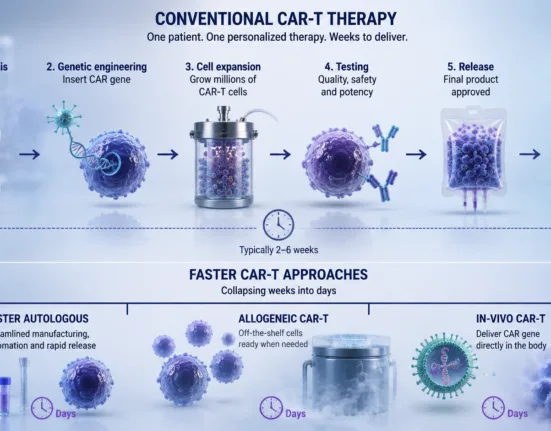
The RMAT designation granted to NouvNeu001 suggests a meaningful shift in how the U.S. Food and Drug Administration views cell therapies derived from non-genetically modified platforms. While most regenerative products receiving expedited designation have historically involved gene edits (CAR-Ts, gene-modified stem cells), iRegene’s chemically reprogrammed approach represents a different regulatory calculus.
Rather than focusing on molecular targeting or genetic insertion, iRegene is betting on endogenous function restoration through native dopaminergic circuitry — a shift that aligns with the agency’s interest in functional endpoints, not just surrogate markers. If future trial phases confirm this approach’s efficacy, it may pave the way for a new class of regenerative products that bypass both the ethical and technical hurdles of gene editing.
Final takeaways for pharma and device executives watching the neuro cell therapy space
iRegene’s RMAT designation marks an inflection point in the maturation of allogeneic iPSC therapies. It underscores growing regulatory openness to chemically induced, non-gene-edited platforms — particularly in diseases where circuit-level regeneration remains elusive. However, much depends on how NouvNeu001 performs in controlled trials, how scalable the manufacturing process proves to be, and whether long-term safety holds up under broader scrutiny.
As of now, the bar has been raised. Future contenders in the iPSC field will be measured against the dual-benchmark iRegene has achieved: strong early efficacy signals and structured regulatory endorsement. Whether this translates into commercial viability will depend on how the next stages of clinical development play out — and whether payers, neurologists, and health systems are ready to embrace disease-modifying cell therapies as part of routine care.