Medtronic has received United States Food and Drug Administration clearance for its LigaSure RAS Maryland jaw device to be used with the Hugo robotic-assisted surgery system, giving the company another instrument as it works to turn Hugo from a robotic platform into a broader surgical ecosystem. LigaSure technology has already been used in more than 45 million procedures globally, and placing it on Hugo matters because robotic surgery competition increasingly depends on what surgeons can do through the platform, not simply on the robot itself.
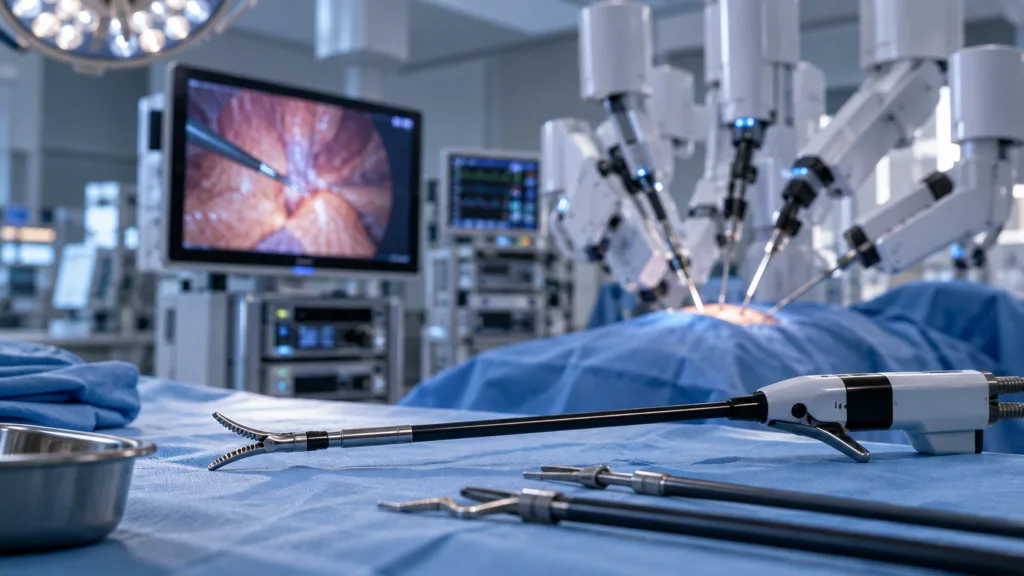
The instrument allows surgeons to seal and divide vessels, lymphatics and tissue bundles up to seven millimeters in diameter, with Medtronic saying LigaSure can complete sealing in approximately two seconds while limiting thermal spread. It is the first robotically driven LigaSure instrument and was introduced in Europe in 2025 following CE marking.
Hugo received FDA clearance for urologic surgery in the United States in December 2025, and the platform has since entered an important expansion phase. Medtronic is pursuing broader general-surgery and gynecologic indications while adding instruments that could make the system useful across more complex procedures. Outside the United States, Hugo has been used in tens of thousands of patients across more than 35 countries and more than 50 procedure types, according to Medtronic.
Why can one vessel-sealing instrument matter so much to a surgical robot?
The economics of robotic surgery are often misunderstood as a competition over expensive capital equipment. Selling or placing the robot is only the beginning. The larger long-term opportunity comes from instruments, accessories, service agreements and procedure-linked consumables that generate revenue every time surgeons use the system.
That is why LigaSure matters. The brand is already familiar to surgeons using Medtronic’s conventional surgical instruments, reducing one element of the learning curve when hospitals move procedures toward robotics. A surgeon who already trusts a vessel-sealing technology in laparoscopic or open surgery has a clearer reason to value access to that same tissue-management capability from the robotic console.
For hospitals, instrument breadth can affect whether a robotic system can support enough surgical volume to justify its capital cost. A platform restricted to a narrow range of procedures may struggle to generate attractive utilization. As Medtronic adds indications and instruments, each incremental procedure type can improve the economic rationale for acquiring or retaining Hugo.
The recurring-revenue effect is equally important. Even when robot placements carry lower initial margins because manufacturers use financing, leasing or placement models, a larger installed base can create years of demand for instruments and service. Intuitive Surgical has demonstrated the power of this model at global scale, and Medtronic’s challenge is to build enough procedure volume for Hugo to develop similar economic characteristics.
How far behind Intuitive Surgical is Medtronic in robotic surgery?
Medtronic is entering a market where Intuitive Surgical has accumulated an enormous installed-base advantage. Intuitive reported 11,710 da Vinci systems installed globally at the end of its second quarter of 2026, up 12% from a year earlier. Procedures performed with da Vinci systems rose approximately 15%, while the company placed another 468 systems during the quarter and generated about $2.89 billion of revenue.
Those numbers illustrate the scale of Medtronic’s task. Every installed da Vinci system creates trained surgeons, familiar operating-room teams, established hospital purchasing relationships and recurring demand for proprietary instruments. A competing robot therefore has to overcome not only technical comparisons but a deeply embedded clinical and commercial network.
Medtronic does have an unusual counterweight: it already sells a vast array of products into operating rooms. Its surgical stapling, electrosurgery, energy and other procedural technologies give the company relationships with many of the same hospitals and surgeons that robotic platforms target. Integrating proven Medtronic instruments such as LigaSure into Hugo is one way of using that existing presence to narrow Intuitive’s ecosystem advantage.
Competition is also becoming more crowded. Johnson & Johnson received FDA marketing authorization in July 2026 for its Ottava robotic system for certain upper-abdominal procedures, creating another major medtech competitor with substantial surgical product relationships. Hospitals evaluating their future robotic fleets may therefore face a more credible multi-platform market than they have for much of the past two decades.
Why is Medtronic spending more money on robotics now?
Medtronic reinforced its robotics ambitions on September 1 when it announced an approximately $700 million investment in Cornerstone Robotics. The transaction also provided Medtronic with distribution rights for Cornerstone’s Sentire robotic platform in selected markets outside the United States. The company has said global robotic-surgery penetration remains relatively low compared with the overall volume of eligible procedures, supporting the view that market expansion does not have to depend entirely on taking share from Intuitive Surgical.
That strategy suggests Medtronic is pursuing robotics at multiple levels. Hugo remains its internally developed flagship system, while external partnerships can widen geographic reach, technology access or price positioning. This approach could be particularly valuable in emerging markets where hospital budgets and operating-room requirements differ from those of large United States academic medical centers.
Medtronic’s fiscal 2026 results also described Hugo among the company’s higher-growth opportunities, while the Medical Surgical segment delivered approximately 5.1% organic revenue growth for the year. Robotics therefore sits inside a broader effort to accelerate growth in a large surgical business rather than functioning as an isolated moonshot.
What does LigaSure add to the hospital economics of Hugo?
Hospital purchasing committees typically evaluate robotic platforms across capital price, service costs, instrument cost per procedure, utilization, operating-room time, training requirements and clinical outcomes. LigaSure can influence several of those variables because vessel sealing is a routine part of many operations and a familiar technology may simplify workflow.
Medtronic also says its Maryland jaw configuration is designed to support grasping, blunt dissection and tissue manipulation in addition to vessel sealing. Multi-function instruments can reduce instrument exchanges during a procedure, potentially improving workflow efficiency. Whether those benefits translate into measurable operating-room savings will ultimately depend on real-world utilization rather than manufacturer specifications alone.
The broader prize is procedure expansion. Hugo is currently cleared in the United States for urologic procedures, while Medtronic has pursued general and gynecologic indications. LigaSure becomes substantially more valuable if those additional clearances arrive because energy and vessel-sealing tools are fundamental across hysterectomy, colorectal, general surgery and other high-volume procedures.
That creates a regulatory sequencing effect: an instrument approval has limited value without eligible procedures, while procedure approvals are more attractive when surgeons have a complete instrument set. Medtronic therefore needs both pathways to progress together.
How are investors viewing Medtronic’s robotics push?
Medtronic shares gained more than 3% after the company raised guidance and announced its Cornerstone Robotics investment earlier in September, showing that investors are willing to assign strategic value to a more aggressive robotics push when it arrives alongside stronger operating performance. More recently, Medtronic traded around $92.60 on September 16 and declined during a weaker broader session, meaning the LigaSure clearance by itself did not trigger a dramatic re-rating.
That response is logical. One additional robotic instrument cannot materially change near-term Medtronic earnings. Its significance lies in the cumulative ecosystem being assembled around Hugo, where each clearance can increase procedure coverage, utilization and recurring instrument revenue.
Investors will consequently focus less on individual instrument launches and more on installed systems, procedure growth, general and gynecologic FDA clearances, recurring consumables, surgeon adoption and the financial return on Medtronic’s substantial robotics investment.
What happens next in the Medtronic versus Intuitive Surgical robotics battle?
The largest near-term catalyst is broader United States labeling for Hugo. General surgery and gynecology encompass large procedure volumes, and access to those markets would materially expand the addressable opportunity. Medtronic must then prove that hospitals will install Hugo at scale and that surgeons will use it frequently enough to create attractive recurring economics.
Instrument expansion will continue to be critical. Robotic platforms become harder to displace as their procedure menus and instrument ecosystems deepen, so Medtronic needs a steady cadence of tools rather than occasional additions. LigaSure gives Hugo one of the company’s most recognizable surgical technologies and demonstrates how Medtronic can transfer existing operating-room strengths into robotics.
The clearance will not erase Intuitive Surgical’s installed-base lead, nor will it prevent Johnson & Johnson and other competitors from advancing. But it illustrates why the robotics contest is becoming broader than the machine sitting beside the operating table. The long-term winners will be determined by procedures, instruments, recurring revenue and workflow economics, and Medtronic has just added another piece to that equation.