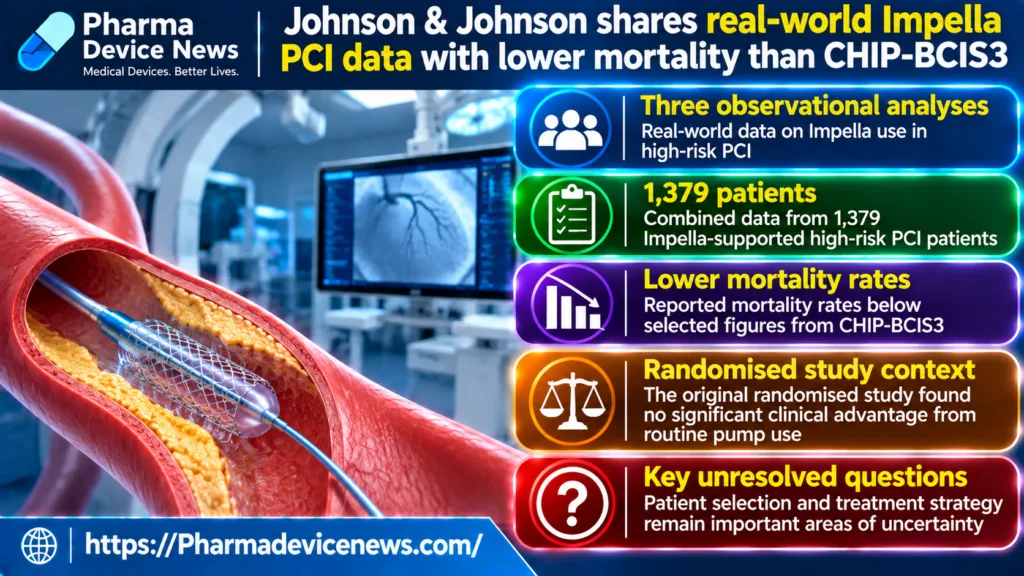
Johnson & Johnson (NYSE: JNJ) has announced three observational clinical analyses involving 1,379 patients undergoing Impella-supported high-risk percutaneous coronary intervention, reporting mortality rates numerically below selected outcomes from the randomised CHIP-BCIS3 trial. Disclosed on November 1, 2026, during the Transcatheter Cardiovascular Therapeutics conference in San Diego, the findings examine clinical experience across hospitals in the United States, Germany, Switzerland and Austria.
The analyses report 30-day all-cause mortality of 6.1% in a 279-patient European registry, discharge cardiovascular mortality of 3.4% in a separate 522-patient US cohort and in-hospital all-cause mortality of 4.7% among 578 patients selected from the PROTECT III study. Johnson & Johnson argues that these results provide additional context for interpreting CHIP-BCIS3, which found no significant improvement in major clinical outcomes when Impella support was used routinely during complex coronary intervention.
However, the new findings do not constitute a randomised comparison between Impella and unsupported procedures. They come from three observational analyses involving different populations, endpoints and follow-up periods. The original CHIP-BCIS3 trial remains important because it directly compared an Impella-supported strategy with standard care and failed to demonstrate superiority on its prespecified primary outcome.
The central clinical question is therefore not whether the new registry numbers appear favourable. It is whether differences in patient selection, procedural technique and the duration of circulatory support can explain the apparent variation in outcomes, and whether those strategies improve results when tested in an appropriately controlled trial.
Why has Johnson & Johnson released new Impella findings after the negative CHIP-BCIS3 trial?
Impella heart pumps provide temporary mechanical circulatory support by moving blood from the left ventricle into the aorta. During high-risk coronary intervention, this support is intended to reduce the workload on the heart and maintain circulation while physicians treat complex arterial disease. The technology is used in appropriately selected patients under relevant regulatory indications.
The clinical rationale is particularly important when patients have severely impaired left ventricular function and extensive coronary artery disease. Balloon inflation, stent implantation and other procedural steps can temporarily interfere with coronary blood flow. Some patients may have insufficient cardiac reserve to tolerate these changes without haemodynamic deterioration.
However, providing circulatory support does not automatically improve long-term outcomes. Device insertion introduces risks, while the effects of temporary unloading must be considered alongside the severity of the patient’s underlying disease. Whether mechanical support delivers a net benefit depends on both immediate procedural performance and subsequent clinical events.
CHIP-BCIS3 challenged the assumption that routine Impella support improves outcomes in the broader population undergoing complex high-risk PCI. Johnson & Johnson’s latest analyses seek to examine whether contemporary clinical practice, including differences in support duration and patient management, may be associated with more favourable results than those observed in that trial.
Navin Kapur, chief medical and scientific officer for Heart Recovery within Johnson & Johnson MedTech, has emphasised the importance of selecting suitable patients and applying consistent care protocols. The company’s interpretation is that the timing and manner of Impella use may influence outcomes. However, the observational studies do not establish that those procedural differences caused the reported mortality patterns.
What did the randomised CHIP-BCIS3 trial actually demonstrate about Impella-supported PCI?
CHIP-BCIS3 was a randomised clinical trial conducted across 21 centres in the United Kingdom. It enrolled 300 patients with severely impaired left ventricular function and extensive coronary artery disease who were scheduled to undergo complex PCI. Participants were assigned to a strategy involving elective microaxial flow pump support or standard care without routine pump assistance.
The trial allocated 148 patients to the Impella-supported group and 152 to standard care. The primary outcome was a hierarchical composite incorporating death from any cause, disabling stroke, spontaneous myocardial infarction, cardiovascular hospitalisation and periprocedural myocardial injury. Investigators evaluated outcomes after a minimum of 12 months, with a median follow-up of approximately 22 months.
The study reported a win ratio of 0.85, with a 95% confidence interval ranging from 0.63 to 1.15 and a p-value of 0.30. Because the result was not statistically significant, the trial did not demonstrate that routine mechanical unloading improved the composite outcome. The point estimate also did not favour the Impella strategy.
Deaths from any cause occurred in 47 patients assigned to the pump group and 33 patients receiving standard care. The reported hazard ratio was 1.54, with a 95% confidence interval of 0.99 to 2.41. This finding raised an important question about potential harm, although the confidence interval did not provide definitive evidence of increased mortality.
The trial therefore offered a materially different conclusion from what might be inferred by looking only at favourable observational outcomes. Its findings do not establish that Impella can never benefit selected patients, but they challenge the use of routine pump support across the studied high-risk population.
The distinction is critical for clinical interpretation. A strategy can improve haemodynamic stability during a procedure without necessarily reducing the likelihood of death, myocardial infarction or hospitalisation over the following months.
What did the 279-patient TRI-GUARD-PCI registry reveal about early and six-month mortality?
The TRI-GUARD-PCI analysis examined 279 patients undergoing elective Impella-supported PCI at hospitals in Germany, Switzerland and Austria. The findings were presented as abstract TCT 197 by Matthias Bossard on November 1, 2026. The analysis focused on real-world outcomes among patients treated with microaxial flow pump support.
The registry reported all-cause mortality of 6.1% at 30 days and 7.9% at 180 days. Johnson & Johnson highlighted that these figures were below selected mortality estimates from the CHIP-BCIS3 trial. The company considers this comparison relevant to understanding outcomes in contemporary Impella-supported practice.
However, the registry did not randomly assign patients to Impella and standard care. All patients included in the reported analysis received mechanical support, meaning there was no concurrent unsupported group against which to measure the treatment effect. The observed mortality rate therefore describes outcomes within the treated population rather than the amount of benefit attributable to Impella.
Differences in age, cardiac function, coronary anatomy and other clinical characteristics may also influence outcomes. Even when two studies examine patients undergoing high-risk PCI, their populations may not have identical baseline risk. A lower observed mortality rate in one cohort could therefore arise from differences unrelated to the device.
The 30-day and 180-day rates also cover shorter periods than the median 22-month follow-up in CHIP-BCIS3. Mortality generally accumulates over time, making it inappropriate to compare these percentages without accounting for the observation periods. The registry findings are encouraging but cannot establish that Impella improves survival relative to standard care.
How did the 522-patient US analysis compare cardiovascular mortality with CHIP-BCIS3?
A separate US multicentre registry analysis involved 522 patients treated with Impella during high-risk PCI. The analysis, associated with abstract TCT 888 and a presentation scheduled for November 2, examined peri-procedural and early post-procedural cardiovascular mortality. Its objective was to provide additional information about outcomes in contemporary clinical practice.
The investigators reported cardiovascular mortality of 3.4% at hospital discharge. Kaplan-Meier estimates placed cardiovascular mortality at 4.7% after 30 days and 6.5% after 90 days. Johnson & Johnson compared these figures with an approximately 8% cardiovascular mortality estimate reported around day four after randomisation in the CHIP-BCIS3 Impella group.
The numerical difference is notable, but the comparison involves several potential sources of bias. The studies differed in design, patient characteristics and clinical management. Hospital discharge is also not a fixed follow-up interval, and the duration of hospitalisation may vary across patients and institutions.
Vasileios Panoulas, an interventional cardiologist associated with Royal Brompton and Harefield Hospitals, has highlighted one procedural distinction involving support duration. The CHIP-BCIS3 protocol required removal of the pump before patients left the catheterisation laboratory, while approximately one in six patients in the US registry remained supported for more than three hours. This suggests that some patients in the observational cohort received a different strategy of peri-procedural support.
However, longer support cannot automatically be credited with the lower mortality figures. Patients requiring prolonged assistance may differ from those whose pumps are removed earlier, and clinicians may select support duration according to perceived risk. The registry cannot determine whether longer support caused better outcomes, whether treatment selection influenced results or whether other factors explain the difference.
A randomised comparison involving different support strategies would provide stronger evidence about duration. Until such data are available, the observed association should remain a hypothesis rather than a clinical conclusion.
What did the 578-patient PROTECT III analysis add to the Impella evidence?
The third analysis examined 578 patients from the PROTECT III study who met eligibility characteristics comparable with those used in CHIP-BCIS3. This approach sought to create a more clinically relevant observational comparison by selecting patients with severe left ventricular dysfunction and complex coronary anatomy. The findings were scheduled for presentation as abstract TCT 1228 on November 3.
The selected PROTECT III cohort had in-hospital all-cause mortality of 4.7%. Johnson & Johnson contrasted this outcome with an approximately 8% mortality estimate cited from CHIP-BCIS3. The analysis was intended to provide context about the outcomes of patients treated using contemporary Impella-supported PCI techniques.
The effort to identify patients resembling the randomised trial population addresses one important source of difference between observational studies. However, matching broad eligibility criteria does not guarantee equivalent baseline risk. Clinical details not captured by the selection process may still influence mortality and other outcomes.
The comparison also involves potentially different endpoint definitions and observation periods. In-hospital all-cause mortality should not automatically be compared with cardiovascular mortality measured at a particular day or with longer-term cumulative mortality. Differences in discharge timing and post-procedural care can further complicate interpretation.
The PROTECT III findings therefore provide additional information about outcomes among Impella-supported patients, but they cannot establish a treatment advantage over standard care. Without concurrent randomisation, it is not possible to determine how the same selected patients would have performed without the device.
The analysis may nevertheless help investigators identify factors associated with more favourable outcomes. These could inform patient selection and trial design, provided subsequent research distinguishes predictive characteristics from potentially misleading correlations.
Why is comparing separate registries with a randomised trial scientifically difficult?
Randomisation is intended to balance measured and unmeasured patient characteristics between treatment groups. It helps investigators estimate whether differences in outcomes arise from the treatment strategy rather than from differences in baseline risk. This is especially important in complex cardiovascular procedures, where patients may vary substantially in cardiac function and disease severity.
Observational registries serve a different purpose. They can describe outcomes in routine clinical practice and identify patterns across larger or more diverse patient populations. However, treatment selection is generally influenced by clinical judgement, local protocols and institutional experience.
A patient receiving Impella may differ systematically from another patient undergoing PCI without mechanical support. Even among Impella-treated patients, those receiving longer support or treatment at specialist centres may have different characteristics. These factors can influence survival independently of the device’s physiological effects.
Comparing outcomes across separate studies introduces additional uncertainty. Differences in follow-up, endpoint definitions, patient exclusions and statistical methods can distort apparent treatment effects. A numerical difference between reported percentages is not equivalent to a statistically valid comparative estimate.
The three analyses announced by Johnson & Johnson involve cohorts totalling 1,379 patients, but they are not a single pooled randomised study. Their combined size does not eliminate the limitations of their observational design. It is also important not to treat all reported endpoints as interchangeable simply because they concern mortality.
The most defensible interpretation is that the registry findings provide information about outcomes associated with Impella-supported procedures under particular clinical conditions. They cannot overturn the primary conclusion of CHIP-BCIS3, which directly tested routine pump support against standard care.
Could patient selection explain why some Impella-supported PCI cohorts report better outcomes?
Patient selection is a plausible factor influencing the outcomes of high-risk PCI. Individuals with extensive coronary disease may differ in left ventricular function, haemodynamic stability and the complexity of planned interventions. These differences can affect both the risks of treatment and the potential value of mechanical support.
For example, some patients may have particularly limited cardiac reserve during prolonged coronary balloon inflation. Others may have more stable haemodynamics despite severe anatomical disease. The amount of physiological support needed may therefore vary substantially, even when patients meet broad criteria for high-risk intervention.
Experienced centres may also select patients according to criteria that differ from those used in a randomised trial. Such decisions can influence the observed complication rate in a registry. A favourable outcome among carefully selected patients does not establish that the same strategy would benefit every patient with reduced ventricular function.
The Johnson & Johnson analyses raise the possibility that better-defined treatment populations may be important. However, the reported results do not identify a prospectively validated subgroup in which Impella has been shown to improve survival over standard care. That distinction must remain clear when considering clinical recommendations.
Future studies could examine whether specific anatomical, physiological or procedural characteristics predict treatment benefit. Such evidence would be more useful than applying routine support broadly without a clearly demonstrated advantage.
What does the duration of Impella support mean for clinical outcomes and procedural risk?
Impella pumps are designed to provide temporary circulatory assistance, and the duration of support can vary according to the clinical situation. During PCI, a pump may be used primarily to maintain haemodynamic stability while complex coronary lesions are treated. Some patients may require continued support during early recovery.
Longer support could potentially help patients experiencing persistent ventricular dysfunction or haemodynamic instability after the procedure. However, continued device use also means prolonged exposure to device-related risks. These can include bleeding, vascular complications, haemolysis and other adverse effects associated with mechanical circulatory support.
The observational finding that approximately one in six patients in the US registry received more than three hours of support is therefore relevant but not decisive. It indicates that clinical practice differed from the CHIP-BCIS3 protocol, which involved removal before leaving the catheterisation laboratory. The available analysis does not establish the optimal duration of treatment.
It is possible that extended support benefits certain patients, while creating unnecessary risk for others. The balance may depend on baseline cardiac function, procedural complexity and post-procedural recovery. Determining that balance requires prospective evaluation rather than interpretation of aggregate mortality percentages alone.
The clinical challenge is identifying when support is necessary, how long it should continue and when removal is safest. These are management questions that a device’s ability to provide circulation cannot resolve by itself.
What safety trade-offs must clinicians consider when using Impella during high-risk coronary intervention?
Mechanical circulatory support can stabilise haemodynamics during demanding procedures, but its insertion and operation introduce additional risks. Impella devices require vascular access, generally involving a relatively large arterial entry site. Access-related bleeding and vascular injury can therefore influence the overall benefit-risk profile.
Other potential complications include haemolysis, device malfunction and problems associated with positioning. The severity and frequency of these events depend on the device, patient characteristics and clinical management. Such risks are particularly relevant when evaluating a treatment strategy that has not demonstrated a clear survival advantage in the broader randomised population.
CHIP-BCIS3 found no material between-group difference in its overall reported bleeding and vascular complication outcomes. Nevertheless, the trial’s findings do not establish that procedural risks are irrelevant. Individual complications must still be considered when selecting treatment, particularly because the primary clinical outcome did not favour routine mechanical unloading.
The new observational studies concentrate largely on mortality outcomes rather than providing a complete comparative assessment of all device-related adverse events. A favourable mortality figure cannot establish overall safety without information about bleeding, vascular injury, renal complications and other relevant outcomes.
Future research will need to examine these risks alongside any evidence of improved procedural stability or survival. The appropriate treatment decision depends on the total clinical benefit-risk balance rather than one outcome measure.
Why is the randomised PROTECT IV trial central to resolving the Impella controversy?
Johnson & Johnson is continuing the PROTECT IV randomised clinical trial, which is designed to evaluate Impella-supported PCI in patients with complex coronary artery disease and reduced left ventricular function. The programme compares an Impella-based strategy with a treatment approach without routine Impella support. Results are anticipated in 2027, according to the company’s latest announcement.
PROTECT IV is intended to examine whether Impella support can reduce a composite of clinically important outcomes, including death, stroke, myocardial infarction, unplanned revascularisation and cardiovascular hospitalisation. The study’s broader objective is to determine whether the device provides benefit beyond temporary haemodynamic stabilisation. Its results may be especially relevant following the neutral CHIP-BCIS3 findings.
The randomised design provides an opportunity to evaluate treatment effects while reducing selection bias. However, the trial will still need to account for patient characteristics, procedural strategies and differences in clinical management. Interpretation of its findings will depend on the prespecified endpoints and the quality of the completed analysis.
If PROTECT IV demonstrates a meaningful clinical benefit, it could strengthen the evidence supporting Impella in the population studied. If it fails to show improvement, the case for routine support may become more difficult to sustain. Either outcome could have implications for clinical practice, reimbursement and future research.
Importantly, the anticipated 2027 results remain prospective. The November 2026 registry analyses cannot be treated as a substitute for them. The current evidence still contains substantial uncertainty about which patients benefit most from mechanical circulatory support.
How important is Impella to Johnson & Johnson’s cardiovascular medical technology business?
Impella is part of Johnson & Johnson’s cardiovascular portfolio following its acquisition of Abiomed in 2022. The technology is used in selected patients requiring temporary mechanical circulatory support, including certain high-risk coronary interventions and cardiogenic shock situations. Johnson & Johnson reports that Impella devices have been used in more than 450,000 patients worldwide.
The company’s cardiovascular business also includes electrophysiology and other technologies addressing coronary and structural cardiovascular disease. This diversification means Impella is an important product family but not the sole driver of the group’s medical technology performance. Its commercial trajectory must be evaluated within a substantially larger business.
Johnson & Johnson reported third-quarter 2026 revenue of $25.4 billion, an increase of 5.9% from the previous year. Its MedTech segment generated $8.64 billion, up 2.5%. The cardiovascular franchise contributed approximately $2.31 billion, representing an increase of 4.3%.
Within cardiovascular, the Abiomed business generated approximately $412 million during the quarter, compared with $423 million a year earlier. The reported decline was approximately 2.3%, while the operational decline was 1.5%. These figures provide context for the commercial performance of the business associated with Impella.
The clinical evidence surrounding high-risk PCI may influence future utilisation, but its financial effects cannot be quantified from the latest registry announcement alone. The company continues to operate across multiple indications and geographies, meaning changes in one treatment setting may not directly determine the performance of the entire franchise.
How did Johnson & Johnson shares perform before the new Impella analyses?
Johnson & Johnson shares closed at $273.20 on October 30, 2026, declining 0.73% from the previous session’s $275.20. The stock had increased 1.53% on October 29 and 0.86% on October 28, reflecting positive movement earlier in the week. The shares traded within a daily range of approximately $273.13 to $282.02 on October 30.
The Impella announcement was published on November 1, after the preceding regular US trading session. Consequently, those October share movements should not be attributed to the newly presented TCT data. The company’s valuation is influenced by the performance of its pharmaceutical and medical technology businesses, as well as broader financial and legal developments.
The implications of Impella research may be commercially important over time, particularly if future studies influence patient eligibility or procedure volumes. However, the three observational analyses do not establish a new regulatory indication, demonstrate definitive superiority or provide a quantifiable earnings contribution.
Investors should also distinguish between the use of Impella during high-risk PCI and its other authorised clinical applications. Evidence from one treatment population cannot automatically be extended to another. The outcome of PROTECT IV may be especially important for expectations concerning future high-risk PCI utilisation.
The latest results therefore provide additional clinical information rather than a definitive change in the business outlook. A clearer investment implication will depend on subsequent randomised evidence and how clinicians respond to the evolving data.
What will determine whether Impella becomes more widely accepted during complex high-risk PCI?
The decisive requirement is evidence demonstrating a favourable clinical benefit-risk profile under a clearly defined treatment strategy. The neutral CHIP-BCIS3 result raises questions about routine mechanical unloading, while the latest registries suggest that selected clinical practices may be associated with different outcomes. The task is determining whether those differences reflect causal treatment effects.
Patient selection will be central to this assessment. Investigators need to identify which characteristics, if any, predict benefit from mechanical support beyond standard care. A broad classification of high-risk PCI may encompass patients with substantially different physiological needs.
Procedural timing and support duration also require further investigation. Temporary mechanical assistance may be useful during particular stages of intervention or recovery, but longer use introduces additional considerations. Prospective comparisons would help determine whether specific strategies improve clinical outcomes.
Safety remains equally important. Any reduction in haemodynamic instability must be considered alongside risks involving bleeding, vascular injury and other complications. A treatment strategy that improves one clinical measure while increasing serious adverse events may not provide an overall benefit.
The forthcoming PROTECT IV results offer an opportunity to clarify these questions. They could support more selective use of Impella, strengthen the case for particular procedural approaches or reinforce the need for caution in routine deployment.
Johnson & Johnson’s new observational findings demonstrate that some contemporary Impella-supported PCI cohorts have reported mortality rates below selected figures from CHIP-BCIS3. However, the comparisons involve different populations and methodologies, and they cannot establish that mechanical support improves survival. The broader evidence remains unresolved, with the original randomised trial finding no significant improvement in its primary clinical outcome.
The next important development will be whether controlled research can identify a treatment strategy that produces reproducible clinical benefits. Until then, the registry results should be interpreted as additional context for an evolving cardiovascular treatment debate rather than proof that the negative randomised findings have been overturned.