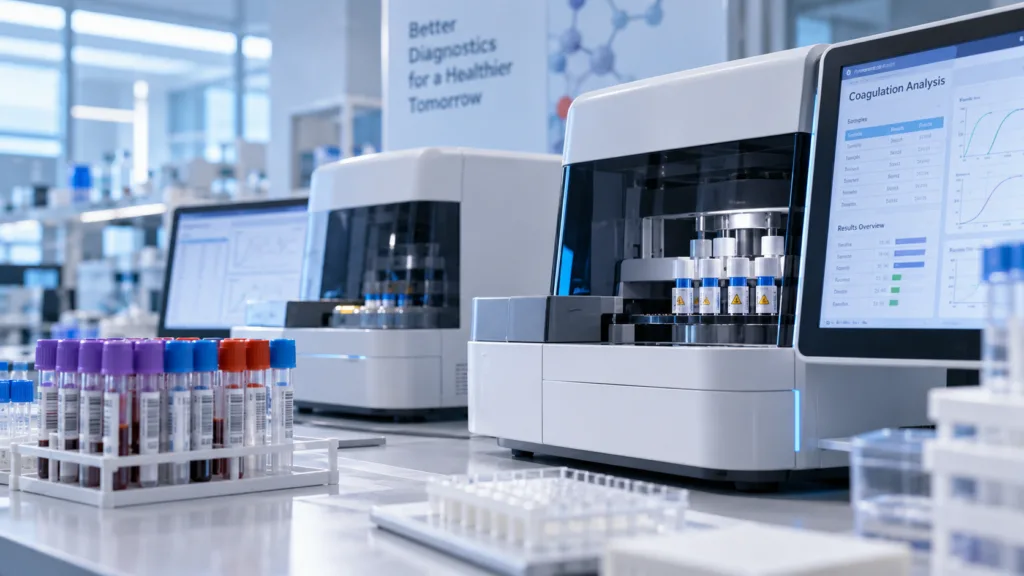
Siemens Healthineers has launched the CN-3000 and CN-6000 automated hemostasis testing systems for patient testing in the United States, expanding its laboratory diagnostics portfolio at a time when the company is under mounting pressure to improve the performance of its Diagnostics business. The systems target mid- and high-volume laboratories and consolidate routine and specialty coagulation testing on compact platforms designed to reduce manual intervention and standardize workflows across laboratory networks.
The CN-3000 and CN-6000 can perform clotting, chromogenic and immunoassay testing, while platelet aggregation functionality is available for research use only in the United States. Siemens Healthineers says the systems can integrate with track-based laboratory automation and its Atellica Data Manager, automate repeat and reflex testing, assess pre-analytical sample quality and provide as much as 13 hours of walkaway operation.
Those features may sound operational rather than transformative, but they address several of the largest pressures confronting clinical laboratories: shortages of skilled personnel, growing testing volumes, space constraints, standardization across hospital networks and the need to reduce manual errors. They also arrive while Siemens Healthineers is reconsidering the strategic structure of Diagnostics after a difficult quarter, making this launch more financially relevant than an ordinary analyzer update.
What do the CN-3000 and CN-6000 actually do for hospital laboratories?
Hemostasis laboratories test how blood forms and dissolves clots, supporting decisions in surgery, anticoagulation management, thrombosis and bleeding disorders. High-volume laboratories may process hundreds or thousands of samples daily, making throughput and automation important not only for cost control but also for the speed at which clinicians receive results.
Siemens Healthineers says its CN systems can run routine tests alongside more specialized coagulation assays without requiring separate instruments for every methodology. The company also says the platforms share reagents, consumables, workflows and interfaces across the product family, which can make it easier for hospital groups operating multiple laboratories to standardize their processes.
The systems are also substantially smaller than some competing platforms, according to Siemens Healthineers, with the company citing a footprint reduction of as much as 60%. The CN-6000 is designed for particularly high throughput, while company product information indicates output of up to 450 prothrombin-time tests per hour under specified conditions.
Laboratory footprint has real economic value. Every square meter occupied by an analyzer competes with other instruments, storage, sample preparation and staff workspace. Hospitals renovating laboratories or consolidating testing from multiple sites can therefore treat compact design as a capital-planning issue rather than a cosmetic feature.
Why does automation matter increasingly for diagnostic laboratories?
Clinical laboratories have been adopting automation partly because experienced technologists are difficult to recruit and retain in many markets. Systems capable of automatically identifying sample problems, triggering repeat testing and managing reagents can allow staff to spend less time on repetitive manual interventions.
The 13-hour walkaway claim is particularly relevant for overnight or low-staffing periods. It does not mean laboratories can operate entirely without personnel, but longer uninterrupted operation can reduce the frequency with which staff must reload consumables, intervene in routine workflows or manage basic analyzer tasks.
Standardization can also improve clinical consistency. A hospital network using the same reagents, interfaces and workflows across different sites can potentially reduce result variation and training complexity. That is important for large integrated health systems increasingly centralizing procurement and demanding vendor platforms that work across community hospitals, reference laboratories and major medical centers.
For Siemens Healthineers, those operational advantages also have a commercial benefit. Laboratory analyzers can generate recurring demand for assays, reagents and consumables long after the instrument is installed. Winning an analyzer placement therefore establishes an installed base from which the company can generate continuing revenue, making laboratory diagnostics economically closer to a platform-and-consumables business than a one-time equipment sale.
Why is this launch strategically important for Siemens Healthineers right now?
The timing is notable because Diagnostics has recently become the weakest part of the Siemens Healthineers portfolio. In the company’s third fiscal quarter of 2026, comparable Diagnostics revenue fell 5.5% and adjusted EBIT margin dropped to 4.1%. Siemens Healthineers subsequently lowered its overall full-year comparable revenue growth expectation to approximately 3.5% to 4.0%, citing pressures that included diagnostics weakness.
China has been an important factor. Volume-based procurement has pressured pricing and volumes for certain diagnostics products, while the company has simultaneously been navigating portfolio transitions. Those conditions contrast with stronger growth in Imaging and Precision Therapy, sharpening the question of whether Diagnostics belongs inside the same corporate structure over the longer term.
Siemens Healthineers has already indicated that Diagnostics will operate with greater strategic independence. Management has argued that the business has fewer synergies with Imaging and Precision Therapy than other parts of the portfolio, while laying out an ambition for Diagnostics to return to mid-single-digit growth over the 2027–2030 period.
Against that background, new product introductions matter because a turnaround cannot rely entirely on cost reduction or organizational restructuring. Siemens Healthineers needs fresh platforms capable of gaining laboratory placements and building recurring reagent revenue.
Can hemostasis materially change the Diagnostics growth profile?
One hemostasis product family will not solve the entire Diagnostics challenge. Siemens Healthineers operates across immunoassay, clinical chemistry, hematology, molecular diagnostics, point-of-care and other laboratory segments, meaning the division’s performance is driven by a much broader portfolio.
However, analyzer cycles can have long consequences. Hospitals may keep core laboratory platforms for many years, and switching suppliers can require validation, staff retraining, information-technology integration and changes to assay workflows. Winning a CN installation can therefore create a durable customer relationship.
The attractiveness increases if Siemens Healthineers can link CN systems to its wider automation ecosystem. Large laboratories increasingly prefer integrated tracks and middleware capable of managing samples across multiple diagnostic disciplines. An analyzer that can join that infrastructure is strategically more valuable than a standalone machine, because it helps the vendor compete for a larger portion of the laboratory’s testing volume.
The company’s approximately €23.4 billion of fiscal 2025 revenue also gives Siemens Healthineers the scale to support global service, reagent manufacturing and customer training. That support infrastructure is especially important in coagulation, where laboratories cannot tolerate significant downtime because results can influence emergency and surgical decisions.
What does current investor sentiment say about Siemens Healthineers?
Siemens Healthineers shares have been under pressure during 2026 as investors weigh diagnostics weakness against stronger imaging and cancer-care businesses. The stock closed at €38.23 on September 11, down 0.5% in that session, and remained well below its 52-week peak. Subsequent trading has been comparatively stable, suggesting investors are waiting for clearer evidence on both operating improvement and the eventual structure of Diagnostics.
That makes new laboratory product launches relevant but unlikely to produce immediate share-price reactions on their own. The larger question is whether they accumulate into improved organic growth, better margins and a stronger strategic position for Diagnostics, whether it remains inside Siemens Healthineers or eventually operates with greater independence.
Investors will therefore watch instrument placement trends, reagent revenue, China performance and margin recovery more closely than the number of individual analyzer announcements.
What should hospitals and investors watch next?
For laboratories, the test will be whether the CN-3000 and CN-6000 deliver the promised throughput and workflow savings in real clinical environments. Integration with existing automation, assay menu breadth, reagent reliability, service quality and total cost per reportable result will ultimately determine adoption.
For Siemens Healthineers, the more consequential issue is whether a new generation of laboratory systems can restore growth while management reshapes the Diagnostics operation. The United States is a particularly important market because large hospital networks can generate substantial recurring assay volumes once a platform is installed.
The CN launch therefore sits at the intersection of product innovation and corporate strategy. It is not merely another analyzer entering American laboratories. It is one of the products Siemens Healthineers needs to prove that its diagnostics franchise can become a stronger growth business again while the company decides exactly where that business belongs.