C2N Diagnostics has secured US Food and Drug Administration clearance for PrecivityAD2, an in vitro blood test designed to help identify Alzheimer’s disease-associated brain amyloid pathology in adults aged 40 and older who already have signs or symptoms of cognitive impairment, expanding regulated blood-based Alzheimer’s assessment into a substantially younger population than the first FDA-cleared plasma test introduced in 2025. The test is intended to supplement a clinical evaluation by healthcare professionals experienced in cognitive disorders and is neither a population-screening test nor a stand-alone Alzheimer’s diagnosis.
The August 20 clearance is important for more than the lower age threshold. PrecivityAD2 uses high-resolution mass spectrometry to quantify both amyloid-beta and tau-related biomarkers and combines two ratios through a proprietary algorithm, creating a different technical approach from the immunoassay-based blood test that first established an FDA-regulated pathway for Alzheimer’s blood biomarkers last year. C2N said the FDA-cleared version is expected to become available later in 2026, while its existing CLIA-validated laboratory version remains available in the meantime.
The regulatory development arrives as blood biomarkers move from an emerging diagnostic technology toward formal incorporation into Alzheimer’s care pathways. A 2025 Alzheimer’s Association clinical practice guideline concluded that sufficiently accurate blood-based biomarkers could serve either as triage tools or, at higher performance thresholds, substitutes for amyloid positron-emission tomography or cerebrospinal-fluid testing in appropriately evaluated patients within specialized care. The guideline simultaneously cautioned that test performance varies considerably between products and that blood biomarkers do not replace a comprehensive clinical evaluation.
What does PrecivityAD2 actually measure in a patient’s blood?
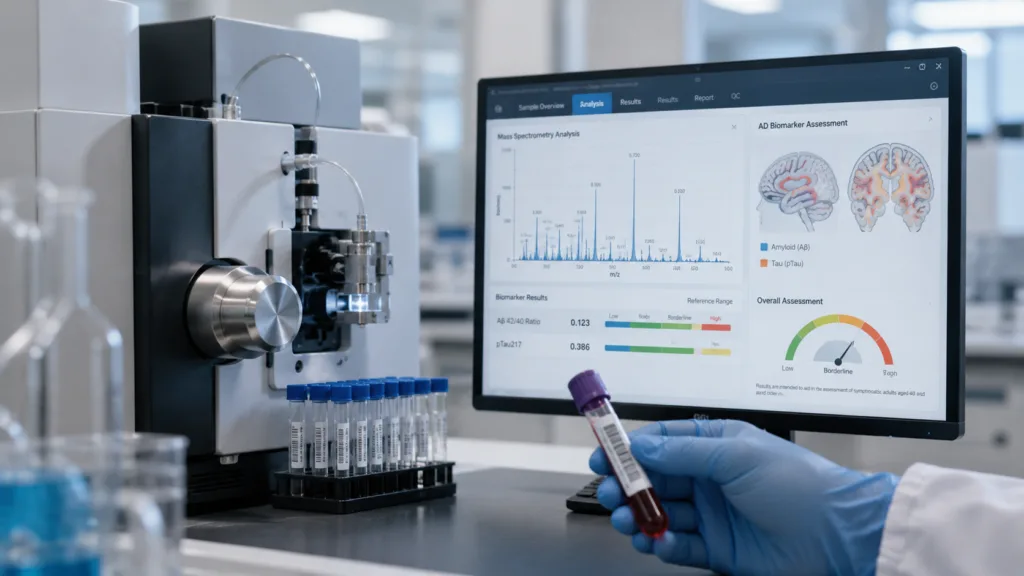
PrecivityAD2 measures plasma Aβ42 and Aβ40 to calculate the Aβ42/Aβ40 ratio and separately measures phosphorylated tau 217 relative to non-phosphorylated tau 217, expressed as %p-tau217. C2N’s algorithm then combines those measurements into an Amyloid Probability Score 2, or APS2, ranging from zero to 100 and intended to estimate the likelihood that amyloid pathology associated with Alzheimer’s disease is present.
The combination matters because Alzheimer’s disease biology is not represented by a single circulating protein. Amyloid-beta deposition and abnormal tau biology are central components of the disease process, and combining information from both pathways can potentially increase diagnostic discrimination compared with relying on an isolated biomarker.
The technical platform is also noteworthy. PrecivityAD2 uses liquid chromatography coupled with mass spectrometry rather than a conventional automated immunoassay. Mass spectrometry can provide highly specific measurement of peptide isoforms, but laboratory workflow, equipment requirements, assay standardization and scalability will influence how rapidly a mass-spectrometry test can be deployed compared with tests capable of running on large installed immunoassay platforms.
Earlier peer-reviewed validation of PrecivityAD2 found an area under the receiver-operating-characteristic curve of 0.94 for APS2 and 88% agreement with amyloid PET. The investigators also reported broadly similar diagnostic performance across age, sex, ethnicity and APOE4 status, providing important evidence before the larger validation dataset associated with the FDA-cleared configuration.
How strong were the clinical validation results submitted for the FDA-cleared test?
C2N reported a clinical validation study involving 1,142 people presenting with signs or symptoms of cognitive decline. Using dual decision thresholds, a PrecivityAD2 Positive result had a 97.6% positive predictive value for amyloid pathology, while a Negative result had a 93.1% negative predictive value when compared with reference testing based on amyloid PET visual interpretation or cerebrospinal-fluid biomarkers.
Those figures require careful interpretation. Positive predictive value describes the probability that someone with a positive result actually has the reference-standard finding in the population studied, while negative predictive value describes the probability that someone with a negative result lacks it. Neither statistic is identical to sensitivity or specificity, and predictive values can change as the underlying prevalence of amyloid pathology changes between patient populations.
PrecivityAD2 also produces an intermediate category. C2N said 17.3% of study participants received a Likely Positive result, which had a positive predictive value of 77.3%. That result is clinically relevant because it illustrates why a multi-threshold test does not simply produce a binary answer for every patient. Some people will remain in a zone where additional diagnostic information, potentially including PET, cerebrospinal-fluid testing or other clinical assessment, may still be appropriate.
C2N additionally reported that performance remained consistent as age increased and across 12 prespecified chronic conditions common in older populations, including chronic kidney disease, diabetes, obesity, hypertension, heart failure and previous cancer. Comorbidity performance is particularly important for blood biomarkers because renal function, body composition and systemic disease can alter circulating protein concentrations and potentially complicate interpretation.
Why does the age-40 indication matter if Alzheimer’s disease is predominantly associated with older adults?
FDA’s first cleared blood-based in vitro diagnostic for aiding Alzheimer’s assessment, Fujirebio Diagnostics’ Lumipulse G pTau217/β-Amyloid 1-42 Plasma Ratio, was authorized in May 2025 for adults aged 55 and older who showed signs and symptoms of the disease. PrecivityAD2 extends the regulated testing population downward to symptomatic adults from age 40, creating a pathway for evaluating younger patients whose cognitive symptoms warrant investigation.
That does not mean routine Alzheimer’s blood testing should begin at age 40. PrecivityAD2 is specifically not intended for asymptomatic population screening. Cognitive impairment in younger adults has numerous possible causes, including neurological, psychiatric, metabolic, sleep-related, medication-related and other conditions, so detection of an Alzheimer’s-associated biomarker still needs to be interpreted within a much broader clinical assessment.
The younger indication could nevertheless be important for patients with early-onset cognitive symptoms or a clinical presentation where Alzheimer’s disease is part of the differential diagnosis. PET imaging is expensive and geographically constrained, while lumbar puncture for cerebrospinal-fluid biomarkers is invasive and may be difficult to scale across large patient populations.
A reliable blood test can therefore change the sequence of diagnostic investigation even if it does not eliminate imaging or cerebrospinal-fluid testing in every case. A clearly negative result in an appropriate patient could reduce the likelihood that amyloid pathology is driving symptoms, while a strongly positive result may allow clinicians to progress more efficiently toward disease staging and treatment decisions.
Could blood biomarkers become more important as Alzheimer’s treatments become more pathology-specific?
The clinical value of identifying amyloid pathology has increased as disease-modifying therapies directed against amyloid have entered clinical use. When treatment eligibility depends partly on confirming underlying Alzheimer’s pathology, the diagnostic bottleneck becomes commercially and clinically more consequential.
That change is reflected in emerging professional guidance. The Alzheimer’s Association guideline said blood biomarker tests reaching at least 90% sensitivity and 75% specificity could be used to triage patients in specialized care, while tests reaching at least 90% sensitivity and specificity could potentially substitute for PET or cerebrospinal-fluid testing in the relevant diagnostic population. The recommendations are explicitly performance-based rather than brand-specific.
PrecivityAD2’s FDA clearance does not by itself establish that every patient can avoid PET or lumbar puncture. The test’s own labeling requires interpretation alongside clinical assessment, while intermediate or discordant findings may still require additional investigation.
Another practical issue is whether laboratories can deliver results quickly and consistently enough to alter the diagnostic journey. C2N’s reliance on high-resolution mass spectrometry provides analytical differentiation but also makes laboratory scale, specimen logistics and reimbursement important components of adoption.
The company already has experience operating Precivity assays through a central clinical laboratory, which should make the transition from a laboratory-developed service to an FDA-cleared configuration less abrupt than launching an entirely new assay. The more substantial question is whether FDA clearance accelerates adoption beyond specialist centers and produces broader payer confidence.
What changes now for C2N Diagnostics and the Alzheimer’s diagnostics market?
The Alzheimer’s blood-test market has moved rapidly from experimental biomarker research toward regulated commercial competition. Fujirebio Diagnostics established the first FDA-cleared blood-based test in May 2025, while multiple diagnostics companies and large laboratory platforms are developing or commercializing p-tau217 and other blood biomarker approaches.
PrecivityAD2 adds a clinically differentiated proposition by combining amyloid and tau ratios using high-resolution mass spectrometry and extending use to symptomatic adults beginning at age 40. That combination creates a potentially broad diagnostic role without turning the product into a screening tool for healthy adults.
Competition is likely to revolve around more than analytical accuracy. Laboratories and health systems will compare turnaround time, sample requirements, indeterminate-result rates, instrumentation, reimbursement, ordering complexity and how well each test integrates into established memory-care pathways.
The FDA clearance therefore represents an important milestone rather than the endpoint of the commercial contest. PrecivityAD2 has now crossed from a widely used laboratory-developed Alzheimer’s blood test into an FDA-cleared in vitro diagnostic, and its 1,142-subject validation dataset provides a substantial foundation for adoption.
The larger clinical test comes next: whether access to high-performing blood biomarkers can shorten the frequently fragmented route from cognitive symptoms to a reliable diagnosis without encouraging indiscriminate testing or replacing the clinical judgment that Alzheimer’s disease assessment still requires.