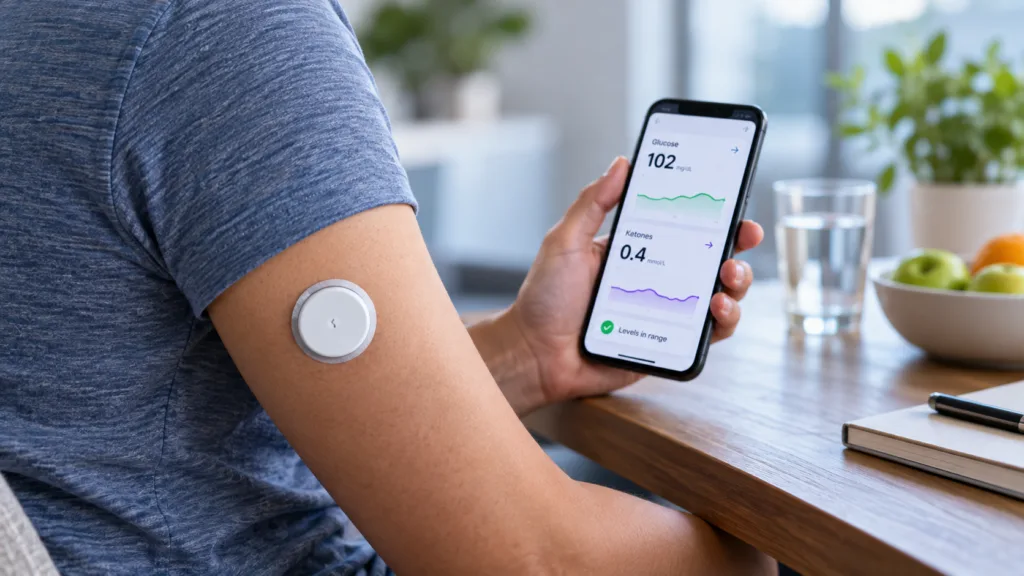
Abbott has received United States Food and Drug Administration authorization for Libre Duo 10 Day, creating what the company describes as the world’s first dual glucose-and-ketone continuous sensing system and adding a new clinical dimension to the rapidly expanding continuous glucose monitoring market. The De Novo authorization establishes a new integrated continuous glucose and ketone monitoring category, with Abbott planning a United States launch later in 2026.
Libre Duo simultaneously provides the glucose information used for day-to-day diabetes management while measuring rising ketones in the background. The purpose is not simply to generate another metabolic metric. Elevated ketones can signal the development of diabetic ketoacidosis, a potentially life-threatening complication that may progress within hours and can sometimes develop even when glucose levels do not appear dramatically abnormal.
The device therefore pushes continuous sensing beyond conventional glucose optimization. Abbott is effectively attempting to transform its wearable from a tool that tells patients how their diabetes is behaving into an earlier-warning platform for one of the disease’s most dangerous acute complications.
Why can ketone monitoring add something that conventional continuous glucose monitoring cannot?
Continuous glucose monitors have transformed diabetes treatment by providing near-continuous information about glucose direction and trends. They allow patients and automated insulin-delivery systems to respond to rising or falling glucose without relying solely on periodic fingerstick measurements.
Ketones describe a different physiological process. When the body lacks enough effective insulin, it begins breaking down fat and generating ketone bodies. Those ketones can accumulate until blood becomes dangerously acidic, producing diabetic ketoacidosis.
High glucose commonly accompanies DKA, but glucose alone does not identify every case. Abbott notes that ketones can rise even when glucose appears relatively stable, which is particularly relevant as some modern diabetes therapies and clinical circumstances can produce atypical presentations. Libre Duo is designed to alert users when ketones reach elevated levels while continuing to provide glucose data.
The practical problem is that current guidance may ask patients to check ketones during illness or sustained hyperglycemia, but many people do not routinely have a blood-ketone meter available. A continuously worn sensor removes the requirement to decide when testing is necessary before obtaining information.
How large is Abbott’s advantage from the existing Libre installed base?
Abbott says its Libre platform is already used by more than eight million people in more than 60 countries. That installed base gives the company a distribution advantage that most new diabetes-device developers would find difficult to replicate because clinicians, pharmacies, insurers and patients already understand the Libre ecosystem.
The commercial model is attractive because sensors must be replaced repeatedly. Unlike durable medical equipment purchased only every several years, continuous glucose monitoring generates recurring consumables revenue as long as patients remain on the platform.
Adding ketone sensing could strengthen that recurring model by giving higher-risk users a reason to choose a premium or differentiated Libre sensor rather than a conventional CGM. Abbott has also designed Libre Duo for compatibility with leading automated insulin-delivery systems, potentially keeping the product inside the increasingly integrated ecosystem connecting sensors, algorithms and insulin pumps.
That integration matters because diabetes technology is steadily moving toward closed-loop systems. The sensor that supplies the data becomes strategically important when insulin delivery, alerts and treatment decisions depend on continuous input.
Who is most likely to benefit from continuous ketone sensing?
The clearest population is people at meaningful risk of diabetic ketoacidosis, particularly insulin-dependent patients. DKA is most strongly associated with type 1 diabetes but can occur in other circumstances, including insulin deficiency, severe illness and selected medication-related situations.
Abbott cited evidence that DKA hospital admissions have increased 55% over the past decade, highlighting both the clinical burden and the economic opportunity for technologies capable of preventing emergency care.
The addressable population will depend on how physicians, payers and professional societies interpret the value of continuous ketone information. Not every person using a glucose sensor necessarily needs continuous ketone monitoring, and reimbursement will be easier to justify in populations where avoiding DKA admissions produces a clear health-economic benefit.
That creates a potentially useful tiering strategy. Abbott can maintain conventional Libre sensors for broad glucose management while positioning Libre Duo for patients whose risk profile justifies additional monitoring.
What limitations should clinicians remember with Libre Duo?
FDA authorization does not mean the device eliminates the risk of diabetic ketoacidosis. Abbott’s own safety information states that urgent alerts may not identify every severe glucose or ketone event, and ketone readings should be interpreted together with glucose information and symptoms. Patients must still seek medical care when clinically appropriate.
A 10-day wear period also means users will need frequent sensor replacement. Adherence therefore remains relevant even though monitoring itself is automatic once the device is applied.
False-positive or borderline ketone alerts could create another implementation issue if patients or clinicians respond with unnecessary emergency evaluations. Conversely, missing clinically meaningful rises would undermine the central safety proposition. Real-world studies will therefore be important in determining how alert thresholds perform outside controlled validation environments.
The most valuable outcome would not simply be detecting more episodes of elevated ketones. It would be demonstrating fewer DKA hospitalizations, earlier intervention and lower emergency-care utilization.
Why does Libre Duo matter financially to Abbott?
Abbott’s Medical Devices business grew 8.4% on a comparable basis in the second quarter of 2026, while Diabetes Care delivered 9.5% comparable growth. Continuous glucose monitoring remains one of the company’s important recurring-growth businesses, making product differentiation particularly valuable as competition intensifies.
The broader company reported 13% second-quarter sales growth on a reported basis and raised adjusted earnings guidance while maintaining comparable sales-growth expectations of 6.5% to 7.5%. That gives Abbott the financial capacity to continue investing across glucose sensing, cardiovascular devices and diagnostics.
Abbott shares closed around $102.23 on September 17 after slipping approximately 0.1% during the session. The stock reaction around Libre Duo has been relatively muted, which is understandable because the device is entering an already large diversified company and has not yet generated United States commercial revenue.
The strategic value could emerge over time if dual sensing increases Libre adoption or raises revenue per user.
Could continuous multi-analyte sensing become bigger than diabetes?
Libre Duo also points toward a broader wearable trend. Once companies demonstrate reliable continuous sensing of more than one biomarker, the long-term question becomes which additional physiological signals can be measured accurately through small wearable devices.
Abbott has already expanded consumer-facing glucose sensing beyond conventional insulin-treated diabetes, while its August partnership with Google was designed to investigate how glucose patterns relate to sleep, physical activity and other daily behaviors.
The danger is assuming every measurable biomarker creates a useful product. Continuous information generates value only when patients or clinicians can act on it. Ketones have a particularly clear use case because rising levels can precede a serious acute emergency.
That makes Libre Duo more than an incremental CGM specification upgrade. Abbott is testing whether the same wearable platform that transformed everyday glucose management can also function as an early-warning system for diabetic ketoacidosis.
If real-world evidence eventually shows fewer emergency visits and hospital admissions, the commercial argument may extend beyond convenience into measurable healthcare savings.