Alentis Therapeutics, a privately held biotechnology company headquartered in Basel, Switzerland, and South Korea’s PinotBio announced on October 14, 2026, that they have entered a research collaboration and licensing agreement to discover and develop new antibody-drug conjugates targeting claudin-1. The agreement combines Alentis’ proprietary antibody portfolio with PinotBio’s PINOT-ADC platform, which includes novel cytotoxic payloads and linker technologies intended to influence drug delivery, tumor-cell killing and treatment tolerability.
Under the agreement, Alentis will receive an exclusive option to license selected PinotBio linkers and payloads for use in future development candidates. PinotBio will receive an upfront payment, while additional development, regulatory and commercial milestones and royalties may become payable for individual ADC programmes selected by Alentis. The companies have not disclosed the upfront amount, maximum potential consideration, royalty percentages or the number of future candidates expected to emerge from the collaboration.
The agreement expands an existing research relationship during which the companies evaluated dozens of ADC constructs. It also follows Alentis’ progress with two claudin-1-targeting oncology candidates, ALE.P02 and ALE.P03, both of which are undergoing Phase 1/2 clinical development. The existing candidates use different classes of cytotoxic payload, providing a foundation for investigating whether additional payload and linker designs could improve activity in cancers that remain difficult to treat.
The collaboration is important because successful antibody-drug conjugate development depends on more than choosing a tumor-associated antigen. Developers must balance antibody binding, cellular uptake, controlled payload release, tumor penetration and toxicity in healthy tissues. Alentis and PinotBio are seeking to optimize those characteristics, but their latest agreement is a research and licensing milestone rather than evidence that a new treatment has already demonstrated clinical benefit.
Why are Alentis and PinotBio developing new ADCs targeting claudin-1?
Claudin-1 is a protein associated with tight junctions, structures that help regulate how adjacent cells interact and form barriers within epithelial tissues. Changes in claudin-1 expression and localization have been observed in several cancers. Alentis describes increased expression across more than ten tumor types, creating a potential opportunity for therapies designed to recognize the protein on malignant cells.
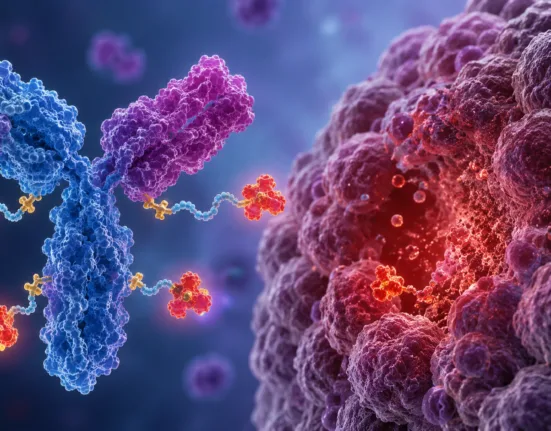
The company’s oncology approach uses antibodies that bind accessible claudin-1 and deliver cytotoxic drugs directly to targeted tissue. An antibody-drug conjugate typically combines a tumor-binding antibody, a chemical linker and a potent drug payload. Following target recognition and cellular uptake, the construct is intended to release its cytotoxic component in a way that damages malignant cells.
The biological challenge is that claudin-1 is not exclusive to cancer. It is also expressed in normal epithelial tissues, where it performs important barrier functions. The accessibility of the protein, its expression level and the organization of tight junctions may influence whether an antibody can distinguish a tumor from healthy tissue.
Alentis’ research has focused on antibodies recognizing exposed claudin-1, a characteristic the company believes can support selective targeting. However, the presence of claudin-1 on a tumor does not automatically predict sensitivity to an ADC. Clinical development must establish the relationship between target expression, treatment response and adverse effects.
The latest partnership broadens the chemistry available for investigating this relationship. By pairing Alentis’ antibodies with additional linker and payload configurations, the companies may identify constructs with different pharmacological characteristics. Whether those changes produce clinically meaningful advantages remains a question for future testing.
How does PinotBio’s PINOT-ADC platform attempt to address drug resistance?
PinotBio’s technology includes novel cytotoxic payloads and tandem-cleavable linker designs intended to control how active drugs are released from ADCs. A linker must remain sufficiently stable during circulation while allowing the payload to become available after the conjugate reaches its intended biological environment. This balance can influence both the effectiveness of tumor targeting and exposure of healthy tissues to the cytotoxic drug.
Premature payload release may increase systemic exposure and treatment-related toxicity. Conversely, a construct that does not release sufficient active drug after reaching tumor cells may produce limited antitumor activity. Linker design is therefore a major component of ADC pharmacology rather than merely a manufacturing detail.
PinotBio believes its platform can help address limitations involving resistance, inadequate responses and tolerability. The company has developed multiple payload-linker configurations that may allow partners to investigate alternative mechanisms of tumor-cell killing. However, those potential advantages must be demonstrated for each finished antibody-drug conjugate.
The relationship between payload design and resistance is particularly important. Cancer cells can become less sensitive to a particular cytotoxic mechanism through changes involving drug transport, intracellular signaling or cellular repair processes. Using a different payload may help in some circumstances, but resistance can involve multiple mechanisms that a new linker or drug class may not overcome.
Alentis and PinotBio have not announced a clinical study comparing the new constructs with existing ADCs. Their initial work will determine which molecular combinations warrant further development. The commercial value of the platform will depend on whether those candidates progress beyond laboratory testing and demonstrate acceptable activity and safety in humans.
What is the difference between Alentis’ ALE.P02 and ALE.P03 clinical programmes?
Alentis is already developing two claudin-1-targeting ADCs that use different cytotoxic payload classes. ALE.P02 carries a tubulin inhibitor payload, which is intended to interfere with the microtubule machinery required for cell division. ALE.P03 uses a topoisomerase I inhibitor payload, designed to disrupt biological processes involved in DNA replication and repair.
These differences create an opportunity to evaluate how the same tumor-associated target performs when combined with distinct mechanisms of cellular injury. In principle, one payload may be more effective in certain biological settings than another. However, differences in laboratory activity do not establish that either candidate will have superior clinical efficacy or a more favorable safety profile.
ALE.P02 is being evaluated in a first-in-human Phase 1/2 trial registered as NCT06747585. The study is designed to enroll approximately 170 adults with selected advanced or metastatic claudin-1-positive squamous solid tumors. Its target populations include squamous non-small cell lung cancer and squamous cancers of the head and neck, esophagus and cervix.
The investigation includes dose escalation and expansion stages intended to evaluate safety, pharmacokinetics, preliminary antitumor activity and the recommended Phase 2 dose. It is an open-label study without a randomized treatment comparator. Any early tumor responses would therefore support further investigation but would not establish superiority over existing treatment options.
ALE.P03 is undergoing a separate Phase 1/2 clinical programme, NCT07169734, involving patients with selected advanced or metastatic claudin-1-positive solid tumors. Its different payload creates an opportunity to investigate another treatment approach within the same molecular target family. The companies have not disclosed mature comparative clinical outcomes establishing which candidate performs better.
What does FDA Fast Track designation mean for ALE.P02?
The FDA has granted Fast Track designation to ALE.P02 for advanced or metastatic claudin-1-expressing squamous cancers regardless of the organ in which the malignancy originated. This is a notable feature because many oncology development programmes focus on individual tumor types. A molecularly defined approach may eventually support investigation across cancers sharing relevant biological characteristics.
Fast Track designation can provide opportunities for more frequent interaction with the FDA and other regulatory development mechanisms when applicable requirements are satisfied. However, it does not establish that the drug is effective, authorize commercial sale or guarantee eventual approval. The investigational programme must still generate adequate clinical evidence.
The designation is specific to ALE.P02 and its defined development setting. It should not automatically be attributed to ALE.P03 or to future ADCs emerging from the PinotBio collaboration. Each investigational product has its own regulatory status and evidence requirements.
The potential breadth of the claudin-1 target also creates a clinical development challenge. Squamous tumors originating in the lung, head and neck, cervix and esophagus differ in disease biology, previous treatment exposure and prognosis. Demonstrating activity across several cancer types may be useful, but regulatory conclusions would depend on the strength and consistency of the evidence.
Alentis will also need to establish whether a defined level or pattern of claudin-1 expression predicts response. A reliable patient-selection strategy could help future clinical trials, but the target must be supported by analytical and clinical validation. Fast Track designation does not resolve these questions.
How does the new PinotBio agreement relate to Alentis’ $355 million CSL partnership?
The PinotBio announcement follows a major transaction involving Alentis’ separate therapeutic programme. On October 5, 2026, Alentis and CSL Limited (ASX: CSL) announced a global agreement to co-develop and co-promote lixudebart, an investigational claudin-1-targeting antibody being studied in rare kidney and liver diseases. CSL agreed to make an initial payment of $355 million, with Alentis eligible for up to another $1.2 billion in commercial milestones.
The agreement also includes CSL funding for specified future clinical development programmes. Following commercialization, global profits are intended to be shared, with CSL receiving 55% and Alentis retaining 45%. These terms apply to lixudebart and should not be transferred to the new PinotBio arrangement.
Lixudebart differs from Alentis’ ADC candidates because it is an antibody being developed for inflammatory and fibrotic conditions rather than a cytotoxic cancer treatment. Its current development includes the Phase 2 RENAL study in ANCA-associated vasculitis with rapidly progressive glomerulonephritis. The programme uses claudin-1 biology for a different therapeutic objective.
The CSL transaction provides an important strategic context for Alentis because it places a substantial financial value on one part of the company’s claudin-1 research portfolio. However, the October PinotBio agreement has undisclosed economics and cannot be described as another billion-dollar partnership. Its potential value remains dependent on future candidate selection and development milestones.
Alentis’ broader strategy is increasingly based on developing claudin-1-directed medicines for different diseases and mechanisms. The CSL arrangement concerns non-oncology development, while the PinotBio collaboration expands its capacity to investigate cancer-directed ADCs. Their shared molecular target does not mean that success in one therapeutic area establishes efficacy in another.
What existing programmes demonstrate PinotBio’s ADC development experience?
PinotBio was founded in 2017 and operates as a South Korean biotechnology developer specializing in antibody-drug conjugate technologies. Its PINOT-ADC platform combines proprietary payloads and linker configurations intended to improve the characteristics of targeted cytotoxic medicines. The company is supported by institutional investors including KB Investment and IMM Investment.
Several existing development programmes incorporate PinotBio technology. These include CT-P70, CT-P71 and CT-P73 through a partnership with Celltrion, alongside PBX-004, which PinotBio identifies as an unpartnered programme. The company states that the three partnered programmes have received FDA Fast Track designation.
These programmes demonstrate that PinotBio’s technology is being used beyond a single research collaboration. However, the announcement does not establish that the platform has produced an approved medicine or demonstrated superiority over established ADCs. Fast Track designations and clinical development progress remain separate from successful marketing authorization.
The Alentis collaboration offers PinotBio access to an antibody portfolio built around a target that is already being investigated in human oncology trials. This may reduce some early uncertainty associated with selecting a tumor target, but the resulting ADCs must still undergo product-specific evaluation. Even an established target can behave differently when combined with a new payload or linker.
For PinotBio, future milestone and royalty payments could create a longer-term revenue opportunity if Alentis selects candidates and advances them successfully. Yet the agreement does not guarantee that any particular number of molecules will be licensed or commercialized.
What safety risks must the next generation of claudin-1 ADCs address?
ADCs can produce adverse events through several mechanisms, including exposure to the cytotoxic payload, antibody-related effects and interactions with tissues expressing the target antigen. The safety profile depends on the complete molecular construct rather than on a single component. Changing the linker or payload can alter pharmacokinetics, tumor exposure and toxicity.
Tubulin inhibitor payloads can be associated with effects on rapidly dividing cells and, depending on the molecule, neurological or hematological toxicity. Topoisomerase I inhibitor ADCs may produce gastrointestinal, hematological and other adverse events, with interstitial lung disease being an important concern for certain products in the broader class. These are general development considerations rather than adverse events already demonstrated with the new Alentis and PinotBio constructs.
Normal tissue expression of claudin-1 introduces another consideration. If an ADC binds accessible protein outside malignant tissue, there may be a risk of drug delivery to unintended cells. Investigators must therefore evaluate where the antibody accumulates and whether tumor selectivity is maintained across clinically relevant doses.
The partnership’s stated emphasis on linkers and payloads suggests that safety optimization is part of the development strategy. However, improved laboratory stability or different tumor-cell activity would not independently establish greater patient tolerability. That conclusion would require a complete preclinical package followed by carefully monitored human studies.
Dose escalation, pharmacokinetic sampling and analysis of treatment-related adverse events will therefore be essential once specific candidates reach clinical development. The companies have not announced a start date for a trial of a new ADC emerging from this agreement.
What must happen before the collaboration produces a new clinical-stage medicine?
The first milestone will be the identification of promising antibody, linker and payload combinations. The companies have already tested dozens of constructs during their earlier collaboration, providing a starting point for further optimization. The new agreement creates a framework for licensing selected technologies, but it does not identify a nominated development candidate.
Candidate selection will depend on biological activity, tumor-cell uptake, drug release characteristics and safety-related findings. Manufacturing feasibility will also matter because an ADC must maintain defined structural and chemical characteristics across production batches. A promising laboratory construct may be unsuitable for clinical development if it cannot be manufactured consistently.
The next stage would involve the studies needed to support an investigational drug application and initial human testing. Those activities could include toxicology, pharmacokinetics, manufacturing controls and additional assessment of claudin-1 expression. None of the new compounds has yet been reported as entering such a programme under the expanded collaboration.
Alentis’ existing ALE.P02 and ALE.P03 trials will provide an important clinical backdrop. Their results may help clarify how different payload classes perform when directed toward claudin-1-positive tumors. However, the partners cannot assume that findings from those molecules will transfer directly to new designs.
The October agreement strengthens Alentis’ ability to investigate additional ADC approaches while offering PinotBio potential licensing income from its platform. Its most important unanswered question is whether new linker and payload combinations can deliver measurable improvement in antitumor activity or tolerability beyond existing candidates. That question will only be answered as specific molecules progress through selection, preclinical validation and, ultimately, appropriately designed clinical trials.