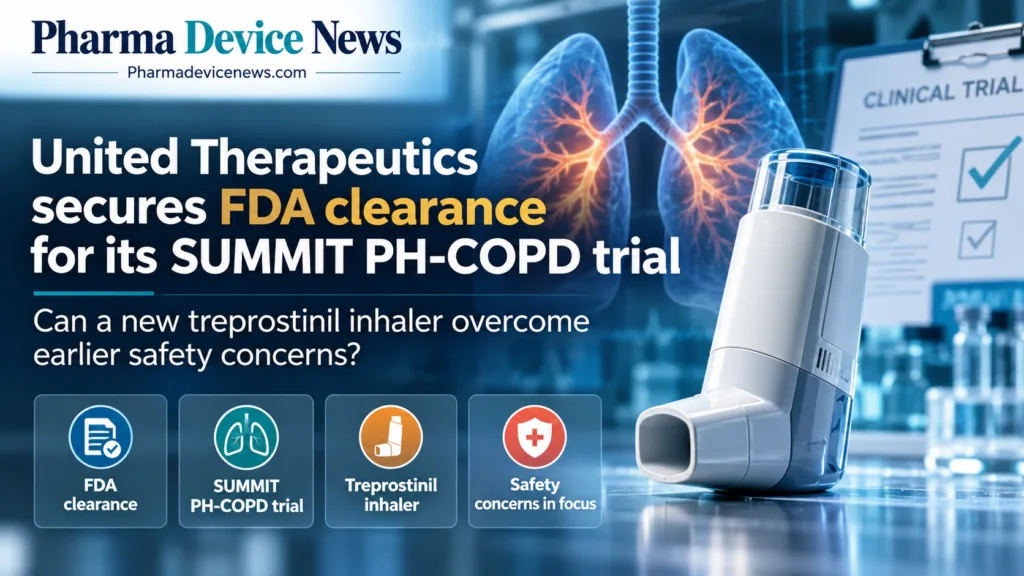
United Therapeutics Corporation (NASDAQ: UTHR) announced on October 19, 2026, that the United States Food and Drug Administration had cleared its investigational new drug application to proceed with the Phase 2 SUMMIT clinical trial of treprostinil delivered through a soft mist inhaler. The study will investigate the safety and tolerability of the investigational formulation in patients with pulmonary hypertension associated with chronic obstructive pulmonary disease, an indication for which no therapy is currently specifically approved in the United States. The regulatory clearance permits clinical investigation but does not establish that treprostinil SMI is effective or safe for this patient population.
The planned study represents an important expansion of United Therapeutics’ inhaled treprostinil development strategy into a respiratory population with substantial unmet clinical needs. However, the company’s ambitions must be assessed against earlier evidence showing that inhaled treprostinil can present significant risks in patients with pulmonary hypertension associated with COPD. The principal question is whether a different inhalation system, careful patient selection and an appropriate dosing strategy can produce an acceptable benefit-risk profile.
United Therapeutics believes that a soft mist inhaler could offer advantages for patients who may struggle with coughing, airway irritation or bronchospasm associated with inhaled therapies. Its proposed delivery system is designed to administer a preserved treprostinil solution in a single breath, potentially simplifying individual administrations. Whether that design produces measurable improvements in tolerability, exercise capacity or other clinical outcomes must be established through controlled investigation.
How will the SUMMIT Phase 2 trial evaluate treprostinil SMI in patients with PH-COPD?
The SUMMIT trial is designed as a 16-week, double-blind Phase 2 study involving approximately 40 patients with pulmonary hypertension associated with COPD. According to United Therapeutics, the principal objectives are to evaluate safety and tolerability, while secondary endpoints will examine exercise capacity and levels of N-terminal pro-B-type natriuretic peptide, commonly known as NT-proBNP. Eligible participants will also have the opportunity to enter an open-label extension intended to provide additional information about longer-term treatment.
The emphasis on safety reflects the physiological complexity of pulmonary hypertension occurring alongside chronic obstructive pulmonary disease. Patients may experience limitations arising from damaged airways, impaired gas exchange, elevated pulmonary vascular resistance and strain on the right side of the heart. A treatment capable of relaxing pulmonary blood vessels could theoretically reduce part of that burden, but changes in pulmonary circulation can also affect the relationship between ventilation and blood flow within diseased lungs.
The choice of exercise capacity as a secondary outcome is clinically relevant because breathlessness and reduced physical endurance are major consequences of advanced cardiopulmonary disease. However, improvements in exercise performance can be difficult to interpret when patients have multiple contributors to functional impairment. A small Phase 2 study is consequently better suited to establishing whether further development is justified than to demonstrating definitive clinical benefit across the wider PH-COPD population.
NT-proBNP provides another perspective because it is associated with cardiac wall stress and can help characterise the burden of cardiovascular dysfunction. A reduction could support a favourable physiological signal, particularly if accompanied by improvements in functional measurements. Nevertheless, changes in this biomarker alone would not establish that the investigational therapy reduces hospitalisations, improves survival or alters long-term disease progression.
United Therapeutics expects to initiate a subsequent Phase 3 registration study in 2028, provided the SUMMIT programme generates sufficiently encouraging findings. That timeline remains a management expectation rather than a confirmed regulatory milestone. The eventual design, size and endpoints of a registration-directed study would depend partly on what investigators learn about safety, dose tolerability and patient characteristics during Phase 2.
Why does the earlier PERFECT trial make safety central to the treprostinil PH-COPD programme?
The central scientific challenge for United Therapeutics is that inhaled treprostinil has already been evaluated in patients with pulmonary hypertension associated with COPD, with unfavourable results. The previously conducted PERFECT study investigated inhaled treprostinil in a multicentre, randomised, double-blind, placebo-controlled programme involving 76 randomised patients. Its findings, published in the European Respiratory Journal in 2024, are particularly relevant to interpreting the new SUMMIT development.
The PERFECT study was stopped early following a recommendation from its data and safety monitoring committee. Investigators reported that the accumulated evidence indicated an increased risk of serious adverse events among participants receiving inhaled treprostinil, alongside suggestive evidence of increased mortality risk. Exercise performance, assessed using six-minute walking distance, was also numerically worse during treprostinil exposure than during placebo exposure.
The published investigators concluded that the observed benefit-risk profile did not support continued development of the inhaled treprostinil regimen evaluated in that study for PH-COPD. Those findings do not automatically determine the outcome of SUMMIT because the new programme involves a different drug-delivery formulation and may apply different patient-selection criteria. Nevertheless, they establish a substantial evidentiary challenge that a new inhalation device cannot resolve without supporting clinical data.
United Therapeutics has indicated that SUMMIT will investigate a carefully defined patient population, suggesting that eligibility criteria could be important to the programme’s development rationale. Detailed information about the exact differences between the proposed population and that of PERFECT will be essential for evaluating whether the company is addressing previously identified vulnerabilities. The safety assessment will also need to distinguish adverse events related to airway administration from complications potentially associated with the drug’s systemic or pulmonary vascular effects.
The earlier findings make a convincing safety profile more consequential than convenience-related advantages alone. A soft mist inhaler might influence drug deposition, administration characteristics or local airway tolerance, but there is no established basis to conclude that it eliminates risks associated with prostacyclin-mediated vasodilation. Investigators will therefore need to examine respiratory deterioration, oxygenation, haemodynamic effects and serious adverse events alongside routine tolerability measurements.
Can a soft mist inhaler improve treprostinil delivery for patients with chronic obstructive pulmonary disease?
The new treprostinil SMI formulation is being developed as a portable, handheld inhaler capable of delivering medication through a single breath. United Therapeutics intends to make different dose strengths available during clinical investigation to support individualised titration and maintenance treatment, with administration scheduled four times daily. Each single-load cartridge is designed to support up to two weeks of use, while room-temperature storage could simplify product handling.
These features could have practical significance for patients with COPD, whose inhalation capacity and respiratory comfort may vary considerably. Conventional inhaled products can require particular breathing manoeuvres, and patients with advanced airflow limitation may find some delivery techniques more challenging than others. A device that reduces administration complexity could therefore improve treatment usability, although SUMMIT must establish whether the proposed system provides acceptable performance in its intended population.
Administration frequency remains an important consideration. Four daily dosing sessions require consistent adherence, especially in patients already using maintenance inhalers, rescue medication or supplemental oxygen. The potential convenience of a single-breath delivery system must consequently be assessed alongside the overall treatment burden, including dose titration, monitoring and the management of any respiratory side effects.
United Therapeutics already markets treprostinil through its Tyvaso inhalation solution and Tyvaso DPI inhalation powder products. Those formulations are approved for specified pulmonary arterial hypertension and pulmonary hypertension associated with interstitial lung disease indications, rather than PH-COPD. Experience with established products may provide useful operational and pharmacological knowledge, but approval in one pulmonary hypertension population does not establish efficacy or an acceptable benefit-risk profile in another.
The distinction is particularly relevant because pulmonary hypertension associated with chronic obstructive pulmonary disease involves different underlying lung pathology from pulmonary arterial hypertension. Even within World Health Organization Group 3 pulmonary hypertension, patients with interstitial lung disease and those with COPD may respond differently to treatment. Successful development of treprostinil SMI would therefore require indication-specific evidence rather than reliance on existing treprostinil approvals.
How large is the commercial opportunity for treprostinil SMI in pulmonary hypertension associated with COPD?
United Therapeutics estimates that approximately 400,000 to 800,000 people in the United States are living with pulmonary hypertension associated with COPD. Management has presented this population as substantially larger than the combined populations addressed by its currently approved therapies. The estimate illustrates why the company considers PH-COPD a potentially important expansion opportunity, although it should not be interpreted as the number of patients who would qualify for treatment.
The commercially accessible population would depend on disease severity, diagnostic confirmation, treatment eligibility, contraindications and the eventual approved indication. Pulmonary hypertension can be difficult to identify in patients with COPD because worsening breathlessness, fatigue and exercise intolerance may be attributed to underlying lung disease. Confirmatory haemodynamic assessment is not routinely recommended for every stable COPD patient, which creates an additional challenge for developing practical identification and referral pathways.
The relevance of the programme to United Therapeutics’ existing business is reinforced by its established treprostinil franchise. In the second quarter of 2026, the company recorded approximately $452.6 million in combined Tyvaso product revenue, compared with $469.6 million a year earlier. The decline reflected lower nebulised Tyvaso sales, partly offset by growth in Tyvaso DPI, demonstrating both the scale of the company’s inhaled treprostinil business and the commercial importance of its delivery platforms.
A successful PH-COPD programme could eventually create an additional indication-driven growth opportunity. However, the size of that opportunity cannot be calculated simply by applying current product prices or penetration assumptions to the company’s estimated disease prevalence. Reimbursement decisions, specialist prescribing practices, diagnostic requirements and long-term clinical outcomes would substantially influence adoption.
United Therapeutics is also pursuing treprostinil SMI development in pulmonary arterial hypertension, pulmonary hypertension associated with interstitial lung disease, idiopathic pulmonary fibrosis and progressive pulmonary fibrosis. These programmes could potentially expand the utility of the delivery technology across distinct respiratory indications. Each indication would nevertheless require its own appropriate clinical and regulatory evidence, and commercial approval in one setting would not automatically extend to the others.
What must United Therapeutics demonstrate before a Phase 3 SUMMIT programme can advance?
The most immediate milestone is the successful execution of a small, safety-focused trial in a population that has previously produced concerning results with inhaled treprostinil. Investigators will need to determine whether patients can tolerate repeated soft mist administration over 16 weeks without an unacceptable pattern of respiratory or cardiovascular complications. Dose selection, discontinuations and findings from the open-label extension may provide important information for shaping subsequent development.
The secondary efficacy measurements will also influence the programme’s direction, but their interpretation must remain proportionate to the study’s size and objectives. An encouraging exercise-capacity signal could support further investigation, especially if consistent with biomarker changes and the safety findings. It would not, by itself, establish the substantial clinical benefit required for a broad treatment indication.
Regulatory discussions following Phase 2 will be especially consequential because the earlier PERFECT experience creates an important clinical precedent. A Phase 3 programme may need sufficiently robust safety monitoring and patient-selection criteria to address the concerns associated with previous inhaled treprostinil treatment in PH-COPD. Determining the most appropriate efficacy endpoints will also require consideration of whether improvements in walking distance or cardiac biomarkers adequately capture meaningful benefit in this population.
The FDA’s clearance allows United Therapeutics to investigate a potentially useful new formulation, but the central regulatory and clinical hurdles remain ahead. SUMMIT will be judged not by the theoretical size of the PH-COPD market or the convenience of the inhalation device, but by whether the company can demonstrate acceptable tolerability and generate a persuasive rationale for confirmatory testing. Given the earlier PERFECT findings, the safety outcomes from this relatively small Phase 2 study are likely to have an unusually important influence on the future of the programme.