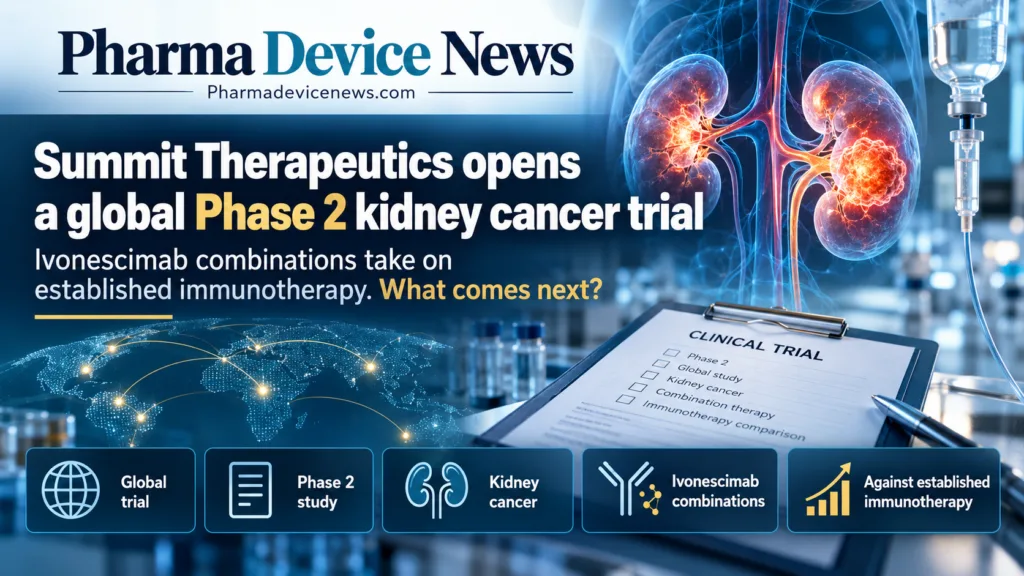
Summit Therapeutics Inc. (NASDAQ: SMMT) announced on October 19, 2026, the initiation and opening of clinical trial sites for SMT112-216, a global Phase 2 study investigating ivonescimab-based regimens in previously untreated advanced clear cell renal cell carcinoma. The randomised, open-label trial will investigate ivonescimab alone and in combination with other immunotherapies, including cadonilimab and ipilimumab, against an established nivolumab plus ipilimumab comparator. The study is being conducted in collaboration with Akeso Inc., with approximately 100 participants planned across clinical sites in the United States and China.
The expansion adds another solid tumour indication to Summit Therapeutics’ increasingly diversified ivonescimab development programme. Originally advanced through substantial clinical research in non-small cell lung cancer, the investigational bispecific antibody is now being studied in several malignancies where immune checkpoint inhibition and other targeted pathways play important therapeutic roles. Advanced clear cell renal cell carcinoma is a relevant setting because both immune signalling and tumour blood vessel formation are established treatment targets.
However, the new trial represents an early clinical investigation rather than evidence of efficacy in kidney cancer. Ivonescimab has not yet demonstrated that its combined PD-1 and VEGF mechanism produces superior clinical outcomes in this disease. The value of SMT112-216 will depend on whether investigators identify regimens with encouraging anti-tumour activity, manageable toxicity and a sufficiently strong rationale for further testing.
How is the SMT112-216 Phase 2 trial designed to evaluate ivonescimab-based treatments?
SMT112-216, also identified as AK112-216 and registered under NCT07877194, is designed to investigate patients with incurable locally advanced or metastatic clear cell renal cell carcinoma who have not previously received systemic treatment for advanced disease. The study uses an open-label, randomised design and includes several experimental regimens intended to examine ivonescimab’s potential as a treatment backbone. Its planned enrolment of approximately 100 participants makes it primarily an exploratory programme rather than a definitive registration study.
The registered protocol describes five treatment arms representing four principal approaches. Two arms evaluate different ivonescimab dose levels in combination with cadonilimab, while another investigates ivonescimab with ipilimumab. The remaining arms evaluate ivonescimab alone and the established nivolumab plus ipilimumab regimen.
This design gives Summit Therapeutics an opportunity to investigate several questions within one clinical programme. The monotherapy arm may help establish the extent of anti-tumour activity attributable to ivonescimab without another investigational agent, while the combination arms can assess whether additional immune checkpoint blockade produces a stronger response signal. Including a recognised immunotherapy comparator also introduces a clinically useful reference point, although the small numbers allocated to individual arms will limit the reliability of treatment comparisons.
The trial registry identifies objective response rate, assessed using RECIST version 1.1, and adverse events as primary outcome measures. Objective response rate measures the proportion of patients whose tumours demonstrate a qualifying reduction in size or disappear according to standardised assessment criteria. It is an important early indicator of anti-cancer activity, but it does not independently establish improvements in overall survival, progression-free survival or quality of life.
Because the study is open-label, investigators and patients know which treatment is being administered. Objective imaging criteria can reduce some forms of measurement variability, but open-label assessment may still introduce interpretive limitations, particularly for subjective safety and patient-experience outcomes. The trial’s eventual findings will therefore need to be evaluated in the context of its modest sample size, treatment allocation and duration of follow-up.
The opening of trial sites represents an operational milestone rather than a clinical result. It confirms that the development programme has entered its site-activation phase, but does not establish that participants have received treatment or that any regimen has shown efficacy in this population.
Why are PD-1 and VEGF attractive targets in advanced clear cell renal cell carcinoma?
Clear cell renal cell carcinoma is the most common histological subtype of kidney cancer and has important biological characteristics that make immune modulation and angiogenesis inhibition relevant therapeutic strategies. Many clear cell tumours exhibit altered pathways associated with oxygen sensing and vascular growth signalling, contributing to the formation of extensive tumour blood vessel networks. Vascular endothelial growth factor, or VEGF, is therefore an established target in the treatment of advanced disease.
Immune checkpoint pathways provide another established treatment mechanism. Programmed cell death protein 1, known as PD-1, acts as an inhibitory receptor on immune cells and can contribute to reduced anti-tumour immune activity when engaged by its ligands. Blocking this pathway can help restore certain anti-tumour immune responses, although clinical benefit varies between patients and treatment settings.
Ivonescimab is designed to combine PD-1 blockade and VEGF inhibition within a single bispecific antibody. Summit Therapeutics and Akeso believe that its molecular architecture may enable cooperative binding in environments where both targets are present. The intended effect is to bring immune checkpoint inhibition and anti-angiogenic activity together through one engineered molecule.
This mechanism provides a scientific rationale for investigating ivonescimab in renal cell carcinoma, but the approach should not be confused with demonstrated clinical superiority. Established treatments already combine immune checkpoint inhibitors with separate agents targeting VEGF-related pathways. The question for Summit Therapeutics is whether integrating these activities into a single antibody delivers a meaningful difference in efficacy, toxicity, pharmacology or treatment administration.
Potential advantages could include coordinated target engagement and a different drug-exposure profile compared with separate-agent combinations. However, combining two mechanisms within one molecule can also make it more difficult to adjust the intensity of each component independently. The clinical consequences of that design will require direct investigation rather than assumptions based solely on molecular characteristics.
Can ivonescimab combinations compete with established first-line kidney cancer immunotherapies?
The first-line treatment environment for advanced clear cell renal cell carcinoma is already highly competitive. Established options include nivolumab plus ipilimumab and immune checkpoint inhibitor combinations with anti-angiogenic agents, such as pembrolizumab plus axitinib, pembrolizumab plus lenvatinib and nivolumab plus cabozantinib. These regimens have generated extensive clinical evidence and are used according to patient characteristics, disease risk and individual treatment considerations.
This therapeutic landscape creates a higher development threshold for new entrants than would exist in an indication with few effective treatments. Demonstrating tumour shrinkage may be necessary to justify additional investigation, but any future commercial role would depend on whether ivonescimab-based approaches offer advantages that clinicians consider meaningful. Those advantages might involve durable disease control, tolerability, effectiveness in particular patient groups or an improved overall treatment experience.
The choice of nivolumab plus ipilimumab as a comparator is particularly informative because it represents an established dual immune checkpoint approach. Nivolumab blocks PD-1, while ipilimumab targets cytotoxic T-lymphocyte-associated protein 4, known as CTLA-4. Together, they provide a clinically recognised combination against which investigators can begin examining the activity and tolerability of new immunotherapy strategies.
Cadonilimab introduces a different experimental concept. Developed by Akeso, the antibody is designed to target both PD-1 and CTLA-4, meaning that its combination with ivonescimab introduces multiple checkpoint and angiogenesis-related activities. The approach could generate stronger immune engagement, but it also creates questions about overlapping mechanisms, additional toxicity and whether incremental efficacy would justify the complexity of combining two bispecific antibodies.
Ivonescimab plus ipilimumab offers another route to testing immune checkpoint intensification. In this arm, the proposed treatment combines PD-1 and VEGF targeting through ivonescimab with CTLA-4 blockade through ipilimumab. Its performance may help researchers understand whether adding CTLA-4 inhibition to ivonescimab provides a clinically useful signal.
The small exploratory study cannot establish that one of these combinations is superior to the current standard of care. Differences in baseline risk, treatment exposure and the number of evaluable patients could materially influence observed response rates. Confirmatory evidence would require a larger, appropriately powered trial with endpoints capable of supporting definitive clinical conclusions.
What safety challenges could emerge when combining ivonescimab with additional checkpoint inhibitors?
Safety will be particularly important because the proposed combinations involve mechanisms associated with potentially serious adverse effects. Immune checkpoint inhibition can produce immune-mediated toxicities affecting organs such as the gastrointestinal tract, liver, lungs, endocrine system and skin. The addition of CTLA-4 blockade may influence the frequency or severity of these events, making treatment-related toxicity an important consideration when investigating new combinations.
VEGF pathway inhibition introduces a different set of potential concerns. Treatments targeting angiogenesis can be associated with hypertension, bleeding, proteinuria and other vascular or renal complications, depending on the specific drug and exposure. Those issues are especially relevant in patients with advanced renal malignancies, whose kidney function and general medical condition may already be affected by disease or prior procedures.
The combination of ivonescimab and cadonilimab therefore requires careful evaluation of both immune-mediated and VEGF-related adverse events. Because the antibodies share some intended checkpoint activity, investigators will need to establish whether there is evidence of useful additional efficacy rather than simply greater treatment intensity. Dose interruptions, corticosteroid treatment for immune-related toxicity and permanent discontinuations could be particularly informative when the safety results become available.
The inclusion of two ivonescimab dose levels in the cadonilimab combination may help identify whether changing exposure alters tolerability and anti-tumour activity. Establishing an appropriate dose is an important part of combination development, particularly when two engineered antibodies interact with several biological targets. Early dose-related findings could consequently influence which regimen, if any, advances into a larger trial.
Longer follow-up will also be necessary because some immune-related adverse events can emerge after extended treatment. A favourable initial safety profile would not eliminate the need for continued observation, especially if future development involves larger populations or prolonged maintenance therapy.
How does the renal cancer programme fit into Summit Therapeutics’ broader ivonescimab strategy?
Summit Therapeutics is pursuing a broader development strategy designed to establish ivonescimab across multiple solid tumour types. The antibody was developed by Akeso, which retains rights outside Summit’s licensed territories, while Summit holds commercial and development rights covering major markets including the United States, Europe and Japan. The partnership combines Akeso’s original molecule development with Summit’s international clinical and regulatory programmes.
Ivonescimab has already obtained marketing authorisation for specified lung cancer indications in China, where Akeso has accumulated substantial clinical and commercial experience. However, the antibody remains investigational in Summit Therapeutics’ licensed territories as of October 20, 2026. Its regulatory progress in China provides relevant product-development experience, but it does not establish efficacy in renal cell carcinoma or guarantee approval in other jurisdictions.
Summit’s central development activity continues to include the HARMONi programme in non-small cell lung cancer. The company has submitted a biologics license application for ivonescimab combined with chemotherapy in a defined previously treated epidermal growth factor receptor-mutated lung cancer population, with a United States Food and Drug Administration target action date of November 14, 2026. That application remains under review, and the regulator’s concerns about the need for statistically significant overall survival evidence in the proposed setting make the pending decision particularly consequential.
The kidney cancer study represents a longer-term pipeline investment rather than an immediate commercial catalyst. Its strategic importance lies in testing whether ivonescimab can extend beyond its existing lung cancer development foundation into a tumour type where both of its intended mechanisms have established relevance. Positive early results could justify additional development, but the programme is not yet positioned to make a near-term contribution to revenue.
Summit is also collaborating with Arcus Biosciences on a separate approach combining ivonescimab with casdatifan, an investigational HIF-2α inhibitor, in advanced clear cell renal cell carcinoma. The two development strategies provide different ways of investigating the same therapeutic area. The cadonilimab and ipilimumab programme emphasises immune checkpoint combinations, while the casdatifan collaboration explores an approach involving a pathway closely associated with renal cancer biology.
This parallel development may eventually help Summit determine which combinations have the strongest clinical rationale. However, differences in trial design and patient characteristics will prevent simplistic comparisons between early results from separate studies.
How will financing requirements and future clinical milestones influence ivonescimab expansion?
Summit Therapeutics reported approximately $690.7 million in cash, cash equivalents and short-term investments at June 30, 2026. The company also reported a net loss of approximately $215.7 million during the second quarter, reflecting the financial demands of its substantial clinical development programme. Those figures provide context for a strategy that now spans multiple cancer indications and several international trials.
The renal cancer study’s planned enrolment is relatively modest compared with the company’s large Phase 3 programmes. Nevertheless, successful exploratory development can create future spending commitments if promising regimens advance into more expensive randomised registration studies. The commercial value of pipeline diversification must therefore be weighed against the cost of generating sufficient evidence in each indication.
A further challenge is that renal cell carcinoma development would require Summit to establish clinical credibility in a market already served by widely used immunotherapy and targeted therapy combinations. The presence of established regimens may provide useful comparators, but it also means that incremental improvements must be sufficiently meaningful to influence prescribing decisions. A larger future study would likely need to demonstrate more than an isolated response-rate signal to establish a compelling place in treatment.
The company’s broader investor outlook remains closely tied to regulatory progress in lung cancer, where development is more advanced. The kidney cancer programme introduces another potential source of long-term value, but it should be evaluated as an early pipeline investment rather than as evidence of an additional approvable indication. The clinical opening itself does not resolve the scientific, regulatory or commercial uncertainties surrounding ivonescimab in advanced renal malignancies.
Which results will determine whether ivonescimab can advance further in kidney cancer?
The first substantial evidence from SMT112-216 will come from the combination of tumour response assessments and adverse-event findings across its treatment arms. Investigators will need to determine whether ivonescimab monotherapy produces meaningful activity and whether either CTLA-4-directed combination generates a sufficiently encouraging incremental signal. The durability of responses, treatment discontinuations and subsequent disease progression will be essential to interpreting early response findings.
An important advantage of the programme is that it can compare several development approaches within the same broad clinical setting. A regimen with substantial anti-tumour activity but difficult tolerability may prove less attractive for further development than one producing a more balanced benefit-risk profile. Identifying the most appropriate combination could be more valuable than pursuing every experimental arm into larger studies.
The programme also has implications for Summit’s wider strategy of applying ivonescimab’s dual mechanism beyond lung cancer. If kidney cancer findings support further development, they may strengthen the case for investigating the antibody in additional settings where immune checkpoint and VEGF pathways are relevant. Conversely, limited activity or overlapping toxicity could help narrow the company’s approach before substantial additional investment.
The immediate development milestone is successful study activation, followed by enrolment, treatment delivery and the accumulation of interpretable clinical observations. Summit Therapeutics has established a biologically plausible programme with an established comparator, but the evidence required to support a new renal cancer indication remains substantially ahead. The eventual importance of SMT112-216 will depend on whether its exploratory results identify a specific ivonescimab regimen capable of justifying a larger, clinically meaningful test.