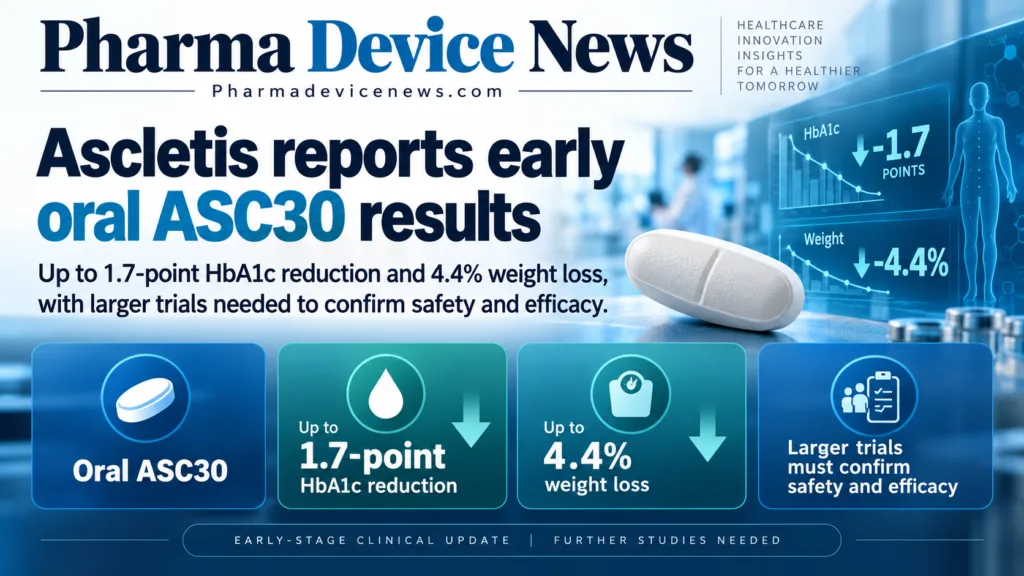
Ascletis Pharma Inc. (HKEX: 1672) has reported positive topline results from a US Phase 2 clinical trial of ASC30, its investigational once-daily oral small-molecule glucagon-like peptide-1 receptor agonist for type 2 diabetes. Announced on October 28, 2026, the 100-patient study met its primary endpoint, demonstrating placebo-adjusted reductions in glycated haemoglobin, or HbA1c, of 1.7, 1.6 and 1.7 percentage points across the 40 mg, 60 mg and 80 mg treatment groups after 12 weeks.
The study also demonstrated statistically significant weight reductions at week 13, with placebo-adjusted decreases ranging from 3.8% to 4.4% across the three doses. Ascletis reported no treatment discontinuations attributed to gastrointestinal adverse events, despite a weekly dose-escalation schedule, and no drug-related serious adverse events during the treatment period. These findings strengthen the clinical rationale for evaluating ASC30 in both diabetes and obesity, although the full dataset has not yet been published in a peer-reviewed journal.
The central development question is whether the combination of glucose lowering, weight reduction and reported short-term tolerability can be sustained in larger and longer investigations. ASC30 remains an investigational medicine without marketing approval, and the current Phase 2 results do not establish long-term cardiovascular benefit, comparative superiority or commercial readiness.
What did the US Phase 2 ASC30 study demonstrate about blood glucose control in adults with type 2 diabetes?
The Phase 2 study, registered as NCT07321678, was designed as a randomised, double-blind, placebo-controlled, multicentre investigation involving 100 participants with type 2 diabetes. Eligible patients had baseline HbA1c concentrations between 7.0% and 10.5%, with an average starting value of 8.3%. The study evaluated three once-daily ASC30 maintenance doses against matching placebo over a 13-week treatment period.
Participants were randomised in an approximate 2:3:3:2 ratio across the 40 mg, 60 mg, 80 mg and placebo groups. Treatment began at 1 mg, followed by weekly dose increases to the assigned maintenance level. The primary efficacy endpoint measured change in HbA1c from baseline at week 12, while body weight change at week 13 was among the secondary endpoints.
According to Ascletis, the 40 mg group achieved a placebo-adjusted HbA1c reduction of 1.7 percentage points, based on 20 participants in the reported efficacy analysis. The corresponding reductions were 1.6 points among 29 participants receiving 60 mg and 1.7 points among 28 participants receiving 80 mg. All three comparisons were statistically significant, with p-values below 0.0001.
The figures represent absolute percentage-point differences in HbA1c, not relative percentage reductions. For a patient with an HbA1c of 8.3%, a 1.7-point reduction would be a substantial numerical change, although the reported results are adjusted comparisons between treatment and placebo rather than individual patient outcomes. The company has not provided the complete distribution of responses or the proportion of participants achieving specific HbA1c targets.
The study used an efficacy estimand evaluating treatment effects while participants adhered to treatment. This distinction matters because results under an adherence-based framework may differ from outcomes observed when all treatment discontinuations and other intercurrent events are incorporated. The full clinical report will be important for evaluating the robustness of the findings under alternative statistical assumptions.
Why are the similar HbA1c reductions across 40 mg, 60 mg and 80 mg important for ASC30 dose selection?
One notable feature of the results is the relatively narrow difference between the three treatment groups. Although the doses increased from 40 mg to 80 mg, placebo-adjusted HbA1c reductions remained between 1.6 and 1.7 percentage points. The announced data therefore do not demonstrate a clear improvement in glucose lowering at the highest dose over the 40 mg regimen.
This pattern may suggest that much of the achievable glucose-lowering effect was already being captured at the lower evaluated maintenance dose during the 12-week observation period. However, the study was not presented as a direct comparative trial powered to establish equivalence between ASC30 doses. Differences in sample size, baseline characteristics and individual treatment response could also influence the apparent pattern.
Dose selection for later development must consider more than average HbA1c reduction. Investigators need to examine drug exposure, gastrointestinal tolerability, treatment adherence and the durability of glucose control. A higher dose might offer a different benefit-risk balance if it produces additional weight reduction over longer treatment periods, but the current diabetes data do not establish such an advantage.
The findings could therefore inform discussions about whether all three maintenance doses need to be carried into subsequent diabetes trials. Selecting the lowest dose that delivers adequate efficacy may be attractive if it also improves tolerability or reduces treatment burden. Any final decision would require detailed examination of the complete Phase 2 dataset rather than relying exclusively on the reported topline averages.
How meaningful was the weight loss recorded with ASC30 after 13 weeks of diabetes treatment?
ASC30 produced statistically significant reductions in body weight across all three dose groups. Participants receiving 40 mg achieved a placebo-adjusted mean reduction of 4.4%, compared with 3.8% for the 60 mg group and 4.0% for the 80 mg group. The company reported p-values ranging from 0.001 to 0.003 for the weight comparisons.
The average baseline body weight was 93.7 kg, providing context for the relative reductions. However, the placebo-adjusted percentages should not be interpreted as the actual average amount of weight lost by each treatment group, because the figures subtract the estimated response in the placebo arm. Detailed results showing unadjusted weight changes and the distribution of individual outcomes would provide a fuller assessment.
The absence of an apparent weight-loss plateau at week 13 is potentially relevant to future development. Weight reduction with GLP-1 receptor agonists often continues over a longer period than the initial three months, making short-term studies insufficient for defining the eventual treatment effect. Nevertheless, continued loss cannot be assumed without additional follow-up.
The dose-response relationship for weight reduction was also less straightforward than might have been expected. The 40 mg group produced a numerically greater placebo-adjusted reduction than the two higher-dose groups. These differences were not reported as statistically significant head-to-head comparisons, and the small groups limit conclusions about the optimal weight-management dose.
For patients with type 2 diabetes and excess body weight, simultaneous improvements in glucose control and weight can be clinically relevant. However, the magnitude and durability of both effects must be considered alongside safety, treatment adherence and other therapies available for the same population.
What do the gastrointestinal safety results reveal about the tolerability of oral ASC30?
Gastrointestinal adverse events are an important consideration for GLP-1 receptor agonists because nausea, vomiting, diarrhoea and related symptoms can affect treatment adherence. Dose escalation is commonly used to reduce the intensity of these effects while patients adjust to treatment. ASC30’s Phase 2 study used weekly titration from 1 mg to maintenance doses reaching as high as 80 mg.
Ascletis reported that no participants discontinued treatment because of gastrointestinal adverse events. Only one ASC30-treated participant discontinued because of an adverse event, identified as hiccups, corresponding to approximately 1.3% of the 80 treated participants. No participant receiving placebo discontinued because of an adverse event.
According to the company, all drug-related adverse events were grade 1 or grade 2, representing mild or moderate severity. No drug-related serious adverse events were reported, and investigators did not identify a hepatic safety signal during treatment. Ascletis also stated that no elevations in alanine aminotransferase, aspartate aminotransferase or total bilirubin were observed.
These findings provide an encouraging short-term tolerability signal, but they do not establish that ASC30 is free from clinically important risks. The study included only 100 participants and lasted approximately 13 weeks, limiting its ability to detect uncommon or delayed adverse events. Larger populations and longer exposure will be necessary to characterise the safety profile.
The absence of gastrointestinal-related discontinuations should also be distinguished from the absence of gastrointestinal symptoms. Participants may experience nausea or other effects without stopping treatment. The announcement does not provide detailed event frequencies across the individual doses, which would be important for evaluating the practical tolerability differences.
Ascletis expects that slower titration in future development could further improve tolerability. That remains a management expectation, not a clinical finding established by the current diabetes study. Subsequent trials will need to evaluate whether a different escalation schedule produces the anticipated benefit without compromising efficacy.
How does ASC30’s small-molecule GLP-1 mechanism differ from established peptide-based therapies?
ASC30 is an orally administered small-molecule agonist of the glucagon-like peptide-1 receptor. GLP-1 receptor activation influences glucose-dependent insulin secretion, glucagon regulation, appetite and other metabolic processes relevant to diabetes and obesity. The therapeutic rationale builds on a pathway already validated by several approved medicines.
Many established GLP-1 treatments are peptide-based molecules delivered through injections, although oral peptide formulations are also available. Small-molecule agonists represent a different approach because their chemical structure and formulation characteristics can support alternative oral delivery strategies. Such differences may influence manufacturing, absorption and administration requirements.
Ascletis describes ASC30 as a fully biased GLP-1 receptor agonist developed through its internal research programme. Biased agonism refers to preferential activation of certain signalling pathways following receptor engagement. However, the relationship between signalling bias and clinical tolerability or efficacy must be demonstrated rather than inferred from the molecular design.
The availability of a once-daily tablet could potentially appeal to patients and healthcare systems seeking alternatives to injections. Nevertheless, oral administration alone does not guarantee better adherence, stronger efficacy or lower costs. Treatment selection also depends on tolerability, administration requirements, access and the evidence supporting long-term benefits.
The competitive market is becoming increasingly demanding because oral GLP-1 development is advancing across the pharmaceutical industry. ASC30 will need to establish a differentiated clinical profile through appropriately designed studies rather than comparisons based solely on individual percentages from unrelated trials.
Why should ASC30’s Phase 2 results not be treated as evidence of superiority over other oral GLP-1 medicines?
Ascletis has expressed confidence that ASC30 could become a leading oral small-molecule GLP-1 treatment for diabetes and obesity. However, the October results came from a placebo-controlled study rather than a direct comparison with another active GLP-1 medicine. The findings therefore establish efficacy against placebo under the tested conditions, not superiority over competing treatments.
Cross-trial comparisons are complicated by differences in patient populations, baseline HbA1c, body weight, dose escalation and treatment duration. Some studies also use different statistical estimands or approaches to handling missing data. Comparing topline reductions without accounting for these differences can produce misleading conclusions.
The 12-week primary endpoint is also shorter than the assessment periods commonly used in pivotal diabetes development. Glucose control and weight reduction may change with continued treatment, while longer exposure can reveal additional tolerability information. A medicine performing favourably during initial dose escalation may not maintain the same relative profile over a year or longer.
The current data nevertheless provide useful evidence that ASC30 can produce substantial short-term glucose lowering at several maintenance doses. Its clinical positioning will become clearer when researchers evaluate longer-term outcomes, treatment persistence and efficacy within larger populations. Direct comparative studies would provide the strongest basis for claims against specific competing therapies.
How does the diabetes study fit alongside Ascletis Pharma’s global Phase 3 obesity programme?
ASC30 is being developed for both obesity and type 2 diabetes, allowing Ascletis to investigate the same molecular platform in two commercially significant metabolic indications. The diabetes results follow earlier Phase 2 research in overweight and obese participants that demonstrated dose-related weight reduction. Those findings supported the company’s decision to advance into a global Phase 3 obesity programme.
The pivotal obesity programme comprises AURORA-1 and AURORA-2, registered as NCT07743463 and NCT07743450. Ascletis has stated that the two trials are enrolling approximately 4,600 participants across the United States, Europe and Canada. These investigations are intended to generate the larger efficacy and safety dataset required for potential regulatory submissions.
Management expects topline results from the obesity programme in the third quarter of 2028. It has outlined plans to submit a US New Drug Application for obesity by the end of 2028 and a European marketing authorisation application in early 2029. These milestones remain conditional on successful trial execution and sufficiently supportive results.
The diabetes programme is at an earlier stage, despite the positive Phase 2 findings. Ascletis has discussed slower dose escalation for future Phase 3 diabetes studies, but the October announcement does not establish a definitive start date or completed pivotal protocol for that indication. The company will need to determine dose selection, treatment duration and the additional clinical evidence required for registration.
Developing ASC30 across two indications creates potential commercial opportunities but also increases capital requirements. Each programme must satisfy the applicable clinical and regulatory requirements, and approval for one indication would not automatically authorise the other.
What are the financial and investor implications of ASC30 advancing through diabetes and obesity development?
Ascletis Pharma is listed on the Hong Kong Stock Exchange under stock code 1672, making ASC30 a central asset for investors evaluating its metabolic disease strategy. The positive diabetes results add another development indication to a programme already advancing through pivotal obesity studies. This may strengthen the scientific and commercial rationale for the asset, but the clinical evidence remains incomplete.
The company has taken steps to finance its development ambitions. In February 2026, Ascletis announced a share placement expected to generate approximately HK$835.3 million in net proceeds, with the majority allocated to preparations and development activities associated with the global ASC30 obesity Phase 3 programme. This illustrates the substantial funding requirements involved in moving a metabolic medicine towards regulatory submission.
For investors, the October announcement represents clinical de-risking of the diabetes indication rather than evidence of immediate pharmaceutical revenue. The Phase 2 study met its primary endpoint and generated encouraging tolerability results, but future approval will depend on larger trials. Commercial performance would subsequently depend on competitive positioning, reimbursement, manufacturing and market access.
An additional consideration is the cost of maintaining simultaneous diabetes and obesity programmes. The company must allocate capital between pivotal studies, manufacturing preparations and potential commercial infrastructure. The eventual value of ASC30 will depend partly on whether development resources can support both indications without unacceptable financing pressure.
The positive Phase 2 results strengthen ASC30’s development position by demonstrating statistically significant glucose lowering alongside short-term weight reduction. The absence of gastrointestinal-related discontinuations is encouraging, but the relatively small and brief study cannot establish the full safety profile or competitive advantage. The next decisive evidence will come from longer trials that determine whether these benefits remain consistent in larger patient populations.