Pulse Biosciences, Inc. (Nasdaq: PLSE) has reported six-month interim clinical results from its PRECISE-BTN study, showing that 86% of 43 evaluated patients achieved at least a 50% reduction in benign thyroid nodule volume following a single treatment using the nPulse Vybrance Percutaneous Electrode System. Presented at the 95th Annual Meeting of the American Thyroid Association in Philadelphia and announced on 6 November 2026, the findings also included a median nodule volume reduction of 72%, improvements in reported symptoms and quality of life, and no serious adverse events in the disclosed interim dataset.
The results provide encouraging evidence for Pulse Biosciences’ nanosecond pulsed field ablation technology in a field where clinicians increasingly consider minimally invasive alternatives to thyroid surgery. However, the findings represent an interim analysis of a prospective, single-arm study rather than completed evidence from the full 100-patient trial, and there is no randomised comparator against established treatment options.
The distinction is commercially important because Pulse Biosciences is already conducting a controlled commercial launch of the Vybrance System. Its clinical programme is intended to support a broader evidence base for thyroid nodule treatment while the company builds physician experience, develops specialist relationships and evaluates the potential for wider adoption.
What do the PRECISE-BTN six-month results reveal about nodule reduction and treatment response?
The interim analysis included 43 patients treated across three United States clinical centres who had reached their six-month follow-up assessment. According to Pulse Biosciences, 86% achieved the study’s primary endpoint of at least 50% reduction in thyroid nodule volume, while the median reduction across the evaluated population reached 72%.
The distinction between these two measurements is important when interpreting the results. The 86% figure represents the proportion of evaluated patients meeting a predefined volume-reduction threshold, while the median percentage indicates the central tendency of the observed changes in nodule size.
Together, the measurements suggest that substantial volume reduction was observed in most patients included in this interim analysis. The company also reported that much of the reduction was apparent by the first month and that nodule shrinkage continued through subsequent follow-up.
The study was designed to evaluate whether findings from earlier feasibility work could be reproduced in a larger, prospective, multicentre setting. That is a meaningful step because results achieved in a small initial investigation may not necessarily be reproduced when additional operators, patients and clinical environments are included.
However, the reported 86% response rate applies specifically to the 43 patients who had reached six-month assessment, not to all 100 enrolled participants. The remaining patients’ outcomes are still required to establish the complete study result at its primary endpoint.
The study’s single-arm design also limits the conclusions that can be drawn about comparative effectiveness. Without randomisation against another ablation technique, surgery or a defined control strategy, the data cannot establish that nPulse Vybrance produces better outcomes than established treatment approaches.
Nevertheless, the magnitude of reported volume reduction is clinically relevant to investigate further because reducing the size of symptomatic benign thyroid nodules is an important objective of minimally invasive ablation. The key clinical test will be whether the completed results confirm consistent shrinkage alongside durable symptom improvement and an acceptable complication profile.
How meaningful are the reported improvements in thyroid symptoms and quality of life?
Pulse Biosciences reported a 78% improvement from baseline in the ThyPRO-39 Overall Quality of Life Impact score at six months. The company also said that neck pressure or fullness had completely resolved in 82% of patients who reported that symptom before treatment.
These findings add a patient-centred dimension to the anatomical results. Benign thyroid nodules can cause neck discomfort, pressure, swallowing difficulties or cosmetic concerns, although symptoms and their severity vary across patients. A reduction in nodule volume is most clinically valuable when it is accompanied by improvements in the problems that prompted treatment.
The ThyPRO-39 questionnaire is a thyroid-specific patient-reported outcome instrument used to evaluate quality-of-life effects. Its inclusion can help assess whether changes observed through ultrasound measurement correspond with changes patients experience in daily life.
However, the company’s announcement does not provide the detailed baseline and follow-up score distributions, confidence intervals or statistical testing needed to independently assess the magnitude and precision of the reported 78% improvement. The percentage should therefore be understood as a company-reported change in a particular questionnaire measure, not as evidence that every participant experienced an equivalent improvement in overall well-being.
Similarly, the 82% symptom-resolution figure refers to patients who had neck pressure or fullness at baseline. It should not be interpreted as 82% of the entire study population becoming completely symptom-free, particularly because benign thyroid nodules may produce several different complaints.
The published announcement does not provide the exact denominator for that symptom subgroup. Full reporting will help clarify how many patients contributed to the result, how symptom improvement was assessed and whether the changes persisted over longer follow-up.
For clinicians, the relationship between volume reduction and symptom improvement may ultimately be more informative than either measurement considered separately. Some nodules may shrink substantially without eliminating symptoms, while other patients may experience meaningful relief following more modest anatomical changes.
Can nanosecond pulsed field ablation offer a meaningful alternative to thermal thyroid nodule treatments?
The nPulse Vybrance Percutaneous Electrode System uses nanosecond pulsed field ablation, a technology that delivers extremely short electrical pulses to targeted tissue. Pulse Biosciences describes the approach as nonthermal, differentiating its primary mechanism from ablation methods that rely on generating heat.
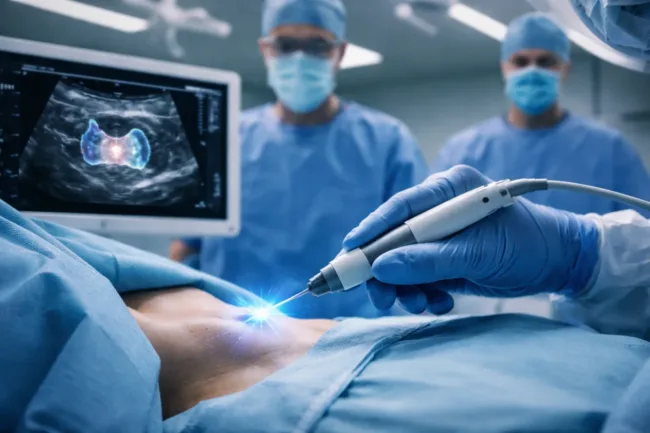
During the procedure, the device is positioned using ultrasound guidance and delivers electrical energy intended to ablate targeted cells. The company says its technology is designed to preserve surrounding noncellular structures, potentially limiting unwanted effects on nearby anatomical features.
This mechanism is relevant to thyroid procedures because the gland is situated close to structures that require careful protection, including nerves involved in vocal cord function, blood vessels and other important neck anatomy.
Established thermal ablation approaches, particularly radiofrequency ablation, already have a substantial clinical evidence base for selected benign thyroid nodules. The American Thyroid Association has recognised ablation as a valid alternative to conventional surgery for appropriately selected patients, while emphasising patient selection, operator training and complication management.
Pulse Biosciences is therefore entering a developing treatment field rather than creating the first nonsurgical option for benign thyroid nodules. Its potential differentiation depends on demonstrating that nonthermal energy delivery can provide reliable nodule reduction with an attractive safety, procedural and recovery profile.
A mechanistic argument for limiting thermal injury does not independently establish superior clinical safety. The PRECISE-BTN results provide clinical information about patients treated with nPulse Vybrance, but they do not directly compare the technology against radiofrequency ablation or other established approaches.
Differences in patient selection, nodule size, composition, treatment technique and follow-up also limit comparisons between separate clinical studies. A direct comparative conclusion would require appropriately designed research rather than isolated response percentages.
For hospitals and specialist centres, the potential value of the technology will depend on the combined evidence for effectiveness, complication rates, procedural efficiency and reproducibility across operators.
What does the interim safety profile establish about the risks of thyroid nodule ablation?
Pulse Biosciences reported no serious adverse events in the 43-patient interim population. This is encouraging during the disclosed six-month follow-up period, particularly given the importance of protecting sensitive structures during thyroid procedures.
However, an absence of reported serious adverse events in a relatively small sample does not establish that the procedure is free of risk. Rare complications may not become apparent until larger numbers of patients have been treated, and some outcomes may require longer observation.
Thyroid nodule ablation can involve concerns such as voice changes, bleeding, haematoma formation, local discomfort and effects on thyroid function. The frequency and mechanisms of complications may vary according to the treatment modality and patient characteristics.
Pulse Biosciences’ announcement emphasised the potential for nonthermal energy delivery to preserve surrounding tissue, but detailed clinical reporting will be needed to determine whether the proposed protective mechanism translates into consistent procedural outcomes.
The company also reported favourable observations concerning thyroid hormone levels among patients with hyperfunctioning nodules. Principal investigator Ralph Tufano indicated that improvements in hormone measures while preserving thyroid function were encouraging, although the announcement did not provide detailed biochemical response rates for this subgroup.
These findings are worth following because hyperfunctioning thyroid nodules introduce additional clinical considerations beyond anatomical size reduction. Hormone normalisation, medication requirements and the persistence of thyroid function are important outcomes when evaluating treatments for autonomously functioning nodules.
The full study dataset will need to clarify the relevant subgroup numbers and the extent of biochemical improvement. Without those details, the interim results should not be interpreted as demonstrating hormone normalisation across all patients with hyperfunctioning nodules.
Longer-term follow-up will also help identify whether additional procedures become necessary because of incomplete ablation, persistent symptoms or nodule regrowth.
How does the PRECISE-BTN trial design affect the strength of the clinical evidence?
PRECISE-BTN is a prospective, single-arm, multicentre clinical investigation enrolling 100 patients at three United States centres. Participating institutions include Sarasota Memorial Health Care System, NYU Langone Health and Weill Cornell Medicine, with patient assessments scheduled at one, three, six and 12 months after treatment.
The study completed enrolment in 2026 after being expanded from its original 50-patient design to 100 participants. Pulse Biosciences disclosed completion of enrolment in September, providing a larger patient population for evaluating the reproducibility of its initial feasibility findings.
Prospective enrolment and a prespecified primary endpoint strengthen the study design by establishing the intended outcome before patients complete follow-up. Multicentre participation also provides information from more than one clinical environment.
Nevertheless, the absence of a randomised control group means the investigation is primarily suited to evaluating performance within the treated population. It cannot provide the same comparative evidence as a trial designed to directly assess nPulse Vybrance against another intervention.
The interim dataset also represents only part of the study’s planned six-month results. Patients who reach follow-up earlier may differ from those assessed later, and additional data may change the final response estimate.
The company has indicated that the full six-month analysis will be reported once all patients complete the relevant assessment. It also expects to provide 12-month results as follow-up progresses.
These subsequent readouts will be more informative for determining whether the response rate remains stable across the full enrolled population and whether volume reduction persists after the initial treatment.
The current findings were presented at a scientific conference and disclosed through a company announcement. They should not be confused with a completed, independently peer-reviewed publication containing all protocol details, patient-level summaries and statistical analyses.
Does existing FDA clearance mean nPulse Vybrance has already established thyroid-specific clinical effectiveness?
Pulse Biosciences received FDA 510(k) clearance for the Vybrance System in March 2024 for the ablation of soft tissue in percutaneous and intraoperative surgical procedures. The existing clearance provides an important regulatory foundation for commercial activity in the United States.
However, 510(k) clearance for the stated soft-tissue indication should not be presented as FDA approval of the device’s thyroid-specific clinical efficacy. The PRECISE-BTN investigation is generating additional evidence concerning its performance in symptomatic benign thyroid nodules.
This distinction is important because a device’s regulatory status and the strength of clinical evidence for a particular application are related but separate considerations. Clearance establishes that the device has satisfied the applicable regulatory requirements for its stated intended use, while clinical investigations can provide more detailed evidence concerning outcomes in specific patient populations.
Pulse Biosciences has been developing its commercial strategy alongside its thyroid nodule research programme. The company has entered agreements with selected clinical centres and continued to evaluate how the Vybrance System performs in routine procedural settings.
In October 2026, Pulse Biosciences announced a commercial and clinical partnership with the Clayman Thyroid Center at the Hospital for Endocrine Surgery in Tampa, Florida. The arrangement includes patient treatment using Vybrance and collaboration on additional clinical evidence concerning benign thyroid nodule ablation.
The Clayman partnership represents a concrete expansion of the company’s clinical and commercial activities, but it is not equivalent to widespread adoption across the United States. Broader penetration would require additional clinical evidence, physician training, distribution capability and sustainable economics for treating institutions.
Why will physician training, reimbursement and clinical workflow determine broader adoption?
The commercial opportunity for nPulse Vybrance depends on whether specialist treatment centres can incorporate the technology into existing thyroid nodule management pathways. This requires more than demonstrating that a treated nodule becomes smaller.
Clinicians must establish suitable patient-selection criteria, confirm benignity, assess anatomical accessibility and determine whether ablation is appropriate relative to observation, surgery or other treatments. Such decisions are particularly important when nodule size, location or characteristics increase procedural complexity.
The American Thyroid Association’s guidance on ablation emphasises the need for appropriate training and careful procedural implementation. As with other image-guided treatments, the consistency of results may depend on operator experience and adherence to established clinical practices.
For Pulse Biosciences, commercial expansion will therefore require effective physician education and support. Specialist centres adopting the system will need to assess procedural workflow, equipment requirements, treatment times and the ability to manage complications.
Reimbursement is another important consideration. Even when a technology is cleared and clinically promising, provider adoption may be affected by billing arrangements, payer policies and the economics of delivering the procedure.
A device manufacturer must also demonstrate that its products can be supplied and supported reliably. Hospitals and specialist centres will evaluate acquisition costs, maintenance requirements, disposable components and the expected volume of procedures before committing to broader use.
These factors may influence the pace of adoption independently of clinical response rates. An effective procedure can remain commercially limited if it does not fit established clinical workflows or if providers face uncertainty over financial returns.
Pulse Biosciences’ controlled launch allows the company to develop these capabilities while gathering additional outcomes data. Expansion beyond selected centres will provide a more demanding test of whether the technology can produce consistent results under routine commercial conditions.
What do Pulse Biosciences’ latest financial results and stock performance suggest about investor expectations?
Pulse Biosciences reported third-quarter 2026 revenue of approximately US$0.4 million, compared with US$0.1 million in the corresponding period of 2025. The company remains in a controlled commercial launch of Vybrance, directing development efforts towards a limited customer base rather than pursuing an immediate broad rollout.
Its GAAP net loss increased to US$23.1 million from US$19.4 million a year earlier, reflecting continued spending on clinical programmes and operating activities. Cash used in operating activities totalled US$15.3 million during the quarter, compared with US$13.0 million in the prior-year period.
The company ended September 2026 with US$189.2 million in cash, cash equivalents and marketable securities, substantially above the US$101.6 million reported at the end of June. The increase followed capital raising through at-the-market equity programmes, including US$95.8 million in net proceeds during the third quarter.
The stronger liquidity position gives Pulse Biosciences additional resources to fund clinical development, commercial preparation and its broader product portfolio. However, the financing also demonstrates the company’s reliance on capital markets while product revenue remains relatively small.
The company’s development pipeline extends beyond thyroid nodule treatment. Pulse Biosciences is also pursuing nanosecond pulsed field ablation technology for atrial fibrillation, with its NANOPULSE-AF pivotal clinical programme having completed enrolment.
This wider pipeline is important when assessing market sentiment because the company’s valuation reflects expectations across several future clinical and commercial opportunities, not simply current Vybrance sales.
Pulse Biosciences shares closed at US$53.07 on 5 November 2026, declining 6.99% during that session. The stock remained approximately 1.6% above its 30 October closing level and roughly 6.7% above its 6 October close. Its 52-week trading range was approximately US$12.56 to US$58.90, with an equity market capitalisation of about US$3.8 billion.
The 5 November closing price preceded the company’s 6 November PRECISE-BTN announcement, so that decline cannot be attributed to the newly disclosed interim thyroid data.
The considerable difference between market capitalisation and current product revenue indicates that investors are assigning substantial value to prospective platform opportunities. This creates sensitivity to clinical milestones, commercial progress and future capital requirements.
The PRECISE-BTN findings offer an encouraging clinical development signal within that broader investment narrative. However, revenue growth, additional customer adoption and evidence from completed trials will be necessary to establish whether expectations translate into sustainable commercial performance.
What must the full PRECISE-BTN results establish before Pulse Biosciences can expand thyroid nodule treatment?
The next major clinical milestone is completion of six-month follow-up for the full 100-patient PRECISE-BTN population. Those results will show whether the initially reported 86% response rate and 72% median volume reduction remain representative when all enrolled patients are assessed.
The 12-month follow-up will provide additional information about the durability of nodule shrinkage, persistence of symptom improvement and longer-term safety. These data are particularly relevant because successful thyroid nodule treatment should ideally provide sustained benefits without repeated intervention.
More detailed reporting will also be important for evaluating hyperfunctioning nodules, patient-reported outcomes and the relationship between anatomical response and functional improvement. The company will need to show how individual clinical characteristics influence treatment success and whether outcomes remain consistent across participating centres.
From a commercial perspective, Pulse Biosciences must continue developing its controlled launch while determining whether the Vybrance System can achieve broader adoption. The Clayman Thyroid Center partnership provides an opportunity to generate additional clinical and real-world information, but wider use will depend on physician acceptance, workflow integration and reimbursement economics.
The PRECISE-BTN interim results strengthen the clinical rationale for continued evaluation of nonthermal ablation in symptomatic benign thyroid nodules. Whether that rationale becomes a compelling commercial proposition will depend on full-population outcomes, durable benefits and evidence that the procedure can be delivered consistently outside a small number of experienced centres.
For Pulse Biosciences, the decisive test is no longer whether its technology can produce substantial nodule reduction in an initial group of patients. It is whether those results persist across the complete study population and translate into a reproducible, financially sustainable treatment option within specialist thyroid care.