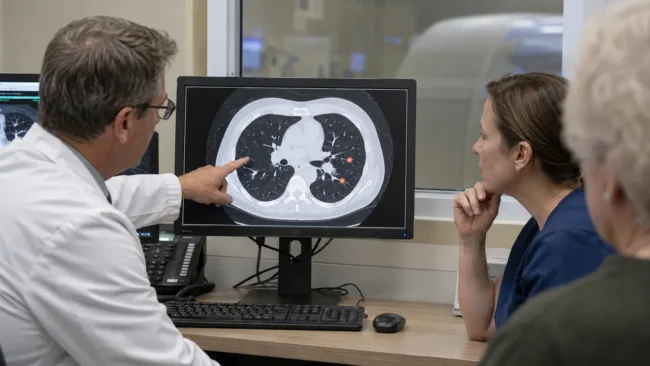
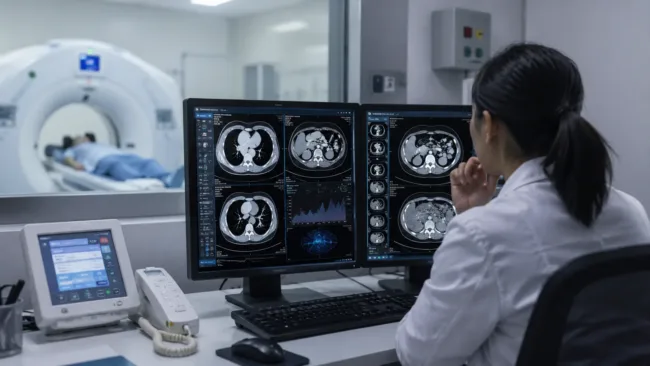
Median Technologies announced it will showcase eyonis LCS, its artificial intelligence and machine learning-based software as a medical device for lung cancer screening, at the European Congress of Radiology 2026 in Vienna. The French diagnostics-focused company is commercially launching eyonis LCS in the United States following recent United States Food and Drug Administration 510(k) clearance, while a CE marking decision in Europe is expected in the second quarter of 2026.
The conference presence itself is not the core story. What matters is how Median Technologies is positioning eyonis LCS at a pivotal regulatory and commercial inflection point. With United States clearance secured and European review nearing completion, the lung cancer screening software moves from validation to scale, and that transition exposes both opportunity and friction in an increasingly crowded AI radiology landscape.
How FDA clearance and pending CE marking reshape the competitive field for AI lung cancer screening software
Regulatory clearance in the United States changes the category from experimental AI adjunct to reimbursable clinical workflow tool. United States Food and Drug Administration 510(k) clearance signals that the agency considers eyonis LCS substantially equivalent to predicate technologies in safety and effectiveness. For hospital procurement committees and integrated delivery networks, that status reduces adoption risk and accelerates vendor evaluation cycles.
In lung cancer screening, where low dose computed tomography programs are expanding under national screening guidelines, AI tools are increasingly evaluated for their ability to improve sensitivity without overwhelming radiologists with false positives. Median Technologies reports that eyonis LCS achieved 93.3 percent sensitivity and 92.4 percent specificity, along with a 99.9 percent negative predictive value in a lung cancer screening reference population. Industry observers note that negative predictive value is particularly important in screening contexts because it underpins clinician confidence in ruling out disease and reducing unnecessary follow-up imaging.
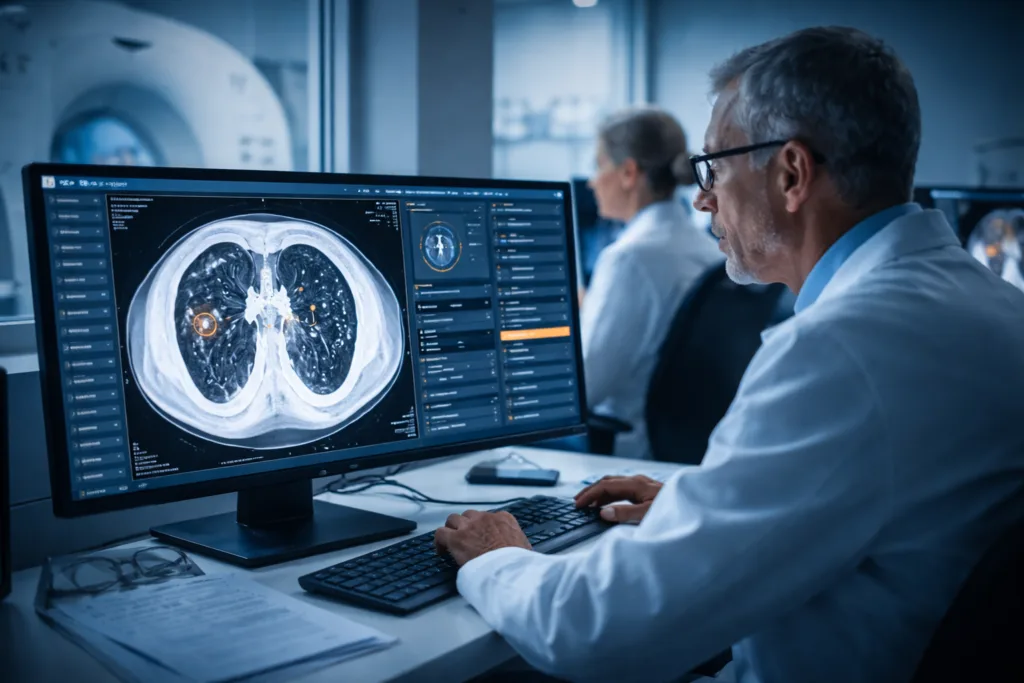
However, manufacturer-reported performance metrics are only one part of the equation. The competitive field includes other AI-based computer-aided detection and diagnosis platforms from established imaging software vendors and emerging digital health companies. Many of these systems already integrate with major picture archiving and communication systems and radiology reporting workflows. The differentiator for eyonis LCS will likely hinge on real-world performance across diverse screening populations, integration ease, and economic value rather than headline sensitivity figures alone.
Why end-to-end CADe and CADx positioning could alter radiologist workflow and liability calculus
Median Technologies describes eyonis LCS as an end-to-end CADe and CADx platform capable of both detecting and characterizing pulmonary nodules in low dose computed tomography scans. The strategic implication is that the software aims to support not only identification but also risk stratification, potentially influencing follow-up recommendations.
Clinicians tracking the field have increasingly differentiated between narrow detection tools and broader diagnostic support systems. Detection alone may reduce oversight errors, but characterization and malignancy risk assessment encroach more directly on clinical decision-making. That raises questions about liability distribution, radiologist trust, and institutional governance of AI recommendations.
If eyonis LCS meaningfully improves risk assessment consistency, it could reduce inter-reader variability, a known challenge in lung nodule evaluation. Yet regulators and hospital compliance officers will likely scrutinize how recommendations are presented. Is the output a probability score, a categorical risk label, or a structured report suggestion? The way results are embedded into workflow determines whether the tool functions as assistive software or as quasi-decision automation.
What real-world evidence and multi-reader studies will determine about clinical credibility
Median Technologies highlights results from a multi-reader multi-case study known as RELIVE, evaluating performance of its end-to-end AI platform. Multi-reader designs are valuable because they simulate variability across radiologists with different experience levels. For AI vendors, demonstrating benefit in that context strengthens claims of workflow augmentation rather than isolated algorithm performance.
Yet experts in imaging informatics caution that conference presentations are only a step in the evidence journey. Peer-reviewed publication, external validation datasets, and post-market surveillance data will ultimately shape payer and guideline committee perceptions. In lung cancer screening, national programs often rely on evidence from large population studies. AI vendors must therefore prove not only statistical performance but also downstream clinical impact, such as reduction in unnecessary biopsies or improved stage at diagnosis.
The negative predictive value cited by Median Technologies suggests potential efficiency gains in excluding malignancy. However, the balance between sensitivity and false positives remains critical. Over-alerting can increase follow-up imaging, patient anxiety, and cost burdens, undermining value propositions.
How reimbursement, procurement, and scalability will influence commercial uptake in the United States and Europe
United States commercialization following Food and Drug Administration clearance opens the door to billing pathway considerations. AI tools in radiology often rely on add-on reimbursement codes or value-based contracting models tied to efficiency improvements. Hospitals will evaluate whether eyonis LCS reduces reading time, lowers recall rates, or improves compliance with screening protocols.
In Europe, CE marking under the Medical Device Regulation carries its own complexity. A Class IIb designation, as described by the company, entails a more rigorous conformity assessment process than lower risk software classes. Regulatory watchers suggest that timelines and notified body capacity remain variable across the European Union. Even if a decision arrives in the second quarter of 2026, country-level adoption will depend on health technology assessment reviews and local reimbursement frameworks.
Scalability also depends on technical integration. Cloud deployment versus on-premise installation, cybersecurity assurances, and compatibility with existing radiology information systems will all influence adoption velocity. European hospital systems, in particular, may require data localization and strict compliance with General Data Protection Regulation standards.
What risks remain around clinical generalizability, competitive differentiation, and regulatory evolution
Despite regulatory milestones, several unresolved questions persist. First, generalizability across diverse populations is essential. Lung cancer screening cohorts differ by smoking prevalence, environmental exposure, and demographic factors. Performance validated in one reference population may not translate seamlessly elsewhere.
Second, the AI radiology field is rapidly evolving. Larger imaging vendors are embedding artificial intelligence capabilities into broader enterprise platforms, creating bundled offerings that may be harder for standalone vendors to displace. Median Technologies must demonstrate that eyonis LCS delivers incremental value rather than duplicating existing capabilities.
Third, regulatory expectations for artificial intelligence software continue to evolve. The United States Food and Drug Administration has signaled interest in lifecycle oversight for machine learning systems, including change control plans for algorithm updates. Maintaining compliance while iterating models will require robust quality systems and post-market monitoring.
Finally, lung cancer screening volumes are expanding but remain sensitive to policy changes. Any modification in national screening eligibility criteria could affect total addressable market assumptions for AI tools in this space.
What clinicians, regulators, and industry observers will watch next as eyonis LCS moves from showcase to scale
The European Congress of Radiology provides visibility among radiology leaders, but the real test lies beyond exhibition booths. Clinicians will look for independent validation data and workflow studies demonstrating measurable impact on reporting accuracy and efficiency. Regulators will monitor post-market safety and performance signals. Hospital administrators will evaluate cost-benefit alignment within constrained imaging budgets.
For Median Technologies, the transition from regulatory clearance to sustained commercial traction will define whether eyonis LCS becomes a durable player in lung cancer screening or one among many AI tools competing for attention. The next 12 months will likely reveal whether reported performance metrics translate into procurement decisions and long-term contracts.