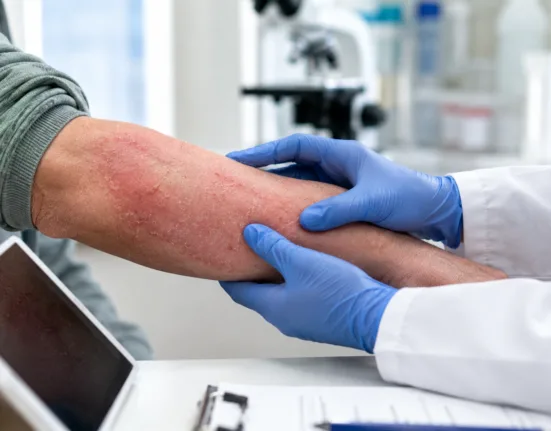
Incyte Corporation will present 54-week efficacy and safety results from its Phase 3 STOP-HS1 and STOP-HS2 trials of povorcitinib, an oral selective JAK1 inhibitor, as a late-breaking oral presentation at the 2026 American Academy of Dermatology Annual Meeting in Denver on 28 March. The data extend the programme’s previously disclosed 12-week primary endpoint results and the 24-week interim findings first reported at the European Academy of Dermatology and Venereology Congress in September 2025, representing the longest continuous efficacy and safety read yet generated for an oral small-molecule therapy in moderate to severe hidradenitis suppurativa.
Why the 54-week timepoint matters for HS drug development
Hidradenitis suppurativa is a chronic, relapsing condition, and short-term response rates have historically been a poor predictor of durable remission. The approved biologic agents in HS, including adalimumab and the more recently cleared bimekizumab, were each granted approval on the basis of 12- to 16-week pivotal data, with long-term open-label extension results submitted subsequently. For povorcitinib, Incyte has structured its regulatory filing strategy around a single integrated dataset that includes both the double-blind controlled phase and the 42-week open-label extension, allowing the agency to assess sustained response, safety signal accumulation, and durability of lesion reduction within the same submission package. That structural choice is consequential: it raises the analytical bar internally but should also shorten regulatory back-and-forth once submissions are lodged.
The 24-week interim data already indicated substantial deepening of response beyond week 12. Nearly 60 percent of efficacy-evaluable patients across both treatment arms achieved the HiSCR50 threshold at 24 weeks, compared with primary endpoint rates of roughly 40 to 42 percent at week 12 in STOP-HS1 and 42 to 43 percent in STOP-HS2. The 54-week readout will confirm whether that trajectory sustained, plateaued, or eroded during the later extension period. This distinction is clinically important because HS patients who achieve initial lesion reduction do not uniformly maintain it, and any attenuation in long-term response rates could affect prescribing confidence among dermatologists accustomed to injectable biologics with well-mapped durability curves.
What the STOP-HS programme has established so far
Across the combined STOP-HS1 and STOP-HS2 programmes, each enrolling approximately 600 adults with moderate to severe HS, povorcitinib at both 45 mg and 75 mg once daily met the primary HiSCR50 endpoint at week 12 versus placebo. The placebo response rates were themselves notable, running at approximately 20 to 30 percent depending on the trial, a range consistent with the high placebo activity historically observed in HS studies and one that has complicated benefit-risk framing in the category more broadly. Povorcitinib’s separation from placebo, while statistically significant, was more pronounced in patients with prior biologic exposure, particularly in the anti-TNF-experienced subgroup, where the absolute response difference was wider. That finding is commercially significant: it positions povorcitinib as a credible option for a treatment-refractory population that currently has limited well-validated oral alternatives.
The quality-of-life data reported at Winter Clinical Miami in early 2026 added important context. Using the Hidradenitis Suppurativa Quality of Life questionnaire, baseline scores across treatment arms reflected very severe impairment, consistent with a patient population living with active disease for an average of approximately a decade. Clinically meaningful improvements were observed as early as week three in the 75 mg cohort, with reductions in psychosocial subdomain scores that reached the minimal clinically important difference in over 60 percent of participants by week 24. Pain data told a similar story: by week 24, between 62 and 70 percent of povorcitinib-treated patients reported mild or no skin pain, versus substantially lower rates at baseline. These endpoints matter for label negotiations and future reimbursement discussions, particularly in health technology assessment systems that weight patient-reported outcomes heavily.
Where povorcitinib sits in the HS treatment landscape
The HS treatment landscape has expanded materially in recent years but remains dominated by subcutaneous and intravenous biologics. Adalimumab has held the market for over a decade, and secukinumab and bimekizumab have added IL-17 inhibition as a validated pathway. Povorcitinib would be the first approved oral systemic agent for HS if regulatory clearance is secured, representing a route-of-administration advantage that industry observers consistently identify as a meaningful differentiator in inflammatory skin conditions, particularly for patients with needle anxiety or compliance challenges associated with self-injection devices.
The mechanistic rationale for JAK1 inhibition in HS is grounded in the condition’s pathway heterogeneity. Unlike psoriasis, where IL-17 and IL-23 axes are dominant drivers amenable to single-cytokine blockade, HS involves multiple cytokines and immune cell populations. JAK1 sits upstream of several of these pathways, including those driven by IL-6, IL-13, IFN-gamma, and IL-17 family members, meaning a selective JAK1 inhibitor addresses the disease’s mechanistic breadth more comprehensively than a cytokine-specific biologic. Clinicians tracking the field observe that this upstream positioning may partially explain why povorcitinib appeared to perform particularly well in patients who had already failed anti-TNF therapy, where residual disease activity is likely driven by pathways not adequately suppressed by TNF blockade alone.
The comparison with other oral agents in development is also relevant. Several JAK inhibitors are being evaluated across inflammatory dermatoses, but the competitive field in HS specifically remains narrower than in atopic dermatitis or psoriasis. Incyte’s head start with povorcitinib’s Phase 3 dataset, combined with its existing commercial infrastructure for ruxolitinib cream in vitiligo and atopic dermatitis in the United States, gives the company a credible operational platform from which to launch a third approved indication if regulators concur.
Safety profile and the JAK inhibitor class risk overlay
The safety signal for povorcitinib through 24 weeks was characterised as consistent with earlier data and class expectations. Treatment-emergent adverse events occurred in 70 to 79 percent of patients who received active drug from randomisation through week 24, a rate that sounds substantial but sits broadly in line with what has been observed for JAK inhibitors in other dermatological indications. Serious adverse events were reported in approximately three to five percent of participants, and adverse events of special interest, the category that encompasses the known JAK class risks such as venous thromboembolism, major adverse cardiovascular events, and serious infections, were observed in zero to 1.4 percent of patients. No major adverse cardiovascular events or deaths were reported through week 24.
The 54-week dataset will be watched closely for any accumulation in these class-effect signals over the full extension period. The United States Food and Drug Administration has imposed boxed warnings on approved JAK inhibitors for rheumatoid arthritis and inflammatory bowel disease, citing trial data generated in older, cardiovascular-risk-enriched patient populations. The HS trial population is meaningfully different, comprising younger adults with a median age well below that of the cardiovascular risk cohorts studied in the ORAL Surveillance trial. Regulatory watchers suggest the agency is unlikely to apply the same categorical warning framework to a younger dermatology population without specific safety signals emerging from the HS dataset itself, but the 54-week safety data will be scrutinised for any directional trends that could complicate the prescribing information or require Risk Evaluation and Mitigation Strategy conditions.
Regulatory submission timing and what the NDA package will need to demonstrate
Incyte has signalled regulatory submissions for povorcitinib in HS in Europe during 2025 and in the United States around early 2026. The European filing would go to the European Medicines Agency through the centralised procedure, and a US new drug application would be reviewed by the FDA’s Division of Dermatology and Dentistry. The late-breaking 54-week presentation at AAD is timed strategically: getting long-term data into the public domain and in front of the clinical community before or alongside regulatory review allows payers, clinicians, and advocacy groups to begin evaluating evidence quality ahead of approval decisions.
The anti-TNF-experienced patient subgroup data being presented separately as an ePoster at AAD also carry regulatory significance. If the submission package includes a proposed label claim for patients who have failed biologic therapy, that subgroup will need to demonstrate a robust and consistent treatment effect across both STOP-HS studies, which the interim data appear to support. Approval of a biologic-experienced claim would open access to a sizeable segment of the HS market that has already cycled through first-line options, a patient population likely to be prioritised by prescribers and potentially favoured by payers seeking evidence of unmet need.
Ruxolitinib cream data and the broader IAI franchise picture at AAD 2026
The AAD programme also includes multiple ePoster presentations for ruxolitinib cream in atopic dermatitis and vitiligo, reflecting Incyte’s strategy of continuously reinforcing label breadth and real-world evidence for its approved products alongside the povorcitinib pipeline build. The atopic dermatitis data from the TRuE-AD4 trial focus on patient-reported outcomes and performance across varying baseline disease severity and prior medication history, addressing the practical prescribing question of which patient profiles respond most reliably. In vitiligo, the TRuE-V repigmentation and quality-of-life data and the real-world survey findings build the evidence base for a product that remains the only approved repigmentation therapy in the United States.
Together, the AAD slate positions Incyte as the most active single sponsor in inflammatory dermatology at the meeting, with presentations spanning three distinct conditions and two molecules at different development stages. Industry observers tracking the Inflammation and Autoimmunity franchise note that the commercial success of ruxolitinib cream in vitiligo has been more modest than initial launch projections in some quarters, partly due to the complexity of establishing a new treatment standard in a condition historically managed without systemic therapy. A successful povorcitinib regulatory approval and launch in HS would substantially rebalance the franchise’s revenue profile and give the company a third approved product in a higher-prevalence inflammatory indication.
What clinicians and payers will watch for in the 54-week data
The questions the dermatology community will bring to the late-breaking session on 28 March are largely predictable. Sustained HiSCR50 rates through week 54 relative to the week-24 numbers will be the headline metric, but deeper response thresholds, specifically HiSCR75 and HiSCR90 rates, will matter for positioning povorcitinib relative to the highest-performing biologic comparators. The proportion of patients achieving complete clearance of draining tunnels, a notoriously treatment-resistant HS feature, is also expected to receive attention given the week-24 findings showing that 35 to 51 percent of patients with draining tunnels at baseline experienced a 100 percent reduction by that timepoint.
Payers and health technology assessment bodies will be looking at a different set of indicators: discontinuation rates, adverse event-related withdrawals, and any comparative effectiveness signals against the approved biologics. Since STOP-HS was not designed as a head-to-head comparison trial, indirect treatment comparisons and network meta-analyses will be required for formulary positioning arguments, and their construction will depend heavily on the consistency and completeness of the 54-week dataset. Reimbursement access in HS has improved across several major markets as the biologic class established clinical validity, but oral drugs in inflammatory dermatology have sometimes faced initial payer resistance based on the assumption that a more convenient route of administration equates to a less medically necessary one, a logic that dermatologists and patient advocacy groups in the HS community are likely to contest vigorously.
The HERALD survey data being presented at AAD alongside the clinical findings adds another dimension. Real-world surveys of physician perspectives on HS diagnosis and treatment patterns, and patient-reported disease burden and treatment history, will provide market context against which the clinical results can be interpreted. If the survey confirms that a substantial proportion of patients remain undertreated or experience significant diagnostic delays, it strengthens the case for expanding the treatment-eligible population and accelerating access to new therapies, both arguments that will feature prominently in any value-based reimbursement negotiation following potential approval.