Pixee Medical, a Besancon, France-based augmented reality navigation company, has received CE mark approval for Knee+ NexSight, its next-generation AR guidance platform for total knee arthroplasty, with the first clinical procedures now completed across sites in France and Belgium. The system, which projects surgical guidance directly into a wearable headset worn by the operating surgeon, is positioned as a lower-infrastructure alternative to robotic-assisted total knee replacement. A 510(k) submission was noted as under FDA review at the time of the CE mark announcement, though the U.S. regulatory pathway has since progressed: the FDA granted 510(k) clearance in April 2025, and the first U.S. procedure was performed in May 2025 at Trinity Health Oakland Hospital in Pontiac, Michigan.
Why the cost and infrastructure argument against robotics matters now
The commercial argument underpinning Knee+ NexSight is straightforward and increasingly consequential: robotic-assisted total knee arthroplasty has established clinical credibility over the past decade, but the economics of full robotic systems remain prohibitive for the segment of the market growing fastest. Stryker’s Mako platform, the dominant system in the U.S. market, now accounts for approximately two-thirds of Stryker’s U.S. knee procedures and has crossed one million total knee cases globally on its installed base of over 2,000 units. The precision case for robotics is largely settled in high-volume hospital environments. The problem is that surgical volumes are migrating toward ambulatory surgery centres, a setting where the capital requirements, physical footprint, and dedicated personnel needs of full robotic systems create real operational barriers. Pixee Medical’s device targets exactly this structural gap.
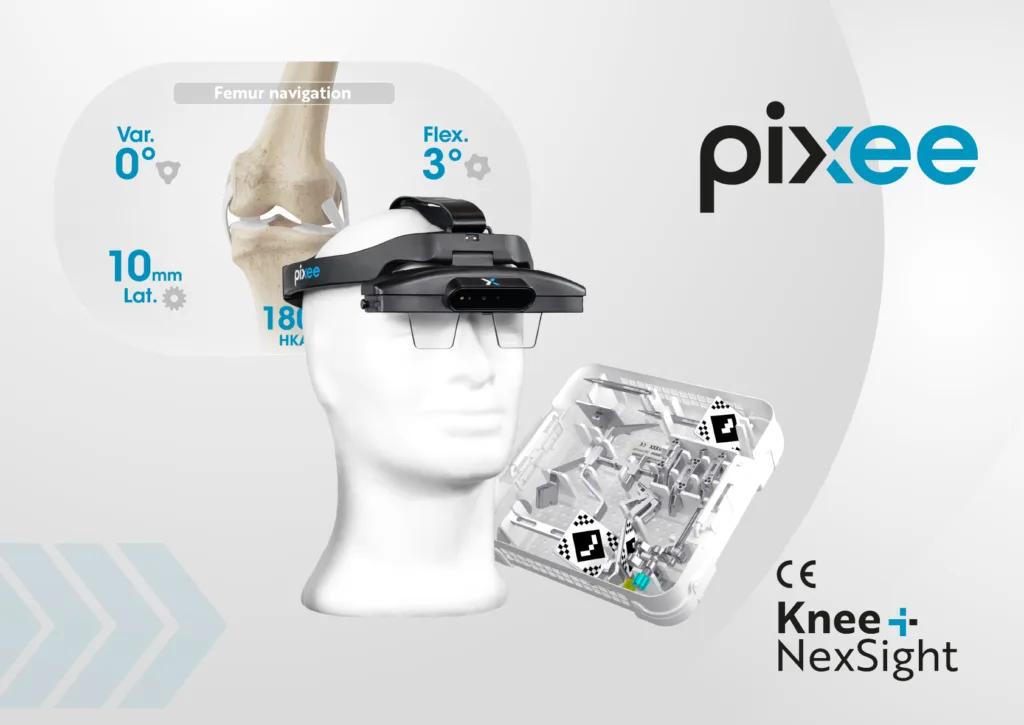
The conventional robotic systems occupying the market, which include Zimmer Biomet’s ROSA Knee, Smith and Nephew’s CORI, Johnson and Johnson’s VELYS, and Stryker’s Mako, share several characteristics relevant to this comparison: they require dedicated consoles, impose learning curves that industry literature places at 15 to 20 cases for most surgeons, and in the case of Mako and TSolution-One require preoperative CT imaging. ROSA and VELYS offer imageless alternatives, and CORI similarly avoids preoperative CT, reducing that particular barrier. What AR-based guidance offers is a substantially different form factor entirely, a wearable headset and instrumentarium rather than a robotic arm and fixed cart, with the implant-agnostic compatibility that closed-platform robotic systems cannot provide. Surgeons using Stryker Mako, ROSA, or VELYS are in practice locked into those vendors’ implant systems. Knee+ NexSight is compatible with most primary knee implants from any manufacturer, preserving the surgical and procurement relationships hospitals and ASCs already have.
What the CE mark reveals about clinical evidence and what it does not yet settle
The CE mark for Knee+ NexSight reflects conformity with EU Medical Device Regulation requirements, but the clinical evidence base for this specific device generation remains early. The 20-plus procedures completed across France and Belgium by six surgeons at the time of the CE mark announcement represent initial adoption under controlled conditions rather than a powered comparative dataset. Pixee Medical’s broader platform has accumulated over 10,000 procedures across more than 20 countries across prior device generations, providing real-world safety context. However, the accuracy and outcomes claims attached to Knee+ NexSight specifically cite a 2024 in vivo study on AR-assisted accuracy and a 2026 single-centre comparative study on alignment and blood loss reduction. These are single-centre and small-sample references by the standards expected for high-confidence regulatory or payer claims. Clinicians and procurement committees evaluating this device will be looking for multicentre, randomised or prospectively controlled data before fully equating AR guidance accuracy with robotic-assisted outcomes in their local populations.
The broader literature on AR navigation in total knee arthroplasty is still developing relative to the robotic evidence base. Industry observers note that navigation and AR systems have historically faced a long journey from initial adoption to widespread acceptance precisely because accuracy data from early adopter sites tends to outperform real-world generalised adoption outcomes, where surgeon familiarity and case volume vary considerably. The claim that Knee+ NexSight delivers robotic-level accuracy is referenced against published data, but the comparison pool, meaning which robotic systems and under what conditions, matters significantly for how clinicians interpret that assertion. Regulatory watchers suggest that the more compelling question is not whether AR achieves similar accuracy in controlled studies, but whether it holds that performance across a diverse high-volume user base in both hospital and ASC settings without the quality control mechanisms that closed robotic platforms embed in their systems.
How kinematic alignment support and implant agnosticism change the commercial calculus
Knee+ NexSight’s support for kinematic alignment strategies, as distinct from mechanical alignment, is commercially significant and clinically contested in roughly equal measure. Kinematic alignment remains an area of genuine debate in arthroplasty, with proponents arguing it produces better functional outcomes by preserving the patient’s native joint kinematics rather than targeting a standardised mechanical axis. An AR system that enables the surgeon to plan and execute personalised alignment targets, including kinematic approaches, without a dedicated robot offers a meaningful degree of flexibility that implant-tied robotic platforms structurally struggle to replicate. The surgeon retains full control over alignment philosophy, which matters to a segment of the high-volume arthroplasty community that has resisted robotic adoption partly on grounds of reduced surgical autonomy.
The implant-agnostic positioning also has procurement-level implications that go beyond clinical preference. Hospital systems and ASC networks operating under multi-vendor implant contracts do not have to restructure purchasing arrangements to introduce Knee+ NexSight across their facilities. For a device targeting high-volume outpatient environments, this removes one of the primary institutional barriers to trial. It is a structural advantage that the major closed-platform robotic vendors cannot easily replicate without undermining their own implant revenue models. Industry observers tracking the orthopedic enabling-technology market note that this dynamic is one reason earlier-generation image-free navigation systems found traction in specific market segments even as robotics grew, and why a new wearable AR iteration of that value proposition merits attention in markets where ASC growth is compressing hospital-centric robotic installation economics.
What the European launch sequence means for the global rollout strategy
The CE mark positions Pixee Medical to commercialise Knee+ NexSight across the EU market, though the European orthopedic technology landscape differs meaningfully from the U.S. context. European hospital procurement cycles are longer, reimbursement pathways for novel surgical technologies are more fragmented across member states, and the ASC model that underpins much of the U.S. commercial thesis for this device is less uniformly developed across Europe. France and Belgium, where the initial procedures were performed, are reasonable early markets given existing surgeon relationships from prior generation device use, but scaling across the EU will require country-by-country reimbursement navigation and health technology assessment engagement that takes considerably longer than regulatory clearance. The company’s $15 million capital raise, led by Relyens Innovation Sante and co-funded by UI Investissement, Innovacom, Angelor, and Bpifrance, provides runway for this expansion, though the funding round is not large by the standards of companies attempting simultaneous U.S. and European scale-up in surgical technology.
With FDA clearance already secured and the first U.S. case completed, the more commercially consequential market is already open. Pixee Medical’s announced focus on expanding Knee+ NexSight across U.S. ambulatory surgery centres places it squarely in competition not just with the robotic platform vendors, but also with PolarisAR’s STELLAR Knee system, another AR-based total knee arthroplasty guidance platform that has been active in the U.S. market. The competitive differentiation between AR platforms, as distinct from the AR-versus-robotics comparison, will be determined by evidence quality, training programme efficiency, commercial support infrastructure, and whether any of these systems build reimbursement propositions that shift payer incentives toward guidance technology adoption. None of these questions are resolved by CE mark approval or first-procedure announcements.
The unresolved questions that will determine long-term clinical and commercial acceptance
Several questions material to the long-term trajectory of Knee+ NexSight remain unanswered by this announcement. First, the accuracy parity claim requires validation in a broader surgical population: the transition from controlled early-adopter use to high-volume generalised deployment is where most guidance technologies encounter their first significant performance headwinds. Second, the voice command and heads-up display workflow, while intuitive in principle, introduces interaction modalities that surgical teams will need to integrate, and the risk of distraction or misinterpretation in a high-stakes intraoperative environment is a legitimate usability question that prospective clinical data should address. Third, the connectivity architecture enabling remote software updates and third-party digital integration raises questions about cybersecurity obligations, data governance under GDPR for European deployments and U.S. FDA Software as a Medical Device frameworks, and what clinical or liability implications flow from intraoperative software updates to a guidance system.
There is also a medium-term question about whether the robotic incumbents respond to the AR challenge through acquisition, partnership, or internal development rather than ceding the ASC segment to independent AR vendors. Stryker’s February 2026 limited launch of the Mako Robotic Precision System, a handheld robotic solution, reflects precisely this competitive pressure from lower-footprint alternatives. Smith and Nephew’s CORI, already an imageless handheld system, occupies adjacent competitive space. Regulatory watchers and clinicians tracking the field suggest the more consequential test for Knee+ NexSight is whether it can demonstrate revision-rate-level outcomes data over a two-to-five-year horizon, the metric that has historically defined durable adoption in arthroplasty technology. CE mark and first-procedure announcements establish market presence. Long-term evidence builds the case for entrenchment.

Pixee Medical receives CE mark for AR knee surgery system as FDA clearance opens U.S. ambulatory market added by Pallavi Madhiraju on
View all posts by Pallavi Madhiraju →