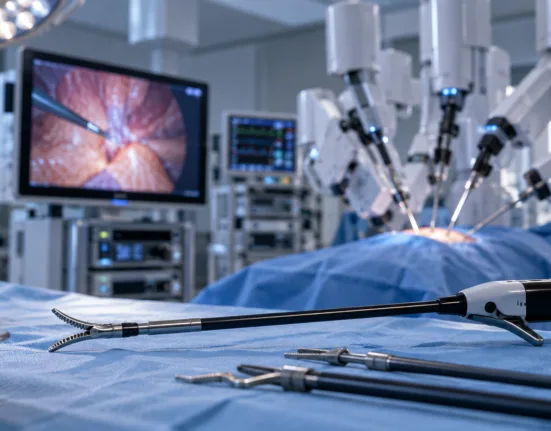
DePuy Synthes has entered into a definitive agreement to acquire selective rights to develop, manufacture and commercialise Gemtrack technology across its joint reconstruction portfolio, including shoulder, hip and knee procedures. The agreement gives the Johnson & Johnson MedTech orthopaedics business access to miniature radiofrequency tracking technology developed by MinMaxMedical for potential use in navigation and robotic-assisted surgery within the VELYS enabling technology portfolio.
Why DePuy Synthes is targeting the weakest link in orthopaedic surgical navigation
The strategic significance of the DePuy Synthes agreement is not simply that another tracking technology could be added to an existing orthopaedics platform. The more important point is that the medical device manufacturer is targeting one of the most persistent workflow constraints in computer-assisted and robotic-assisted surgery: the dependence on optical tracking systems that require direct line of sight between cameras, instruments, arrays and anatomical reference points.
For years, orthopaedic robotics and navigation have been built around a broadly similar model. Cameras track patient anatomy and surgical instruments, while reference markers or arrays help the system maintain spatial accuracy during the procedure. That model has helped bring greater planning discipline, intraoperative feedback and execution control to joint reconstruction. However, it has also created practical operating-room friction. Line-of-sight interruptions, bulky arrays, pin placement and room-setup complexity can all affect surgical rhythm, particularly in high-volume arthroplasty settings where every additional step matters.
Gemtrack appears positioned as a response to that constraint. If radiofrequency miniature tracking can deliver continuous, accurate real-time spatial data without depending on infrared cameras, the technology could make image-guided and robotic-assisted workflows less physically restrictive. That would not automatically make surgery easier, safer or faster across every use case, but it could reduce a common source of inefficiency that surgeons and operating-room teams know well. The challenge is that tracking technology must clear a high bar. In joint reconstruction, a more convenient system is only valuable if accuracy, reliability and reproducibility remain strong under real surgical conditions.
What radiofrequency miniature tracking could change in knee, hip and shoulder procedures
The most attractive part of the Gemtrack agreement is its intended reach across the broader DePuy Synthes joint reconstruction portfolio. Knee arthroplasty has historically been the most visible proving ground for robotic-assisted orthopaedics, but shoulder and hip procedures also offer meaningful opportunities for navigation, planning and precision tools. A tracking architecture that works across multiple anatomical applications could give DePuy Synthes more flexibility than a narrowly designed single-procedure technology.
In knee reconstruction, a less intrusive tracking system could support more fluid robotic-assisted workflows by reducing the dependence on patient-mounted hardware and camera positioning. In hip procedures, where anatomy, access angle and implant positioning present their own navigation challenges, continuous tracking without camera line-of-sight constraints could be particularly relevant. In shoulder arthroplasty, where glenoid placement and bone loss can make execution complex, integrated tracking could help strengthen the link between preoperative planning and intraoperative delivery.
The unresolved question is whether one radiofrequency tracking approach can perform consistently across these different procedural environments. Knees, hips and shoulders differ in surgical exposure, instrument movement, soft-tissue interference, anatomical landmarks and workflow expectations. A technology that performs well in a controlled development environment still has to prove that it can tolerate the realities of orthopaedic operating rooms. That includes interference risk, calibration demands, sterilisation compatibility, integration with implants and instruments, and the need to remain accurate even as anatomy is manipulated during surgery.
Why this deal matters for the VELYS platform and Johnson & Johnson MedTech’s robotics strategy
The agreement also reveals how DePuy Synthes is thinking about the next phase of the VELYS enabling technology portfolio. The orthopaedics market is no longer impressed by robotics as a standalone label. Hospitals, surgeons and purchasing committees increasingly ask whether a platform improves workflow, expands procedural utility, reduces variability, supports training and produces measurable clinical or economic value. In that environment, technology integration matters more than feature accumulation.
VELYS already gives DePuy Synthes a strategic base in digital surgery, robotic assistance and orthopaedic procedure support. Adding rights to Gemtrack technology could allow the portfolio to evolve from camera-dependent tracking toward a more embedded, less obtrusive guidance model. That would fit a broader medtech trend in which enabling technologies are expected to disappear into the workflow rather than dominate it. The best surgical technology, from a surgeon’s perspective, is often the technology that improves execution without forcing the team to constantly manage the tool itself.
The risk for Johnson & Johnson MedTech is execution complexity. Platform expansion requires more than acquiring rights to promising technology. DePuy Synthes will need to develop procedure-specific applications, validate performance, secure regulatory approvals and demonstrate that the resulting products add enough value to justify adoption. Orthopaedic robotics is already a competitive and capital-intensive category. Hospitals may welcome workflow simplification, but they will still assess training burden, system cost, service support, procedure volume and compatibility with existing surgical preferences.
How this could affect competition in robotic-assisted orthopaedic surgery
The deal should also be read in the context of an increasingly competitive orthopaedic robotics market. Companies in joint reconstruction are trying to differentiate not only through implants, but through digital ecosystems that connect planning, navigation, robotics, data and postoperative insights. The winners are likely to be those that make these systems feel clinically useful rather than technically impressive in isolation.
If DePuy Synthes can commercialise radiofrequency tracking at scale, it could create a new competitive talking point against systems that remain more dependent on optical tracking and line-of-sight management. That does not mean optical systems are obsolete. Infrared camera-based navigation has a substantial track record and remains deeply embedded in many platforms. However, the promise of a smaller, less line-of-sight-dependent tracking method could resonate strongly with surgeons frustrated by array placement, camera obstruction or setup interruptions.
The industry should be careful not to overstate the near-term impact. This is not yet a commercial product announcement across the joint reconstruction portfolio. DePuy Synthes has indicated that further milestones and timing will depend on development and regulatory pathways. That means the competitive effect will unfold only if the technology translates into approved, reliable and scalable products. Rivals will watch closely, but they are unlikely to change strategy until DePuy Synthes can show clinical workflow advantages in real procedures.
Why regulatory approval may be the real test of Gemtrack’s commercial potential
For a tracking technology used in navigation and robotic applications, regulatory scrutiny will focus on accuracy, safety, reliability and clinical performance. The bar is especially high because intraoperative tracking can influence surgical decisions and implant positioning. Any system that claims to support real-time guidance must show that its data remains trustworthy under conditions that resemble actual surgery.
That creates a key distinction between technical promise and regulatory-commercial readiness. Miniature radiofrequency tracking may offer an elegant solution to line-of-sight limitations, but regulators will need evidence that the technology performs consistently across patients, anatomy, procedure types and operating-room environments. They may also examine how the system manages potential signal interference, how it alerts users to tracking uncertainty, and how it behaves when instruments or patient anatomy move unexpectedly.
For DePuy Synthes, the advantage is that the technology is being pursued within an established orthopaedics and medtech infrastructure. Johnson & Johnson MedTech has the regulatory, quality, manufacturing and commercial capabilities needed to take a promising surgical technology through development. Even so, the pathway may not be simple. Each use case across knee, hip and shoulder reconstruction may require its own validation logic, and robotic applications may face more demanding scrutiny than navigation-only tools.
What surgeons and hospitals will need before changing workflows
Surgical adoption will depend on whether Gemtrack-enabled systems can solve a problem that surgeons feel daily, without introducing a new layer of complexity. Orthopaedic surgeons are pragmatic technology adopters. They may be open to robotics and navigation when these tools improve confidence, reproducibility and planning execution. However, they are less patient with systems that slow procedures, increase staffing dependence or require extensive setup before benefits are visible.
A radiofrequency tracking system that reduces camera positioning constraints and minimises intrusive anchors could make a compelling workflow argument. In busy arthroplasty centres, even small reductions in setup friction can matter if they improve predictability across cases. Hospitals may also be interested if the technology reduces reliance on bulky components, simplifies room configuration or supports broader use of robotic-assisted surgery without excessive operational disruption.
The limitation is that workflow claims must be proven in practice. Surgeons will want to see whether the technology improves case flow across different teams, not just in expert hands. Hospitals will ask whether it shortens training curves, reduces procedural variability or supports better utilisation of robotic assets. Payers and health systems may still require evidence that the technology produces outcomes or efficiency gains that justify investment. Convenience alone rarely carries a premium in medtech unless it is linked to measurable clinical or economic value.
Why MinMaxMedical gives DePuy Synthes a specialised innovation route rather than a conventional acquisition story
The role of MinMaxMedical is also important. The Grenoble-based developer brings a focused surgical innovation background, while DePuy Synthes brings global orthopaedic scale. This type of selective rights agreement can be attractive in medtech because it allows a large device company to access differentiated engineering without necessarily acquiring an entire business or platform outright.
For DePuy Synthes, the structure appears targeted and portfolio-specific. The rights cover development, manufacture and commercialisation across joint reconstruction, including navigation and robotic applications. That gives Johnson & Johnson MedTech a defined path to integrate Gemtrack into VELYS-related opportunities while leaving room for product development and regulatory sequencing. It is a classic medtech scaling play: identify a specialist technology, align it with an existing commercial platform, then use global infrastructure to turn it into a procedural standard.
The risk is that selective rights still require deep integration. Surgical robotics is not plug-and-play. Tracking hardware, software, instruments, surgical planning systems, implants and user interfaces must work as one coherent system. If the integration feels fragmented, the technology could remain promising but commercially underpowered. DePuy Synthes will need to make Gemtrack feel native to the VELYS ecosystem rather than an added layer attached to it.
What industry observers will watch next as DePuy Synthes advances the programme
The next meaningful signals will be development milestones, regulatory submissions, procedure-specific product details and early clinical or usability evidence. Industry observers will want to know whether DePuy Synthes first targets knee arthroplasty, where VELYS already has market visibility, or whether it prioritises a broader multi-joint positioning from the outset. The sequencing will matter because early adoption success often depends on choosing the procedure where the problem is clearest and the commercial pathway is most efficient.
Another key question is whether the technology can reduce invasive anchors in a way that materially changes surgeon perception. The announcement points to potential reductions in reliance on invasive anchors, but the final product architecture will determine how meaningful that becomes. If Gemtrack can reduce pin burden while preserving tracking confidence, that could become a strong differentiator. If invasive fixation remains necessary in many cases, the line-of-sight advantage may still matter, but the overall adoption story may be more incremental.
The broader implication is that orthopaedic robotics may be moving into a new phase. The first phase proved that robotic-assisted workflows could enter mainstream joint reconstruction. The next phase may be about making those workflows less intrusive, more integrated and easier to scale. DePuy Synthes is betting that miniature radiofrequency tracking can help remove one of the category’s nagging physical constraints. The opportunity is substantial, but the real test will come when the technology has to perform not in a development narrative, but in the crowded, time-sensitive and unforgiving environment of the operating room.