
Long Bridge Medical, Inc. has received U.S. Food and Drug Administration clearance to begin an Investigational Device Exemption study of LensOne, its investigational prosthetic capsular bag for patients who need secondary intraocular lens fixation but lack adequate capsular support and are poor candidates for anterior chamber intraocular lenses. The IDE clearance allows the South San Francisco ophthalmic device developer to launch the GOLDEN GATE pivotal trial after the device had already received FDA Breakthrough Device Designation, moving LensOne from early feasibility into a more consequential evidence-building stage.
Why the LensOne pivotal study could matter more than a routine IDE clearance in ophthalmic devices
What makes this announcement important is not simply that another ophthalmic implant has reached a pivotal study. The more consequential question is whether Long Bridge Medical can turn one of anterior segment and vitreoretinal surgery’s most technically awkward problems into something more reproducible, anatomically intuitive, and commercially scalable. Eyes without sufficient capsular or zonular support remain a challenging subgroup because surgeons currently rely on a patchwork of options that include anterior chamber intraocular lenses, iris fixation, and scleral fixation, each with its own learning curve, complication profile, and case-selection bias.
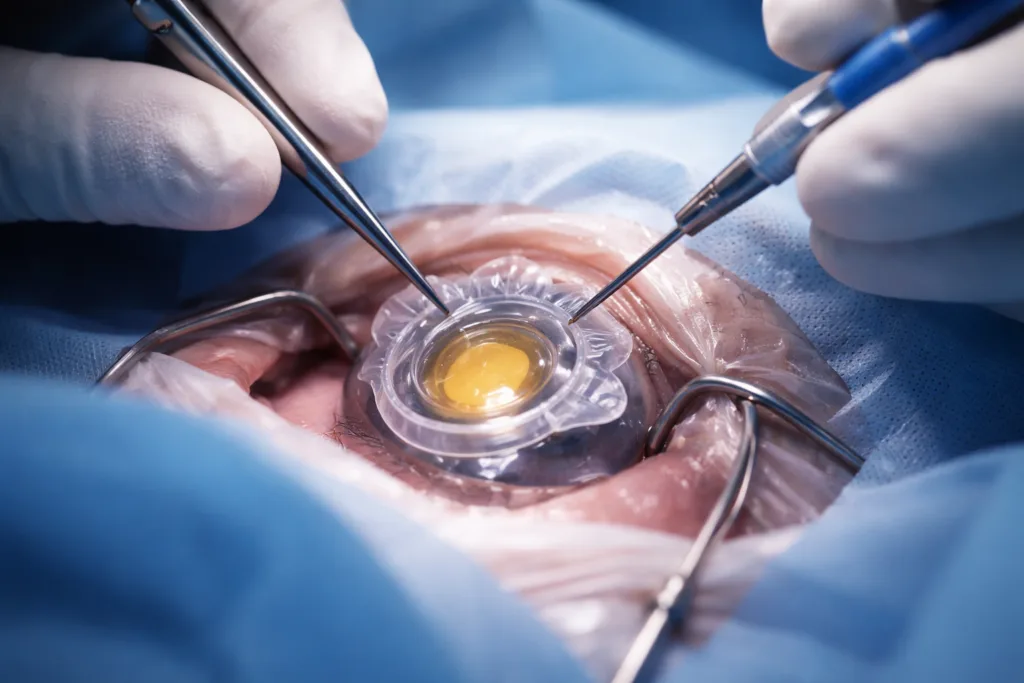
This is the real strategic opening for LensOne. Rather than asking surgeons to master yet another variation of off-label fixation technique, the device is positioned as a prosthetic capsular bag that restores an anatomic foundation for posterior chamber lens implantation in eyes where native support has been lost or compromised. Long Bridge Medical is effectively betting that the market does not just need another way to fixate an intraocular lens, but a way to make that fixation feel more familiar and more repeatable for surgeons working in difficult anatomy. That distinction matters because in ophthalmology, technical elegance alone rarely changes practice. Adoption usually follows when a device reduces procedural variability, lowers the dependence on individual artisanal skill, and fits into existing surgical habits.
What Long Bridge Medical is really trying to solve in secondary intraocular lens fixation
The company’s positioning reflects a real clinical pressure point. Patients who present with aphakia, trauma-related instability, or late intraocular lens dislocation often land in a zone where the surgeon is balancing anatomy, comorbidity, endothelial risk, long-term stability, and operative complexity all at once. For years, the field has made progress with scleral-sutured approaches, sutureless intrascleral methods such as the Yamane technique, and selected anterior chamber strategies. But the broader problem remains only partially solved because the field has advanced through technique refinement more than through true platform standardisation.
That is why LensOne matters beyond the company itself. The device is not just another implant candidate. It is an attempt to move secondary intraocular lens fixation away from a world dominated by surgeon improvisation and toward a more standardised procedural framework. If that sounds ambitious, it is. But it is also exactly the kind of ambition that tends to attract attention in ophthalmology when a device targets a high-friction surgical niche that many surgeons recognise as difficult, inconsistent, and underserved.
Why the absence of a clearly superior secondary IOL technique creates room for a new platform
Current alternatives remain clinically useful but imperfect. Scleral fixation can preserve a posterior chamber lens position but may involve technical complexity, suture-related issues, or variability depending on surgeon experience. The Yamane technique has gained visibility because it avoids sutures and can produce good outcomes in experienced hands, but it is also operator dependent and not universally reproducible across the broader cataract and retina community. Anterior chamber intraocular lenses still have a role in selected cases, yet they are not ideal for every anatomy or risk profile.
That leaves the market in an unusual position. There are several workable approaches, but no universally accepted, standardised solution that can claim broad superiority across safety, ease, and long-term stability. This kind of fragmented treatment landscape is exactly where a platform-style device can become interesting. Long Bridge Medical appears to understand that it does not need to prove LensOne is better than every existing method in every scenario. It needs to show that for a clearly defined subset of difficult eyes, it can make a hard procedure more dependable and more repeatable.
How the GOLDEN GATE study may determine whether LensOne is scalable beyond expert surgeons
This is where the GOLDEN GATE study becomes more important than the announcement itself. According to the company, the pivotal trial will be a prospective, multicenter study evaluating safety and effectiveness in patients with intraocular lens dislocation who are poor candidates for anterior chamber intraocular lenses. That design matters because multicenter evidence is often where a device either demonstrates real-world transferability or reveals that its promise is confined to a few highly skilled hands.
Long Bridge Medical has said it previously reported 12-month first-in-human data in 15 patients that showed a favorable safety and performance profile, with those findings presented in 2025 by J. Michael Jumper, MD, President of the American Society of Retina Specialists, at the group’s annual meeting. That is directionally encouraging, but the sample is still small enough that it should be treated as feasibility evidence rather than adoption-defining proof. Small early studies can show that a concept works. They usually do not answer whether it works consistently across broader anatomy, across different surgeons, and across the messy variability of routine clinical practice.
That gap between feasibility and scalability is where many device stories become more difficult. A surgeon-friendly concept on paper does not always translate into a product that can withstand differences in technique, case selection, and postoperative management. LensOne’s real test will not be whether it can be implanted successfully in a limited series. The real test will be whether the pivotal study shows that it can reduce unpredictability in a way that matters clinically and operationally.
What this FDA Breakthrough Device context changes and what it still does not guarantee
The prior FDA Breakthrough Device Designation adds a useful layer of context, but it should not be misunderstood. The designation signals that regulators see potential relevance for an unmet need and are willing to support more interactive and potentially faster development pathways. What it does not do is validate the final clinical case. Breakthrough designation is process support, not product endorsement.
For Long Bridge Medical, that matters in two ways. First, it gives the company a stronger credibility signal in a niche ophthalmic segment where surgeon trust and regulatory seriousness matter. Second, it raises expectations. Once a device has both Breakthrough status and IDE clearance for a pivotal study, observers expect the evidence package to begin answering more mature questions about safety durability, workflow practicality, and comparative relevance. In other words, the regulatory halo helps get attention, but it also sharpens scrutiny.
What could still go wrong as LensOne tries to move from concept to standard of care
The unresolved questions are substantial. Long-term safety remains one of the biggest. In secondary intraocular lens fixation, short-term procedural success is important, but long-term stability, endothelial impact, inflammation risk, decentration, tilt, and reoperation burden may matter even more. A device that looks elegant at 12 months may face a very different judgment if complications emerge over a longer follow-up window.
There is also the issue of patient selection. The phrase poor candidates for anterior chamber intraocular lenses is directionally useful, but commercial and clinical adoption will depend on how precisely Long Bridge Medical defines the subgroup in which LensOne offers meaningful value over established posterior chamber fixation options. If that subgroup is too narrow, the opportunity may remain limited. If it is too broad, the company may struggle to persuade experienced surgeons that they should change practice patterns that already work reasonably well in their own hands.
Training and workflow will also matter more than many early-stage device narratives admit. Even if LensOne is conceptually simpler, hospitals and surgical centers will still ask whether it fits existing operating room routines, whether the learning curve is truly lower than competing methods, and whether any reduction in variability is large enough to justify adoption. Reimbursement and procedural economics could also become a quiet but important hurdle, especially if the device adds cost in a category where surgeons are already accustomed to solving the problem using off-label methods and existing tools.
What clinicians, regulators, and industry observers are likely to watch next
The next phase of attention will likely center on several practical questions. Clinicians will want to know whether the procedure is genuinely easier to reproduce than scleral fixation techniques, whether LensOne supports stable and predictable intraocular lens positioning, and whether complication patterns are reduced or merely shifted. Regulators will focus on whether the pivotal study design and endpoints are robust enough to support a compelling benefit-risk profile in a small but meaningful unmet-need population.
Industry observers will likely watch for signs that Long Bridge Medical is building not just a trial, but a pathway to category creation. That means looking at surgeon advocacy, site selection, training burden, evidence quality, and whether the company can frame LensOne as a platform answer to a persistent structural problem in ophthalmic surgery. If it succeeds, this could become a notable niche medtech story in anterior and posterior segment crossover care. If it falls short, the field may conclude that absent capsular support remains less a device opportunity than a permanent domain of surgical craftsmanship.
The broader takeaway is that LensOne represents a more ambitious thesis than the press release initially suggests. Long Bridge Medical is not merely advancing an implant into a pivotal study. It is testing whether a difficult corner of ophthalmic surgery can be made more standardised through hardware rather than through ever more refined technique. That is a meaningful proposition, and the FDA clearance matters because it moves that proposition out of theory and into a real evidentiary test.

