Capitan Orthopedics, Inc. has received U.S. Food and Drug Administration Breakthrough Device Designation for its SupraSpacer implant, a shoulder surgery technology designed for patients with irreparable rotator cuff tears. The designation places SupraSpacer within a regulatory pathway intended for devices that may address serious or irreversibly debilitating conditions and may offer more effective treatment or diagnosis than existing options.
Why SupraSpacer’s FDA Breakthrough Device Designation matters for irreparable rotator cuff tear treatment
The strategic significance of the SupraSpacer designation is not that the implant has reached the market, but that the U.S. Food and Drug Administration has accepted the underlying unmet-need argument as serious enough to qualify for its Breakthrough Devices Program. For Capitan Orthopedics, Inc., that changes the regulatory conversation from a conventional implant development pathway to one that could allow closer interaction with regulators, more structured feedback, and potentially faster review if the technology later meets the evidence threshold for authorization.
That distinction matters because irreparable rotator cuff tears occupy one of the more frustrating spaces in shoulder care. Many rotator cuff injuries can be repaired surgically, but once the tendon is too damaged, retracted, or biologically compromised, traditional repair becomes less feasible. The source announcement states that more than 2 million people a year are diagnosed with a rotator cuff injury and more than 700,000 undergo surgery for a primary rotator cuff tear, while emphasizing that a subset of patients remains poorly served when the tear is irreparable.
The clinical gap is especially relevant in younger and active patients. Reverse shoulder replacement can be a powerful option in older patients with cuff tear arthropathy or severe functional decline, but it is not always an ideal early intervention for patients under 60 because of implant longevity, revision complexity, activity expectations, and the desire to preserve future surgical choices. SupraSpacer is being positioned as a joint-preserving implant intended to restore alignment, reduce pain, and maintain range of motion while keeping later treatment options open. That positioning is clinically attractive, but it also raises the central evidence question: can the device show durable functional improvement without accelerating the very degenerative pathway it aims to delay?
What the Breakthrough Devices Program could enable, and what it does not guarantee
The Breakthrough Devices Program is often misunderstood as a shortcut to approval. It is not. The U.S. Food and Drug Administration describes the program as a voluntary pathway for certain medical devices and device-led combination products that may provide more effective treatment or diagnosis for life-threatening or irreversibly debilitating diseases or conditions. The agency also states that the program is designed to speed development, assessment, and review while preserving the statutory standards for premarket approval, 510(k) clearance, and De Novo marketing authorization.
For Capitan Orthopedics, Inc., the practical benefit is likely to be regulatory access rather than regulatory certainty. Breakthrough status can support more frequent interaction with the agency, earlier discussion of clinical evidence expectations, and a clearer view of what the device must prove before commercialization. That could be particularly useful for an implant aimed at a difficult orthopedic indication where patient selection, comparator choice, endpoint durability, and safety follow-up are not straightforward.
The unresolved issue is the evidentiary bar. SupraSpacer’s premise depends on biomechanical restoration, pain reduction, functional improvement, and preservation of future surgical pathways. Regulators, surgeons, payers, and ambulatory surgery centers will need more than a compelling mechanism. They will likely look for meaningful improvements in shoulder function scores, range of motion, pain outcomes, adverse event rates, revision rates, progression of arthritis, and durability across different tear patterns. Breakthrough designation may accelerate the conversation, but the device will still need data strong enough to change clinical behavior.
How SupraSpacer is being positioned between soft tissue repair and reverse shoulder replacement
SupraSpacer appears to be targeting the treatment gap between failed or impossible soft tissue repair and reverse shoulder arthroplasty. That is a commercially interesting space because it is not defined only by surgical technique. It is defined by timing. A joint-preserving device that can be used before end-stage degeneration could appeal to surgeons who want an intermediate option for patients who are too symptomatic for conservative care but not ideal candidates for replacement.
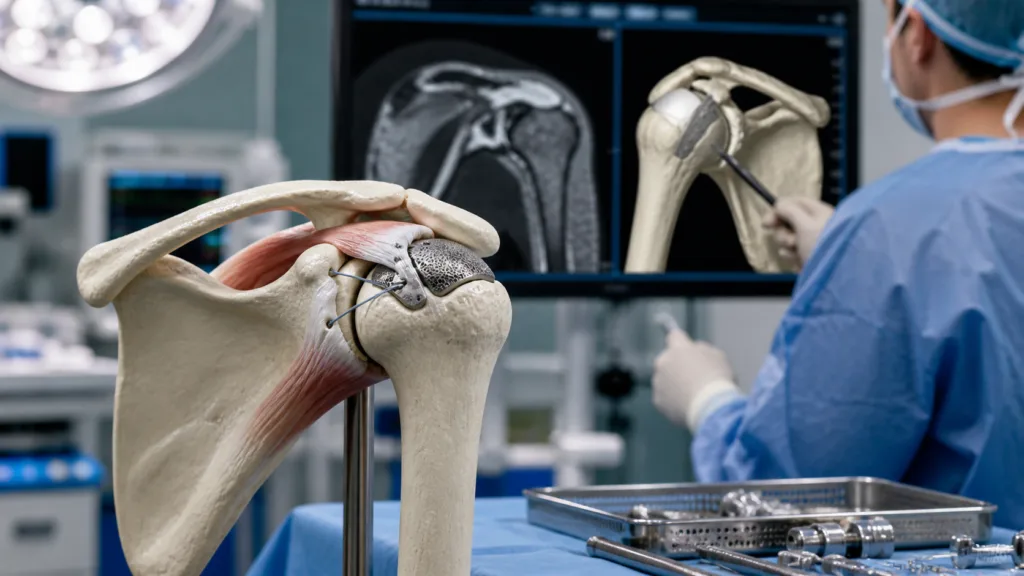
The implant’s stated design logic is biomechanical. Capitan Orthopedics, Inc. says the technology is intended to help keep the humeral head centered in the joint, reduce painful contact between the humeral head and the undersurface of the acromion, lower the risk or progression of shoulder arthritis, and allow impingement-free range of motion. The lead surgeon designer, R. Sean Churchill, MD, MBA, framed the device as a simple and repeatable surgical option intended to improve outcomes and workflow.
That workflow claim could become important if the product advances. Orthopedic adoption is often shaped by how easily a new procedure fits into existing operating room routines, how reproducible it is across surgeons, and whether it can be performed efficiently in an ambulatory surgery center. Capitan Orthopedics, Inc. is already positioning the SupraSpacer system for the ambulatory surgery center setting with sterile-packaged instruments and implants. That could help the commercial case, but only if clinical results are strong enough and reimbursement pathways support the procedure economics.
Why ambulatory surgery centers could become a key test for SupraSpacer adoption
The ambulatory surgery center angle is more than a packaging detail. Shoulder surgery has increasingly moved toward outpatient and efficiency-driven care models, and any implant that claims to solve a difficult problem while fitting into streamlined surgical workflows will be judged partly on procedural predictability. A device that requires a steep learning curve, long operating time, complex instrumentation, or high revision concern would face resistance even if the underlying clinical concept is promising.
SupraSpacer’s commercial opportunity therefore depends on three linked variables: surgeon confidence, facility economics, and payer acceptance. Surgeons will need confidence that the implant addresses pain and function in a reproducible way. Ambulatory surgery centers will need confidence that the procedure can be scheduled, stocked, and performed efficiently. Payers will need evidence that the implant reduces downstream costs, delays or avoids more invasive procedures, or improves outcomes enough to justify coverage.
That is where Breakthrough Device Designation could become strategically useful, especially in the current reimbursement environment. U.S. health regulators recently announced a RAPID coverage pathway intended to coordinate regulatory review and Medicare coverage decisions for certain FDA-designated Class II and Class III breakthrough devices, with the goal of reducing delays between approval and reimbursement. That does not automatically mean SupraSpacer will qualify or secure coverage, but it shows why breakthrough status can matter beyond the regulatory desk.
What clinicians and regulators will likely watch as SupraSpacer moves forward
The biggest clinical question is whether SupraSpacer can generate durable outcomes in a patient population that is inherently heterogeneous. Irreparable rotator cuff tears vary by tear size, tendon quality, fatty infiltration, patient age, activity level, baseline arthritis, muscle function, and prior procedures. A device that works well in one subgroup may not perform as well in another. That makes trial design and patient selection central to the product’s future.
Regulators will likely focus on whether the selected endpoints match the claimed benefit. Pain relief alone may not be enough if the device is also positioned around restored alignment, preserved motion, reduced impingement, and delayed disease progression. Functional scores, imaging outcomes, revision rates, adverse events, and longer-term follow-up could all matter. The more Capitan Orthopedics, Inc. frames SupraSpacer as a joint-preserving alternative to later-stage surgery, the more stakeholders will ask whether the implant changes the disease pathway or mainly provides symptom relief.
Industry observers will also watch how SupraSpacer compares with other strategies for massive and irreparable rotator cuff tears, including superior capsular reconstruction, tendon transfers, partial repair, balloon spacers, debridement, biologic augmentation, and reverse shoulder arthroplasty in selected cases. The device does not need to replace all of those approaches to be commercially relevant. It needs to define the patient segment where its risk-benefit profile is most compelling.
Why this designation could strengthen Capitan Orthopedics’ investment story but not remove execution risk
For an emerging orthopedic implant developer, Breakthrough Device Designation can be a powerful credibility marker. It signals that the regulatory agency sees the target condition and device rationale as potentially important enough to warrant enhanced engagement. That can support fundraising, surgeon interest, clinical site recruitment, and strategic partnership discussions. Capitan Orthopedics, Inc. is backed by Genesis Innovation Group, Inc., and the announcement clearly frames SupraSpacer as a first-in-class opportunity for a large underserved patient population.
However, investors and commercial partners will still separate designation from derisking. Orthopedic devices face long development cycles, procedure adoption hurdles, training demands, reimbursement uncertainty, and evidence-generation costs. Even promising implants can struggle if clinical results are mixed, if the target population is narrower than expected, or if surgeons find the procedure less predictable than competing approaches. Breakthrough status may improve the path, but it does not erase the burden of proof.
The more interesting takeaway is that shoulder innovation may be moving toward joint-preserving procedural solutions for patients who sit between repair and replacement. That is a meaningful theme in orthopedics because it reflects a broader push to treat patients earlier, preserve anatomy longer, and avoid committing younger patients to irreversible surgical pathways too soon. SupraSpacer is now more visible in that conversation. The next test is whether Capitan Orthopedics, Inc. can convert regulatory momentum into clinical evidence that changes how surgeons think about irreparable rotator cuff tears.