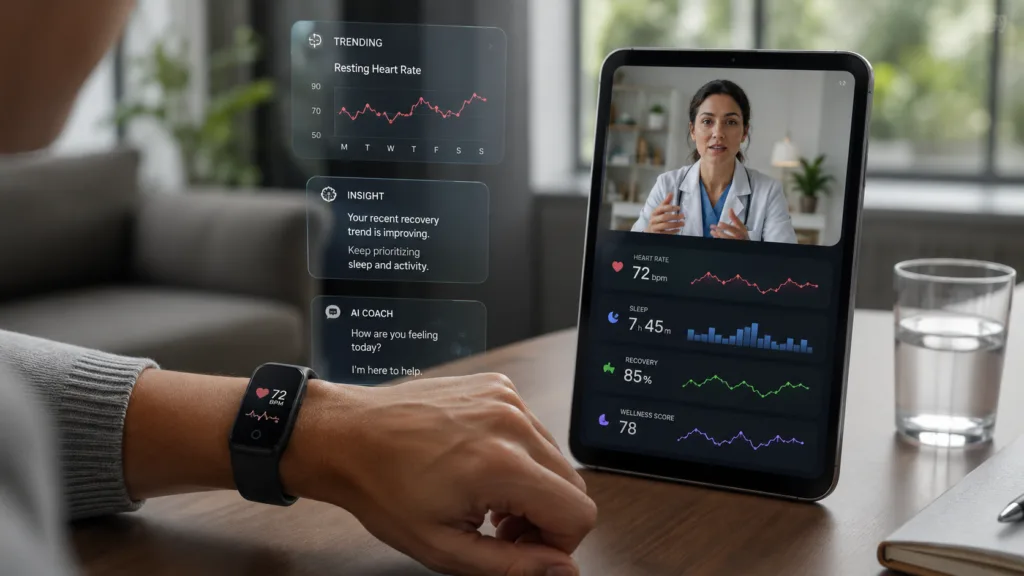
WHOOP has announced new health and artificial intelligence features for its wearable membership platform, including on-demand clinician consultations, Electronic Health Record syncing, My Memory for WHOOP AI, Proactive Check-Ins, and a redesigned WHOOP Journal. The update moves the Boston-based human performance company further beyond fitness tracking and into a more clinically connected digital health model, where continuous biometric data, user context, bloodwork, and medical history can be combined inside one consumer health platform.
Why WHOOP’s clinician access move changes the boundary between fitness tracking and healthcare engagement
WHOOP’s expansion into live clinician consultations marks a more meaningful shift than another software update for a wearable device. The central change is that WHOOP is trying to connect continuous health tracking with professional interpretation inside the same app environment. That matters because most wearable platforms have historically generated large volumes of sleep, strain, recovery, heart rate, and wellness data without necessarily closing the loop between data collection and clinical reasoning.
The commercial logic is straightforward but strategically ambitious. If a member can move from a recovery score or abnormal trend to an on-demand video consultation, WHOOP begins to resemble a longitudinal health engagement layer rather than a passive tracker. This could help the company defend its subscription model, increase member dependence on the platform, and create a higher-value membership experience at a time when Apple Inc., Google Fitbit, Garmin Ltd., Oura Health Oy, and other connected health players are competing for daily health attention.
The unresolved question is whether clinician access inside a performance wearable can scale without blurring boundaries around diagnosis, medical responsibility, liability, and regulatory positioning. Continuous biometric data can be useful context, but it can also generate ambiguity when members interpret wellness signals as medical indicators. WHOOP will need to manage that tension carefully, especially as its platform increasingly links consumer-grade engagement with clinician-facing workflows.
How Electronic Health Record syncing could give WHOOP a stronger data advantage in personalized health
The planned Electronic Health Record syncing through HealthEx is one of the most strategically important parts of the announcement because it gives WHOOP a route into structured clinical context. Wearables often know how a person sleeps, trains, recovers, and responds to stress, but they do not always know enough about diagnoses, medications, procedures, or clinical history to personalize insights responsibly. EHR integration could help reduce that blind spot.
For WHOOP, this creates a richer data moat. Recovery, strain, heart rate variability, sleep trends, blood biomarker analysis, medication context, and clinical history become more powerful when interpreted together. A member taking a new medication, recovering from a procedure, or managing a chronic condition may see changes in sleep, recovery, or strain tolerance. WHOOP’s ability to connect those signals could make its coaching feel less generic and more clinically aware.
However, EHR syncing also raises the stakes around privacy, consent, data governance, and user trust. Health data platforms that aggregate biometric and clinical information must convince members that personalization will not come at the cost of control. WHOOP’s My Memory feature, which allows members to view, manage, add, edit, or delete personal context used by WHOOP AI, appears designed partly to address this issue. The harder test will be whether users understand which data is being used, how insights are generated, and where the line sits between coaching, wellness guidance, and medical interpretation.
Why WHOOP AI is becoming less of a chatbot and more of a persistent health context layer
The My Memory and Proactive Check-Ins updates show that WHOOP is trying to move artificial intelligence beyond reactive question-answering. Instead of waiting for members to ask why their recovery score dropped or whether they should train harder, WHOOP AI is being positioned as a context-aware coaching layer that remembers goals, habits, travel, upcoming events, and user preferences. That is a major product direction because health coaching becomes more valuable when it understands the real-world context behind the data.
This is where WHOOP’s continuous data model becomes commercially interesting. A wearable device can detect changes in sleep, recovery, strain, heart rate, and behavior patterns, but a useful coach must know why those changes matter. Travel, stress, alcohol intake, supplements, illness, menstrual cycle changes, workload, and training intensity can all distort signals. WHOOP’s redesigned Journal, with voice and text logging, is meant to reduce friction around capturing those inputs.
The risk is that proactive coaching can become noisy if recommendations are too frequent, too obvious, or too weakly connected to meaningful outcomes. Members may tolerate data collection if they receive useful insights in return, but they may disengage if the platform feels intrusive or repetitive. WHOOP’s challenge will be to prove that its AI layer can improve decision quality rather than simply produce more notifications.
Why WHOOP’s clinical direction puts it closer to preventive health but not fully inside healthcare
WHOOP’s move should not be confused with becoming a traditional healthcare provider. The platform still sits largely in the consumer health, wellness, performance, and longevity ecosystem. Even so, clinician access, blood biomarker analysis, ECG features, blood pressure insights, EHR syncing, and AI coaching collectively move WHOOP closer to preventive health engagement than most conventional fitness trackers.
That positioning could be powerful because healthcare systems remain episodic, while wearable data is continuous. A physician may see a patient a few times a year, but WHOOP can track patterns across sleep, exercise, recovery, and stress every day. If clinician consultations begin with months of biometric history, the encounter may feel more informed than a traditional snapshot-based visit. This could appeal to performance-focused consumers, executives, athletes, military users, and longevity-minded members who want faster interpretation of their own data.
The limitation is that continuous data does not automatically equal better care. False reassurance, false alarm, measurement variability, and user misinterpretation are all familiar challenges in digital health. WHOOP’s success will depend on how clearly it communicates the role of its tools, how clinicians use the data, and whether outcomes improve enough to justify the membership economics.
How WHOOP’s expansion affects competition across wearables, telehealth, and longevity platforms
WHOOP is moving into a competitive zone where several sectors overlap. Apple Inc. has built deep health features into the Apple Watch. Oura Health Oy has gained traction around sleep, recovery, and readiness. Google Fitbit remains a recognizable consumer health brand. Telehealth platforms offer clinician access, while longevity and biomarker companies offer blood testing and personalized health dashboards. WHOOP is trying to bundle parts of all these models into a membership experience built around continuous performance data.
That bundling strategy could help WHOOP differentiate itself. The screen-free hardware, subscription model, performance identity, and elite-athlete association have always separated WHOOP from broader smartwatch platforms. By adding clinician access and deeper AI personalization, WHOOP is seeking to make its membership feel less like a device purchase and more like an ongoing health operating system.
The competitive risk is that larger platforms have stronger distribution, deeper operating system integration, and broader consumer reach. Apple Inc. can embed health features across devices and services. Google can leverage Android and Fitbit. Healthcare incumbents can use payer, provider, and employer relationships. WHOOP’s advantage lies in depth of engagement, but it must keep proving that its subscription delivers value beyond what users can get from devices they already own.
Why regulatory and reimbursement uncertainty remains the key pressure point for WHOOP’s health platform
WHOOP’s direction raises important questions about regulatory interpretation, especially as consumer wellness, clinical insight, and medical device functionality increasingly overlap. Features such as ECG, blood pressure insights, biomarker analysis, and clinician consultations can sit in different regulatory and commercial categories depending on claims, intended use, and how results are presented to users. The more WHOOP emphasizes health support rather than performance tracking, the more carefully it must manage language, workflows, and clinical escalation.
Reimbursement is another open question. WHOOP’s current model is membership-led, which gives it direct-to-consumer control but may limit adoption among populations unwilling to pay out of pocket. If WHOOP wants to move deeper into healthcare, employer wellness programs, payer partnerships, clinician referrals, or enterprise health channels could become more important. However, those channels usually demand stronger evidence, clearer outcomes, and more formal compliance processes.
The near-term opportunity is not necessarily reimbursement in the traditional sense. WHOOP may instead use clinician access and EHR integration to justify premium membership pricing, improve retention, and deepen engagement among members who already view health optimization as a paid service. That could be commercially attractive even before broader healthcare reimbursement enters the picture.
What clinicians, regulators, and health-tech investors are likely to watch next
Clinicians are likely to watch whether WHOOP’s data improves consultation quality or merely adds another stream of information to interpret. Continuous recovery, strain, and sleep data may be useful, but clinical relevance depends on context, accuracy, and how the information changes decisions. The strongest use cases may emerge in prevention, behavior change, recovery management, and performance optimization rather than acute diagnosis.
Regulators will likely focus on claims, data handling, algorithmic interpretation, and whether users could rely on wellness signals for medical decisions. The addition of clinician access may help create a safer interpretation layer, but it also makes governance more important. If WHOOP can keep the product clearly framed while offering more meaningful clinical context, it may find a workable middle ground between wellness and healthcare.
Investors and industry observers will watch whether WHOOP’s platform expansion supports stronger retention, higher average revenue per member, and international scalability. The company’s broader challenge is to show that it is not just another wearable hardware business. Its clinician access, EHR syncing, AI memory, proactive coaching, and biomarker-linked insights point toward a larger ambition: becoming a continuous health intelligence platform for high-engagement consumers.
For now, the most important signal is not simply that WHOOP added clinicians or AI features. The bigger signal is that the consumer health market is moving toward platforms that combine biometric data, clinical context, and personalized interpretation. WHOOP is betting that the winning wearable will not be the one that collects the most data, but the one that turns that data into trusted, timely, and actionable health decisions.