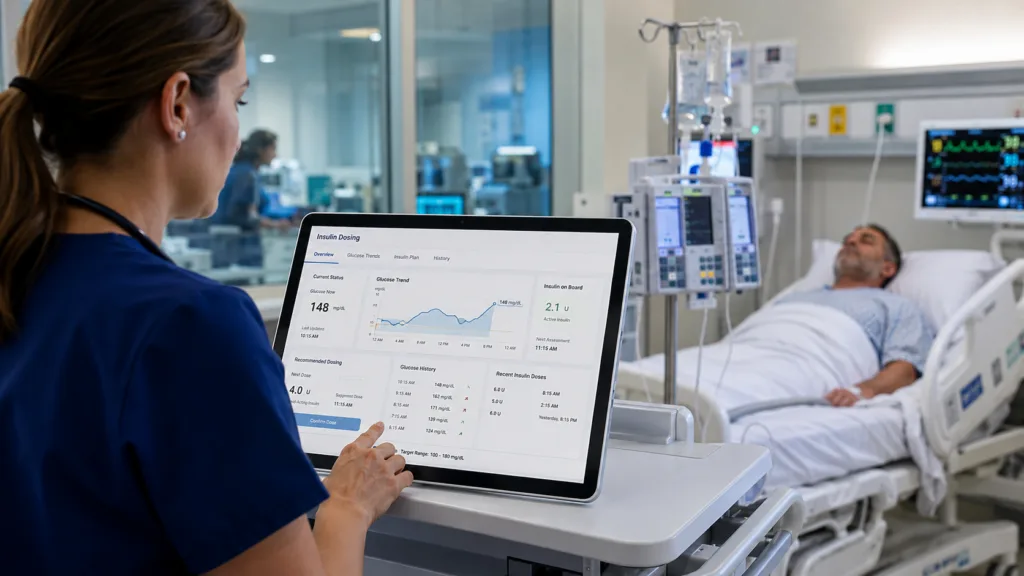
Glooko, Inc. has received U.S. Food and Drug Administration 510(k) clearance for EndoTool IV Cloud, a cloud-based version of its patient-specific insulin dosing platform for hospitalized patients requiring intravenous insulin therapy. The clearance moves Glooko’s inpatient diabetes technology strategy beyond on-premise deployment and into a cloud architecture aimed at hospital scalability, centralized maintenance, and broader glycemic safety workflows.
Why Glooko’s cloud clearance matters beyond another diabetes software milestone
The regulatory clearance is not simply another software update in digital diabetes care. It signals a shift in how inpatient insulin dosing tools may be deployed across hospital systems that are under pressure to standardize care, reduce avoidable glycemic events, and lower the informatics burden attached to bedside decision support. Intravenous insulin dosing remains a high-risk clinical workflow because dosing decisions are frequent, patient responses can change quickly, and protocol variation can expose hospitals to safety and quality gaps.
For Glooko, the genuinely new element is the cloud deployment model rather than a new dosing algorithm. EndoTool IV Cloud uses the same core insulin dosing algorithm as the existing EndoTool IV platform, which means the commercial story rests less on clinical novelty and more on operational scalability. That distinction matters. Hospitals evaluating the platform will likely ask whether cloud delivery can reduce implementation friction, simplify updates, and support multi-site consistency without introducing new cybersecurity, downtime, or integration risks.
That also places the clearance in a more cautious regulatory context. A 510(k) clearance indicates that the device cleared the substantial equivalence pathway, not that the FDA has declared it superior to existing insulin protocols or competing systems. For hospital executives, the clearance opens the door to adoption, but it does not remove the need for local validation, staff training, governance review, and ongoing monitoring of outcomes after implementation.
How EndoTool IV Cloud could change inpatient insulin workflow for hospitals
The practical promise of EndoTool IV Cloud is that hospitals may be able to deploy patient-specific insulin dosing support with less dependence on on-premise infrastructure. In large health systems, that can be meaningful because software maintenance, version control, cybersecurity patching, and multi-site standardization often determine whether a clinical decision-support tool scales beyond early adopter departments. A cloud-based model could make it easier for hospital networks to expand a common glycemic management protocol across intensive care units, emergency departments, and other inpatient environments where intravenous insulin therapy is used.
The clinical context is important because inpatient glycemic control is not merely a diabetes management issue. It intersects with critical care, post-surgical recovery, diabetic ketoacidosis management, sepsis care, nutrition changes, steroid use, and fluctuating insulin sensitivity. In those settings, protocol-based insulin dosing can reduce variability, but paper protocols and manually interpreted algorithms can still place a heavy burden on nursing teams. A software-driven platform that adapts to patient-specific data can help standardize dosing recommendations while preserving clinician oversight.
However, the workflow risk is equally real. A cloud-based dosing platform must fit into the realities of bedside care, including EHR integration, nursing documentation, glucose testing cadence, alert handling, and escalation protocols. If integration is clumsy, hospitals may see new friction rather than reduced burden. If downtime procedures are not robust, clinical teams may need parallel fallback processes. The central adoption question is therefore not whether cloud deployment sounds modern, but whether it makes insulin dosing safer, faster, and easier inside actual hospital workflows.
What this reveals about Glooko’s inpatient and outpatient diabetes strategy
Glooko has long been associated with connected diabetes data across outpatient care, device syncing, remote collaboration, and digital health workflows. EndoTool IV Cloud gives the U.S.-based digital health company a stronger bridge into inpatient glycemic management, especially after its acquisition of Monarch Medical Technologies. That matters because diabetes care is increasingly being viewed as a continuum rather than a series of disconnected encounters between hospital admission, discharge, specialist care, and home monitoring.
The strategic logic is clear. If Glooko can support outpatient diabetes data management and inpatient insulin dosing infrastructure, it can present itself as a broader enterprise diabetes partner rather than a point-solution vendor. Hospitals and health systems are increasingly trying to consolidate digital tools, reduce vendor sprawl, and connect clinical workflows across care settings. EndoTool IV Cloud gives Glooko a more compelling inpatient anchor in that conversation.
The limitation is that inpatient and outpatient diabetes technology are very different markets. Outpatient diabetes platforms often compete on device connectivity, patient engagement, remote monitoring, and longitudinal data visualization. Inpatient insulin dosing tools compete on safety, clinical governance, bedside reliability, integration, training, and institutional risk management. Glooko’s ability to connect these worlds may become an advantage, but only if hospital customers see operational value rather than a broader platform narrative that moves faster than implementation evidence.
Why clinical trust will depend on evidence, not cloud architecture alone
EndoTool IV has been positioned around patient-specific insulin dosing and glycemic safety, including claims related to reduced hypoglycemia, faster time to target blood glucose, improved time in range, and fewer blood glucose checks. Those endpoints are clinically relevant because hypoglycemia and uncontrolled hyperglycemia can both complicate inpatient care. A dosing platform that supports better time in range while reducing unnecessary testing could appeal to both clinicians and hospital administrators.
Still, industry observers will want more detail on the evidence base behind the cloud version. Since EndoTool IV Cloud uses the same core algorithm as the existing platform, the central clinical question may be whether cloud deployment preserves existing performance across different hospital environments. Regulators may have cleared the device, but clinicians will still look for real-world evidence, implementation studies, safety monitoring, and outcomes data that reflect diverse patient populations and care settings.
The unresolved issue is that software performance in hospitals depends on more than the algorithm. Staff adherence, glucose measurement timing, EHR data quality, order set configuration, and institutional insulin protocols can all influence outcomes. A strong algorithm can underperform if implemented poorly, while a simpler protocol can perform well in a disciplined workflow. That is why Glooko’s commercial launch will need to be supported by transition planning, training, and credible post-deployment evidence.
What hospitals will likely watch before adopting EndoTool IV Cloud
Hospitals considering EndoTool IV Cloud will likely focus first on integration and governance. Any insulin dosing platform touches medication safety, nursing workflow, pharmacy oversight, endocrinology input, IT security, and compliance review. A cloud-based model may reduce local infrastructure demands, but it also brings questions about uptime, data security, user access, audit trails, and interoperability with existing EHR systems.
The reimbursement angle is less direct than with implantable devices, diagnostics, or outpatient digital therapeutics. EndoTool IV Cloud is more likely to be evaluated as hospital infrastructure, quality improvement technology, or enterprise clinical decision support. That means purchasing decisions could depend on demonstrated reductions in adverse glycemic events, nursing workload, length of stay, ICU efficiency, or avoidable complications. The economic argument will need to be local, measurable, and credible.
Commercial timing also matters. Glooko expects U.S. launch before the end of 2026, giving the medical technology provider time to prepare migration support for existing EndoTool IV users and implementation pathways for new customers. Existing customers may welcome a cloud option, but they will still need clarity on transition timelines, training requirements, data migration, contract structure, and whether the cloud product changes day-to-day use at the bedside.
Why the FDA clearance could intensify competition in digital inpatient care
The clearance arrives at a time when hospitals are becoming more selective about digital health tools. After years of experimentation, many health systems now want fewer platforms, deeper integration, clearer ROI, and stronger evidence. In that environment, EndoTool IV Cloud gives Glooko a differentiated talking point because it combines a regulated inpatient dosing product with a cloud-based deployment pathway.
Competition may not come only from insulin dosing vendors. It may also come from EHR-native clinical decision support, hospital-developed protocols, broader medication safety platforms, and emerging AI-enabled glycemic management tools. Cloud architecture could help Glooko keep pace with hospital expectations for scalable software, but it also raises the bar. Once a platform moves into the cloud, customers may expect faster feature evolution, stronger analytics, easier benchmarking, and smoother enterprise deployment.
The risk is that cloud-based medical software can be judged harshly if implementation falls short. Hospitals do not buy medication-related decision support on architecture alone. They buy it when it reduces risk, fits clinical routines, and survives scrutiny from nursing leaders, endocrinologists, pharmacy teams, compliance officers, and IT security reviewers. Glooko’s clearance creates opportunity, but adoption will depend on evidence that EndoTool IV Cloud can improve operational performance without adding new complexity.
What comes next for Glooko after the EndoTool IV Cloud clearance
The next phase will likely be defined by commercial execution rather than regulatory celebration. Glooko now has to show that EndoTool IV Cloud can move from cleared product to scalable hospital deployment, especially in systems that already face crowded IT roadmaps and constrained clinical staffing. The most important early signals will include customer migration patterns, new health system adoption, integration performance, and real-world outcomes after launch.
For clinicians, the question will be whether the cloud version preserves the dosing confidence associated with the existing EndoTool IV platform while making the tool easier to access and maintain. For hospital administrators, the question will be whether the platform can support safety, standardization, and efficiency across multiple sites. For regulators and industry watchers, the question will be whether cloud-based clinical decision support can scale without weakening oversight of high-risk medication workflows.
Glooko’s FDA clearance is therefore meaningful, but not because it suddenly changes the science of insulin dosing. Its significance lies in what it enables. It gives inpatient diabetes technology a more scalable software architecture, strengthens Glooko’s position across the diabetes care continuum, and sets up a real-world test of whether cloud-based clinical decision support can meet the safety expectations of hospital medication management. The clearance opens the door. The harder part begins when hospitals decide whether the platform is dependable enough to walk through it.