AstraZeneca will present Phase III findings from the EMERALD-3 and SERENA-6 trials at the 2026 American Society of Clinical Oncology Annual Meeting, highlighting new data involving durvalumab and tremelimumab-actl combinations in unresectable hepatocellular carcinoma alongside camizestrant-based treatment strategies in hormone receptor-positive, HER2-negative advanced breast cancer. The presentations position the United Kingdom-based pharmaceutical group at the center of two increasingly important oncology debates: whether earlier and more adaptive intervention strategies can extend long-term survival outcomes, and whether biomarker-guided treatment sequencing may eventually reshape standard cancer care pathways.
The significance of the EMERALD-3 and SERENA-6 datasets extends beyond individual product updates because both studies reflect broader structural changes taking place across oncology drug development. Pharmaceutical companies are increasingly shifting toward earlier intervention strategies, biomarker-guided treatment sequencing, and integrated monitoring approaches designed to extend disease control before resistance becomes clinically evident. Industry observers note that both liver cancer and hormone receptor-positive breast cancer are becoming key testing grounds for whether adaptive treatment models can deliver more durable long-term outcomes while justifying growing oncology treatment costs.
Why AstraZeneca’s liver cancer strategy reflects a broader shift toward earlier immunotherapy intervention
The EMERALD-3 trial may prove especially influential because it attempts to expand immunotherapy combinations into a patient population that historically relied heavily on locoregional procedures rather than systemic treatment intensification. The Phase III study evaluates durvalumab and tremelimumab-actl, with or without lenvatinib, combined with transarterial chemoembolization in patients with unresectable hepatocellular carcinoma eligible for embolization.
Hepatocellular carcinoma remains one of the most clinically complex solid tumor markets because treatment decisions depend heavily on tumor burden, liver function, vascular involvement, and procedural eligibility. Unlike several other oncology categories where standardized systemic treatment pathways dominate, liver cancer management often requires coordination between medical oncology, interventional radiology, hepatology, and transplant teams. That complexity has created persistent uncertainty around how immunotherapy combinations should be integrated into earlier-stage disease settings.
Clinicians tracking the field believe AstraZeneca’s approach reflects growing confidence that immunotherapy may generate stronger long-term benefits when introduced before extensive hepatic deterioration or widespread metastatic progression occurs. Earlier-stage intervention could theoretically improve immune responsiveness while also extending the period during which patients remain eligible for multimodal treatment approaches.
The commercial implications are substantial because the liver cancer market has become increasingly competitive. Multiple checkpoint inhibitor combinations, tyrosine kinase inhibitors, and procedural strategies are competing simultaneously for physician adoption and reimbursement support. Positive EMERALD-3 data could strengthen AstraZeneca’s position in a market where differentiation increasingly depends on demonstrating meaningful survival improvements in carefully selected patient populations rather than broad all-comer indications.
However, unresolved questions remain regarding treatment complexity and real-world implementation. Combining immunotherapy, antiangiogenic therapy, and embolization procedures introduces logistical and toxicity management challenges that may be easier to address at specialized cancer centers than in broader community oncology settings. Regulatory watchers suggest long-term adoption could depend not only on efficacy outcomes but also on whether the regimen demonstrates manageable safety profiles and operational feasibility across diverse healthcare systems.
Why SERENA-6 could accelerate the industry’s move toward molecularly adaptive breast cancer treatment
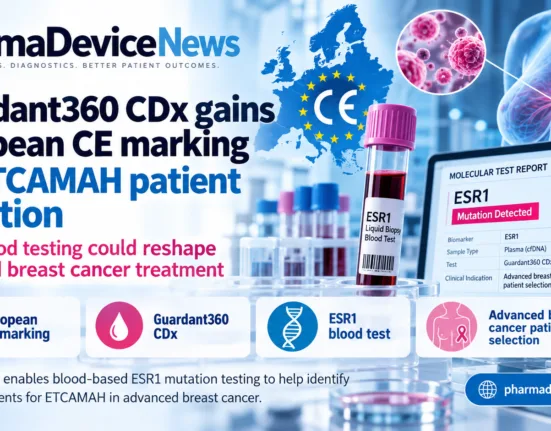
The SERENA-6 findings involving camizestrant may carry equally important implications because the trial directly addresses one of the largest unresolved issues in hormone receptor-positive breast cancer management: acquired endocrine resistance. AstraZeneca plans to present final progression-free survival 2 results and circulating tumor DNA clearance findings in patients receiving camizestrant with cyclin-dependent kinase 4/6 inhibitors after the emergence of ESR1 mutations.
The broader significance of the study lies in its emphasis on molecular monitoring rather than waiting for traditional radiographic progression. Industry observers increasingly believe oncology treatment paradigms are moving toward earlier intervention based on evolving tumor biology detected through blood-based diagnostics and genomic surveillance tools.
ESR1 mutations have emerged as a major driver of endocrine resistance in advanced hormone receptor-positive breast cancer, particularly after prolonged aromatase inhibitor exposure. Existing treatment approaches often continue until visible progression occurs on imaging, even when resistant tumor clones may already be expanding biologically. SERENA-6 appears designed to test whether earlier molecularly informed treatment adaptation can delay broader clinical deterioration.
That concept could eventually influence how clinicians think about metastatic cancer management more broadly. Rather than treating progression as a binary event identified through scans, future oncology care may increasingly involve continuous molecular assessment with therapy adjustments occurring before overt progression develops.
The potential commercial value of that approach is considerable because hormone receptor-positive breast cancer represents one of the largest oncology markets globally. Successful integration of circulating tumor DNA monitoring with targeted endocrine therapy adaptation could strengthen AstraZeneca’s ability to establish a broader treatment ecosystem around camizestrant rather than positioning the medicine as a standalone therapy.
Still, several uncertainties could influence long-term adoption. Biomarker-driven treatment adaptation requires reliable access to high-quality molecular testing infrastructure, which remains inconsistent across healthcare systems. Reimbursement challenges may also emerge if payers question whether earlier therapeutic switching generates sufficiently meaningful long-term survival improvements relative to cost.
Why AstraZeneca’s broader ASCO 2026 strategy reinforces the importance of platform diversification
The EMERALD-3 and SERENA-6 presentations also highlight a broader strategic reality shaping large pharmaceutical oncology portfolios. Sustainable growth increasingly depends on maintaining diversified exposure across multiple therapeutic modalities, disease stages, and biomarker-defined patient populations rather than relying on isolated blockbuster assets.
AstraZeneca’s wider ASCO 2026 program includes antibody-drug conjugates, T-cell receptor therapies, rare disease assets, and immunotherapy combinations spanning several tumor types. That portfolio breadth reflects an industry-wide recognition that oncology competition is becoming increasingly fragmented and biologically specialized.
The pharmaceutical sector has entered a period where single-mechanism dominance appears less likely to persist across large disease categories. Instead, companies are attempting to build interconnected treatment franchises capable of addressing different resistance pathways, biomarker subgroups, and sequencing opportunities throughout disease progression.
Industry analysts note that AstraZeneca’s current strategy appears particularly focused on combining earlier intervention with adaptive treatment evolution. In liver cancer, the emphasis involves moving immunotherapy combinations into less advanced disease settings. In breast cancer, the focus centers on molecular monitoring and earlier response to resistance emergence. Across both areas, the underlying theme involves extending the duration of effective disease control before irreversible progression develops.
At the same time, expanding treatment complexity introduces new pressures around healthcare system capacity, reimbursement sustainability, and physician decision-making burden. Clinicians already face increasingly complicated sequencing decisions across many cancer types, and additional biomarker-driven interventions could intensify those challenges rather than simplifying care pathways.
The importance of EMERALD-3 and SERENA-6 may depend less on isolated statistical outcomes and more on whether the datasets reinforce a broader industry transition toward earlier, more adaptive, and biologically informed cancer treatment models. If the findings demonstrate durable clinical benefit alongside manageable implementation complexity, AstraZeneca could strengthen its position as one of the pharmaceutical groups helping shape the next phase of oncology treatment evolution.