Wave Neuroscience has received U.S. Food and Drug Administration clearance for its Magnetic EEG-guided Resonance Therapy system for post-traumatic stress disorder. The clearance gives the non-invasive, biomarker-guided neuromodulation platform a regulated path into PTSD care after a double-blind, randomized, multisite clinical study showed meaningful reductions in symptom severity.
Why does Wave Neuroscience’s MeRT clearance matter for the future of PTSD treatment?
The importance of Wave Neuroscience’s clearance is that it moves biomarker-guided neuromodulation further into a psychiatric condition where treatment remains difficult, heterogeneous, and highly dependent on individual patient response. Post-traumatic stress disorder is usually managed through psychotherapy, pharmacotherapy, or combined approaches, but many patients continue to experience intrusive memories, hyperarousal, avoidance, sleep disturbance, and functional impairment despite available care. A device-based option that uses patient-specific brain activity data therefore enters a market looking for more objective and personalized treatment tools.
What is genuinely new is the regulatory positioning of MeRT as a personalized, biomarker-guided neuromodulation technology for PTSD. Transcranial magnetic stimulation is already established in parts of psychiatry, especially major depressive disorder, but PTSD has been a more complex target because symptom biology, trauma history, comorbidity, and neural network dysregulation vary widely across patients. Wave Neuroscience is trying to differentiate MeRT by using EEG-based analysis to guide individualized treatment protocols rather than relying on a one-size-fits-all stimulation model.
The risk is that clearance does not automatically settle clinical adoption. PTSD is not simply a disorder of one brain rhythm or one anatomical circuit, and the field has a long history of promising interventions that show benefit in selected populations but struggle with generalizability. Clinicians, payers, and institutional buyers will want more detail on durability, patient selection, treatment burden, safety monitoring, sham response, and how the system performs outside controlled study conditions. The clearance is meaningful, but the commercial proof will come from real-world use.
How does biomarker-guided neuromodulation change the treatment logic in post-traumatic stress disorder?
MeRT is built around the idea that treatment can be informed by measurable brain activity patterns. The platform combines EEG-based biomarker analysis with individualized neuromodulation protocols, aiming to align treatment delivery with each patient’s neurophysiology. That approach is important because it reflects a wider shift in mental health technology from symptom-only categorization toward measurable biological signals that may guide intervention.
The clinical context is compelling. PTSD patients may share a diagnostic label while presenting very different patterns of anxiety, depression, sleep disruption, irritability, dissociation, cognitive difficulty, traumatic brain injury history, substance use, and functional impairment. A biomarker-guided device could be attractive if it helps clinicians move beyond trial-and-error treatment selection. For health systems, the promise is not just another therapy. It is a more structured way to match intervention to patient biology.
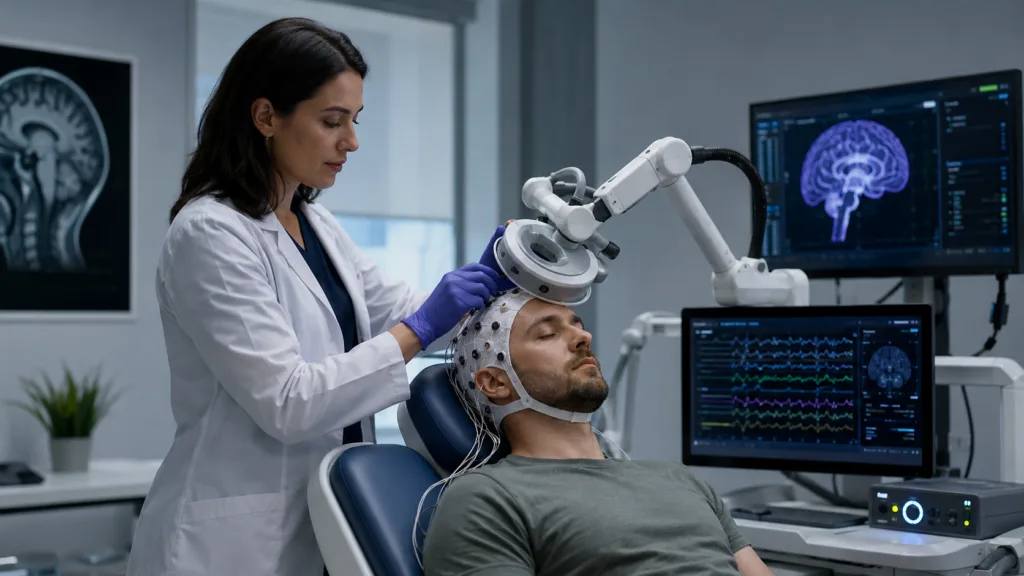
However, biomarker-guided psychiatry carries its own burden of proof. EEG signals can be affected by measurement conditions, medications, sleep, comorbid disorders, and technical variability. For MeRT to gain trust, Wave Neuroscience will need to show that its biomarkers are reproducible, clinically meaningful, and actionable. A device can be personalized only if the measurement guiding personalization is robust enough for routine care. That is the line between a precision medicine platform and an attractive but difficult-to-standardize technology.
What does the sham-controlled clinical evidence suggest, and what remains unanswered?
The regulatory submission was supported by a double-blind, randomized, controlled, multisite trial evaluating the safety and effectiveness of MeRT for PTSD. That trial design is important because neuromodulation studies can be vulnerable to expectancy effects, site differences, subjective outcomes, and placebo-like responses. A blinded and sham-controlled framework gives the evidence package more weight than an open-label experience or single-site observational dataset.
The reported clinical signal is that treatment with the MeRT system led to significant and clinically meaningful reductions in PTSD symptom severity. In a condition where functional burden can remain high despite standard interventions, that outcome is relevant. It suggests that individualized neuromodulation could become part of a broader treatment conversation for patients who continue to experience persistent symptoms.
The unanswered questions are substantial. The public disclosure does not provide enough detail to evaluate effect size, responder definitions, durability of response, subgroup performance, adverse event profile, dropout rates, treatment schedule, or how much improvement was sustained after treatment ended. Those details will matter because PTSD treatment is not judged only by short-term symptom movement. Clinicians will want to know whether patients maintain benefit, whether sleep and function improve, whether comorbid depression or anxiety affects response, and whether repeated treatment courses are needed.
Why could MeRT face a different adoption path than drug-based PTSD therapies?
A device-based PTSD therapy changes the adoption pathway because it is not prescribed, dispensed, and monitored like a medication. It requires equipment, trained operators, treatment protocols, patient scheduling, clinic workflow integration, and a reimbursement structure that supports repeated sessions. That makes the commercial model more operationally complex than a drug launch, even if the intervention is non-invasive and personalized.
The upside is that non-pharmacologic options can appeal to patients and clinicians when medication response is incomplete or side effects are problematic. PTSD care often involves patients with complex histories, comorbid conditions, and sensitivity to treatment tolerability. A neuromodulation platform could fit into care pathways where psychotherapy and medication remain important but insufficient for some patients. The ability to present MeRT as a regulated, non-invasive, biomarker-guided option may strengthen physician and institutional interest.
The limitation is that device adoption depends heavily on clinic economics. Providers will need to evaluate chair time, session length, staff requirements, equipment costs, referral flow, payer coverage, documentation burden, and whether the system can be integrated into psychiatric, neurology, veterans’ health, or behavioral health settings. A device that works clinically can still struggle commercially if reimbursement is uncertain or if clinic throughput does not support sustainable deployment.
How could FDA clearance affect payer engagement and institutional confidence?
FDA clearance gives Wave Neuroscience a stronger starting point for payer discussions, health system evaluation, and institutional partnerships. For mental health technologies, regulatory clearance can help separate clinically reviewed devices from wellness tools, consumer neurotechnology, and unregulated brain training products. That distinction matters because payers and health systems are increasingly cautious about digital and device-based mental health claims.
The clearance also creates a foundation for broader regulatory strategy. If MeRT can be positioned as a platform technology, Wave Neuroscience may pursue additional indications involving dysregulated brain networks. That could include other neuropsychiatric or neurological conditions where objective measurement and individualized stimulation protocols may have relevance. Platform expansion, however, depends on disease-specific evidence. A PTSD clearance does not automatically validate the technology in other indications.
The reimbursement question remains unresolved. Payers may ask whether MeRT should be covered broadly for diagnosed PTSD, only after failure of standard care, or only in specific settings. They may also demand comparative evidence against existing psychotherapy, medication, conventional transcranial magnetic stimulation, or integrated care models. FDA clearance can open payer conversations, but reimbursement will depend on clinical utility, durability, cost-effectiveness, and the ability to define the right patient population.
What does this clearance reveal about the broader evolution of precision psychiatry?
The MeRT clearance reflects a broader industry movement toward precision psychiatry, where objective measurements are being used to guide diagnosis, treatment selection, monitoring, or intervention delivery. Psychiatry has historically relied heavily on symptom interviews and validated scales, which remain essential but do not always explain treatment response or biological heterogeneity. Technologies using EEG, imaging, digital biomarkers, and computational models are trying to fill that gap.
For PTSD, this trend is particularly relevant because the disorder can involve fear circuitry, arousal systems, sleep regulation, attention networks, mood regulation, and trauma memory processing. A biomarker-guided neuromodulation platform fits the direction of travel in the field: more measurement, more personalization, and more interest in network-level brain intervention. The clinical attraction is obvious. If a patient’s brain activity pattern can guide treatment, care could become more targeted and less dependent on repeated trial and adjustment.
The risk is overinterpretation. Precision psychiatry is still building its evidence base, and objective measures must prove that they improve outcomes rather than merely add technical sophistication. A device that produces impressive brain maps or personalized protocols must still demonstrate patient-level benefit that is meaningful, durable, and reproducible. The strongest future for MeRT will depend on showing that personalization improves outcomes compared with less individualized neuromodulation approaches.
How might PTSD heterogeneity shape real-world use of Wave Neuroscience’s system?
PTSD heterogeneity could become both the strongest rationale for MeRT and one of its biggest implementation challenges. Patients may differ by trauma type, time since trauma, military or civilian exposure, comorbid traumatic brain injury, depression, anxiety, substance use, sleep disorder, pain, and medication history. A biomarker-guided approach could help identify neurophysiological patterns that matter more than symptom categories alone.
This creates a potentially important role for MeRT in referral networks serving veterans, first responders, trauma survivors, and patients who have not responded adequately to conventional treatment. If the system helps clinicians stratify and treat patients more precisely, it could become attractive to specialty clinics and institutions with high PTSD caseloads. That is especially true if additional data show which subgroups benefit most and how treatment protocols should be adapted.
The challenge is that heterogeneous patients make evidence generation harder. Real-world populations are less controlled than trial populations, and comorbidities can affect both outcomes and interpretation. Wave Neuroscience will need post-clearance evidence that includes diverse patient groups, longer follow-up, and practical data on treatment persistence and functional recovery. Without that, adoption may remain concentrated in specialized centers rather than spreading into mainstream mental health systems.
What risks could slow adoption despite a strong regulatory milestone?
The first risk is evidence transparency. Clinicians and payers will need access to detailed study data, including trial population, baseline severity, comparator performance, treatment schedule, endpoints, adverse events, and follow-up duration. A general statement of clinically meaningful symptom reduction is encouraging, but it is not enough for broad practice change. PTSD treatment decisions are high stakes, and the field will want granular data.
The second risk is workflow friction. Neuromodulation services require physical infrastructure and patient attendance across repeated sessions. Some PTSD patients may face transportation challenges, work constraints, avoidance symptoms, anxiety around treatment environments, or difficulties sustaining repeated appointments. A therapy that is clinically promising must still be deliverable for the people most likely to need it.
The third risk is expectation management. The mental health technology sector can attract strong interest because unmet need is so visible, but overstatement can damage trust. Wave Neuroscience will need to frame MeRT as a treatment option within PTSD care rather than as a universal solution. The most credible adoption path will likely involve defined patient selection, trained clinical delivery, careful outcome tracking, and integration with broader care models.
What should clinicians, regulators, and neurotechnology investors watch next?
Clinicians should watch for peer-reviewed publication of the pivotal PTSD dataset and further detail on durability, patient selection, safety, and functional outcomes. The most useful evidence will clarify whether symptom improvement is sustained, which patients respond best, and how MeRT should be used alongside psychotherapy, medication, or other supportive interventions. PTSD treatment is rarely one-dimensional, so integration into care pathways will matter.
Regulators and institutional decision-makers will watch how Wave Neuroscience manages post-market evidence, protocol consistency, operator training, quality controls, and expansion into additional indications. For a biomarker-guided platform, standardization is central. The system must be personalized at the patient level while remaining consistent enough for clinical governance and regulatory confidence.
Investors and industry observers should watch payer engagement, adoption by specialty clinics, partnerships with health systems, and whether the company can turn a first cleared indication into a scalable platform. Wave Neuroscience has achieved a meaningful regulatory milestone in a difficult mental health indication. The next test is whether MeRT can convert personalized neuromodulation from a compelling concept into a durable, reimbursable, and clinically trusted treatment model.