Tanner Health and Healthliant Ventures have partnered with Optellum to deploy the Virtual Nodule Clinic, an artificial intelligence platform designed to help care teams identify, risk assess, and manage patients with potentially cancerous lung nodules. The deployment brings Optellum’s FDA-cleared lung cancer prediction technology into a regional health system serving west Georgia and east Alabama, placing AI-enabled diagnostic support closer to community-based cancer pathways rather than only large academic medical centres.
Why does Tanner Health’s Optellum deployment matter for regional lung cancer pathways?
The significance of the Tanner Health deployment is that it moves AI-powered lung nodule risk assessment into the kind of regional setting where many patients first encounter the healthcare system. Lung nodules are often detected during CT scans performed for other reasons, creating a clinical problem that is deceptively simple on paper but difficult in practice. Most nodules are not cancer, but a small share are malignant, and the consequences of missing or delaying the right follow-up can be substantial.
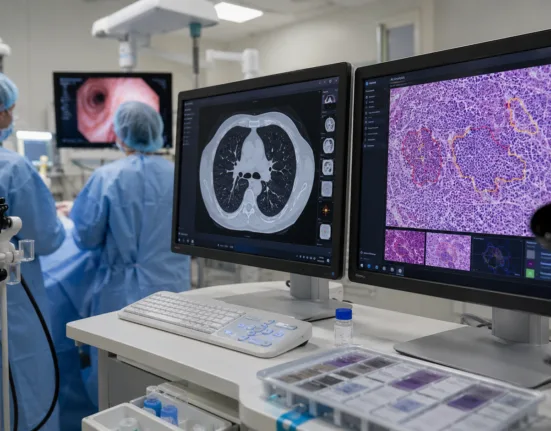
Optellum’s Virtual Nodule Clinic is intended to help clinicians manage this grey zone by combining imaging analytics, machine learning, and care pathway support. The platform’s Lung Cancer Prediction AI evaluates CT-detected nodules and supports risk stratification, while the broader workflow helps care teams track and manage patients through follow-up decisions. For Tanner Health, the partnership is therefore not just a technology procurement. It is a move to make lung nodule management more systematic across a regional health system.
The limitation is that AI risk scoring does not solve the entire diagnostic pathway. A risk score can help prioritize patients, but it cannot by itself guarantee timely pulmonology review, biopsy access, thoracic surgery availability, patient adherence, or payer approval for downstream procedures. The real test for Tanner Health will be whether AI-assisted prioritization translates into faster, more consistent clinical action, rather than simply adding a new data layer to an already complex care journey.
What does this reveal about the shift from AI validation to health system implementation?
The Optellum deployment reflects a wider shift in medical device and diagnostics markets. AI tools are moving from regulatory clearance and pilot validation into operational deployment, where success depends on workflow fit, clinician trust, interoperability, reimbursement, and measurable outcomes. For software as a medical device platforms, this is often the harder phase. Demonstrating technical performance is only the beginning. Getting physicians, radiologists, pulmonologists, care navigators, and administrators to use the tool consistently is the bigger commercial challenge.
In lung nodule management, that challenge is especially important because the pathway touches multiple departments. Radiology identifies the nodule, pulmonology may assess the next step, oncology may become involved after diagnosis, and primary care often remains responsible for continuity. A platform such as Optellum’s Virtual Nodule Clinic has potential value because it addresses both risk assessment and pathway coordination. That makes it more than a standalone algorithm, at least in commercial positioning.
The risk is that health systems may treat AI as a narrow diagnostic add-on rather than a pathway redesign tool. If the technology is not embedded into referral protocols, radiology workflows, electronic health records, and care navigation processes, its clinical impact may be diluted. Regional deployments will therefore be watched closely by industry observers because they show whether AI can work where resources are more constrained and specialist capacity is less concentrated.
How could Optellum’s lung cancer prediction model change nodule management decisions?
The clinical problem that Optellum targets is the uncertainty around indeterminate pulmonary nodules. CT imaging has become increasingly common, which means more nodules are found incidentally. Clinicians then face a familiar dilemma. Some patients need close surveillance or invasive diagnostic workup, while others may be safely monitored without immediate intervention. The difficulty lies in identifying which patient belongs in which category.
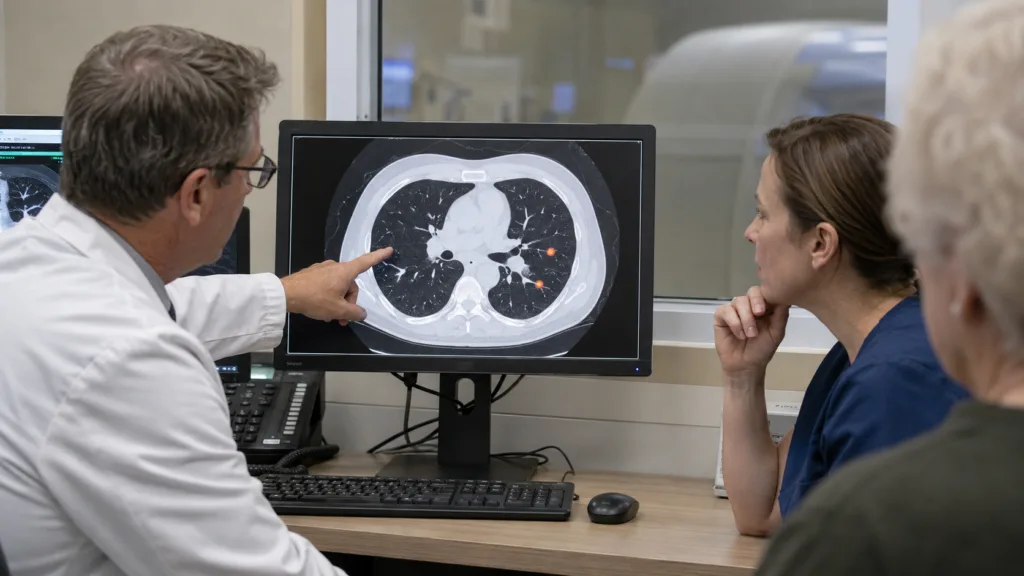
Optellum’s Lung Cancer Prediction AI is designed to assist that judgment by analyzing imaging features and producing a risk assessment that can support clinical decision-making. In theory, higher-risk patients can be escalated earlier, while lower-risk patients may avoid unnecessary procedures. That is clinically meaningful because lung cancer outcomes are strongly influenced by stage at diagnosis, while unnecessary invasive procedures carry cost, anxiety, and complication risk.
However, the device’s intended role must remain clear. It is decision support, not an autonomous diagnosis. Clinicians still need to interpret the AI output alongside patient history, nodule size, morphology, smoking status, prior imaging, comorbidities, and guideline-based recommendations. The danger in this category is not only algorithmic error. It is also workflow overconfidence, where a numerical score can feel more definitive than it should. Responsible deployment will require training that reinforces both the value and the boundaries of AI-assisted risk stratification.
Why is community deployment a tougher but more important test than academic adoption?
Academic medical centres often have the infrastructure needed to evaluate and integrate advanced diagnostics. They may have dedicated thoracic oncology teams, clinical research departments, AI governance committees, and specialized radiology expertise. Regional systems face a different reality. They may cover broader geographies, serve more dispersed populations, and manage patients who face travel barriers, delayed specialist access, or fragmented follow-up.
That is why Tanner Health’s deployment has strategic relevance. If AI-enabled lung nodule management can be integrated into a regional system, it supports the argument that advanced diagnostic support can move beyond elite centres. For patients in west Georgia and east Alabama, the potential value lies in earlier identification of higher-risk nodules and a more structured route to follow-up. For Optellum, the deployment can help demonstrate that its platform is viable in community systems where the operational need may be high.
The commercial risk is that community settings can expose implementation weaknesses more quickly. Staffing constraints, variable imaging workflows, technology integration costs, and competing clinical priorities can slow adoption. If the platform requires too much hands-on management or does not align cleanly with existing radiology and pulmonology processes, utilization could lag. In regional healthcare, practicality often decides whether innovation survives beyond the announcement.
What does the FDA-cleared and reimbursed status mean for market adoption?
Optellum’s platform benefits from having an FDA-cleared and reimbursed software as a medical device position in the United States. That is commercially important because many AI diagnostics struggle to move from regulatory authorization to payment. Reimbursement can reduce one of the main barriers to adoption by giving hospitals a clearer economic route for using the technology in appropriate clinical settings.
For health systems, reimbursement is not just a finance issue. It affects how easily a tool can be justified internally. If an AI platform has a payment pathway, administrators can evaluate it against potential improvements in clinical efficiency, referral quality, and downstream cost avoidance. In lung nodule management, the economic argument may include earlier cancer diagnosis, reduced unnecessary invasive workups, better tracking of patients, and more consistent guideline-aligned care.
The unresolved question is whether reimbursement is strong enough to support widespread use across different health system types. Payment availability does not automatically cover implementation costs, software integration, training, IT oversight, cybersecurity review, and ongoing performance monitoring. Hospitals will still ask whether the platform produces enough measurable clinical and operational value to justify long-term use. For Optellum, reimbursement helps open the door, but evidence of real-world impact will determine how far the door opens.
How does the Tanner Health deployment compare with traditional lung nodule workflows?
Traditional lung nodule workflows can be inconsistent because they depend on radiology reporting language, clinician follow-up, patient scheduling, specialist availability, and institutional tracking systems. A suspicious nodule may be identified clearly, but the patient still needs to move through the right next steps. Missed follow-up is a known problem in many imaging-driven pathways, especially when findings emerge incidentally rather than through a planned cancer screening program.
The Virtual Nodule Clinic addresses that gap by combining nodule identification, risk assessment, and management support in one workflow. That is commercially relevant because hospitals do not need another isolated diagnostic score as much as they need a system that helps prevent patients from falling through cracks. If the platform can support care teams in prioritizing higher-risk patients and organizing follow-up, it could become part of broader lung health infrastructure.
The limitation is that workflow platforms can be harder to sell and implement than single-purpose tools. They require alignment across departments and may challenge existing habits. Radiologists, pulmonologists, oncologists, and care coordinators must agree on how the output is used, what thresholds trigger action, and who owns the follow-up. Without those decisions, even a technically capable platform can become a dashboard that people admire but do not consistently use.
What could go wrong as AI lung cancer triage scales in real-world care?
The first risk is false reassurance. If an AI system categorizes a lesion as lower risk, clinicians must still ensure that appropriate monitoring or follow-up occurs when warranted. The second risk is over-escalation. If the technology increases the volume of patients sent for additional workup without sufficient specificity, it could increase costs and strain pulmonology or procedural capacity. The third risk is uneven performance across imaging protocols, patient populations, and nodule types.
There are also governance risks. AI tools in radiology and oncology must be monitored for performance drift, integration reliability, user access, cybersecurity, auditability, and documentation standards. Health systems need to know not only what the tool outputs, but also how results are captured in the medical record, how clinician decisions are documented, and how disagreements between AI output and clinical judgment are managed.
For Tanner Health and similar regional systems, the challenge will be to avoid treating AI deployment as a plug-and-play event. The value of Optellum’s technology will depend on protocols, training, oversight, and outcome tracking. Industry observers will watch whether the deployment generates measurable improvements in time to diagnosis, referral appropriateness, follow-up completion, and clinician efficiency. Those are the metrics that matter beyond the launch headline.
Why could this partnership matter for the broader AI diagnostics market?
The partnership matters because it reflects the next phase of AI diagnostics commercialization. The first phase was about proving that algorithms could match or assist specialist interpretation. The second phase was about regulatory clearance. The current phase is about health system adoption, and that phase is much less forgiving. Hospitals want tools that reduce bottlenecks, improve patient management, and fit into existing care pathways without creating new burdens.
Optellum is entering this phase with advantages. Its technology has regulatory clearance, reimbursement positioning, and a focused clinical use case. Lung cancer is a high-burden disease with a clear early-detection rationale, and pulmonary nodules represent a practical target for AI risk stratification. That gives the platform a stronger value proposition than broader, less defined AI tools.
The market risk is that AI diagnostics can be oversold. Health systems have become more cautious about products that promise transformation but deliver incremental workflow changes. For Optellum, the Tanner Health deployment offers an opportunity to show that AI can be useful in a regional setting where earlier identification and better coordination could matter deeply. If the platform improves clinical prioritization without increasing complexity, it could strengthen the case for AI-enabled nodule clinics as a scalable model. If it does not, the lesson may be just as important: diagnostics AI succeeds only when it changes what clinicians can do next.