MedX Health Corporation has commercially launched SkinSecure, a cloud-based research platform connecting its SIAscope multispectral imaging devices with contract research organization and clinical trial workflows. The platform is designed to measure and track collagen, melanin, dermal melanin and haemoglobin without a biopsy, with full commercial deployment scheduled to begin in July 2026. SkinSecure is currently intended solely for clinical investigational use and is not cleared for diagnosis, treatment decisions or routine clinical care.
Why SkinSecure could change how sponsors build collagen endpoints into skin studies
The most important aspect of SkinSecure is not simply that it creates another image of the skin. Its potential value lies in converting optical information into repeatable quantitative endpoints that can be followed across subjects, sites and study visits.
Many aesthetic, dermatology and skincare studies still depend on investigator grading, patient questionnaires, conventional photography, skin elasticity measurements or indirect surface characteristics. Those methods can be clinically useful, but they do not necessarily demonstrate whether a treatment has produced a measurable biological change beneath the skin’s surface. Variations in lighting, camera position, evaluator judgement and subject perception can also create noise that weakens small studies.
A platform capable of tracking collagen, pigmentation and vascular changes during the same examination could therefore give sponsors a more detailed picture of treatment response. A biostimulator study, for example, may need to understand whether an apparent cosmetic improvement is associated with collagen remodelling, vascular change, pigmentation change or a combination of effects. Capturing several biological components through one device could simplify the endpoint strategy and reduce dependence on disconnected instruments.
The unanswered question is whether SkinSecure’s measurements will consistently correspond with clinically meaningful change. A statistically significant movement in an imaging value is not automatically evidence that patients, clinicians or regulators will consider the treatment effective. Sponsors will still need to connect the platform’s outputs with validated clinical scales, histology, functional outcomes or other recognised reference measures.
How non-invasive chromophore mapping compares with biopsy, photography and advanced imaging
Punch biopsy remains an important research tool because it provides actual tissue that can be examined through histology, staining and molecular analysis. It can reveal structural organisation, cell populations, inflammatory activity and collagen characteristics that an external optical device may not fully distinguish.
Biopsy nevertheless creates several problems for longitudinal research. It is invasive, can cause pain and scarring, requires trained personnel and pathology processing, and cannot repeatedly sample precisely the same intact tissue. Participants may also refuse studies involving multiple biopsies, creating recruitment challenges or missing data at later timepoints.
SkinSecure offers a different trade-off. Spectrophotometric Intracutaneous Analysis uses reflected light across selected wavelengths to estimate the distribution of skin chromophores beneath the surface. This makes repeated measurement possible without removing tissue and may allow researchers to observe change at substantially more timepoints.
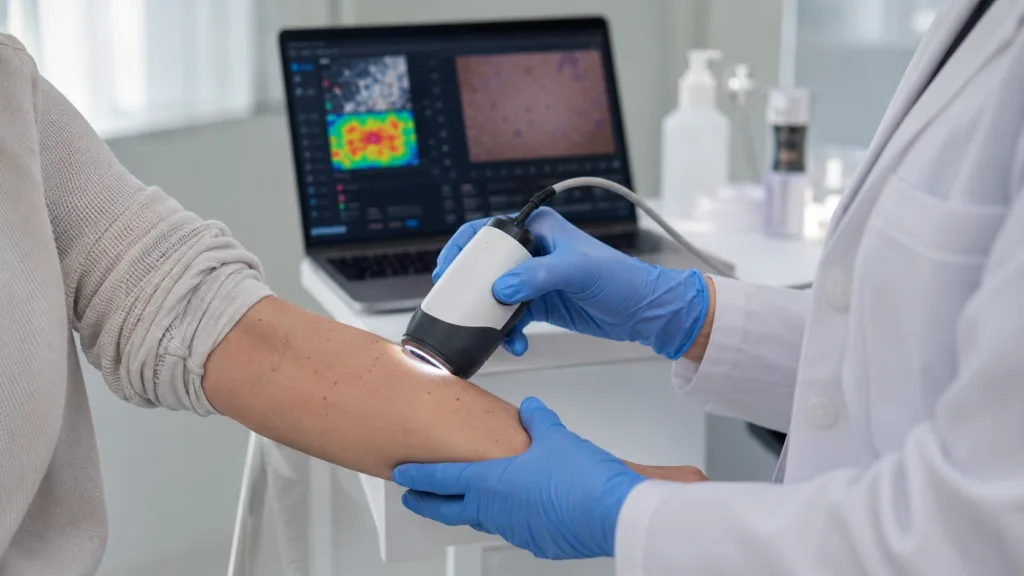
However, the description of the process as direct biological measurement should be interpreted carefully. SkinSecure is more biologically grounded than ordinary photography or visual grading, but its results remain optical measurements generated through calibrated physical models and software analysis. They are not identical to microscopic examination, biochemical assays or direct quantification of collagen from excised tissue.
Other non-invasive technologies, including optical coherence tomography, reflectance confocal microscopy, high-frequency ultrasound and multiphoton imaging, can also provide information about skin structure or collagen. Some offer greater structural resolution, while others may require more specialised equipment, technical expertise or interpretation. SkinSecure’s competitive advantage may therefore depend less on producing the most detailed image and more on delivering a practical, standardised and scalable endpoint for multicentre studies.
It should not be treated as a universal replacement for biopsy. Its more realistic near-term role is to reduce biopsy frequency, identify informative timepoints, support exploratory endpoints and enable longitudinal assessments that would be impractical with repeated tissue sampling.
Why multicentre repeatability will matter more than a fast scan or cloud dashboard
A roughly 30-second scan may improve site efficiency, but scan speed alone will not establish SkinSecure as a credible clinical research tool. Contract research organizations and sponsors will focus on repeatability, sensitivity, calibration and control of measurement variability.
Skin measurements can change with body location, hydration, temperature, recent physical activity, pressure from the device, ambient conditions and positioning. Collagen distribution also varies by age, sex, anatomical region, sun exposure, scarring and underlying disease. Even small differences in probe placement could matter when researchers are attempting to detect modest biological changes over time.
MedX Health will therefore need to demonstrate strong intra-operator, inter-operator, inter-device and inter-site reproducibility. Study protocols may require site-specific training, anatomical landmarks, positioning templates, environmental controls and rules governing when scans can be repeated. Device calibration and software version control will also be important when data are collected across multiple countries over several months.
The cloud architecture could help by standardising acquisition, automatically checking protocol compliance and creating structured datasets. It could also provide sponsors with faster central oversight and allow questionable scans to be identified before a participant leaves the site.
Yet centralisation creates another layer of responsibility. Sponsors will expect secure data transfer, role-based access, audit trails, reliable backups and documentation supporting electronic record requirements. A platform that produces scientifically useful images but creates data integrity concerns will struggle to become part of regulated research workflows.
What the investigational-use boundary means for regulatory claims and future expansion
SkinSecure’s restriction to investigational use gives MedX Health a defined initial commercial pathway. Contract research organizations can use research technologies to support study endpoints without implying that the platform independently diagnoses disease or determines treatment.
That distinction is particularly important because the underlying SIAscope technology has previously been used within regulated skin imaging and teledermatology applications. Existing experience with the hardware, quality systems and multispectral imaging principles may reduce some technical uncertainty, but it does not automatically validate every new SkinSecure endpoint or commercial claim.
Research use involving collagen measurement raises different questions from lesion imaging. Sponsors may ask whether the output is intended as an exploratory biomarker, a secondary endpoint, a patient-selection tool or evidence supporting a regulated product claim. The validation burden will become progressively higher as the measurement moves closer to influencing pivotal trial conclusions or regulatory submissions.
Expansion into routine diagnosis, clinical monitoring or treatment selection would require a more clearly defined intended use and potentially additional regulatory review. Claims involving disease progression, treatment response or individual patient management would also require evidence that the platform performs reliably in the relevant population and clinical environment.
MedX Health can therefore commercialise SkinSecure initially without solving every future regulatory question. However, long-term value will depend on whether sponsors can eventually use its data in formal submissions and whether regulators accept the measurement as sufficiently validated for the role assigned to it.
How SkinSecure could lower study costs without automatically improving evidence quality
The economic argument for non-invasive measurement is straightforward. Biopsies involve procedure time, sterile supplies, local anaesthesia, pathology processing, specialist interpretation and participant follow-up. Repeated biopsies multiply these costs and may increase withdrawals or protocol deviations.
SkinSecure could allow studies to include more timepoints without proportionately increasing procedural burden. Researchers may be able to measure early biological responses, observe the durability of change and identify when treatment effects begin to diminish. This could be especially useful for aesthetic injectables, topical products, energy-based devices, wound treatments and regenerative therapies.
A software as a service model also gives MedX Health an opportunity to generate recurring revenue rather than relying exclusively on one-time hardware sales. Contract research organizations could deploy SIAscope devices at study sites while sponsors access centralised data, comparisons and longitudinal analysis through the cloud platform.
Nevertheless, lower measurement costs do not guarantee a better study. Sponsors could collect large volumes of precise but clinically uninformative data. Additional endpoints can also introduce statistical complexity, multiplicity concerns and the temptation to select favourable measurements after results are available.
The strongest use cases will involve prospectively defined hypotheses, standardised acquisition procedures and a clear relationship between SkinSecure outputs and the treatment’s proposed mechanism. A collagen endpoint is most persuasive when collagen change is biologically expected, measured at an appropriate depth and linked with a clinical outcome.
Why diverse skin tones, treatment mechanisms and body sites could test the platform
The simultaneous measurement of melanin, dermal melanin, haemoglobin and collagen may be particularly relevant for studies enrolling participants across a wide range of skin tones. Conventional photography and some automated image systems can perform inconsistently when pigmentation, lighting and contrast vary.
SkinSecure could potentially help separate pigmentation-related changes from vascular or collagen-related effects. That may improve interpretation in studies where redness, post-inflammatory pigmentation or changes in skin tone could otherwise be confused with treatment efficacy or adverse reactions.
This potential must be demonstrated rather than assumed. Optical measurements can be affected by baseline pigmentation, tissue depth and the interaction of light with different skin characteristics. Validation datasets will need adequate representation across Fitzpatrick skin types, ages, sexes and ethnic backgrounds.
Body location will create another challenge. Facial skin, forearm skin, abdominal skin, scars and chronic wounds differ in thickness, vascularity, sun exposure and collagen organisation. An algorithm performing reliably on one anatomical region may require separate reference ranges or calibration for another.
Different treatments may also alter the optical environment in ways that complicate interpretation. Swelling, inflammation, bruising, dehydration or temporary vascular responses could influence results before longer-term collagen remodelling becomes detectable. Carefully designed validation studies will need to separate transient treatment effects from genuine structural change.
What MedX Health must prove commercially as it moves from legacy technology to SaaS
SkinSecure represents an attempt to convert MedX Health’s established imaging intellectual property into a broader research analytics business. The strategic logic is credible because clinical research offers repeat usage, centralised data requirements and customers that already understand the cost of inconsistent endpoints.
Execution capacity remains a significant consideration. MedX Health generated CAD 177,749 in revenue during the three months ended March 31, 2026, including CAD 21,535 from the SIAscopy product line. The medical device manufacturer reported a quarterly net loss of approximately CAD 1.22 million and a working capital deficit of about CAD 8.23 million.
Those figures do not determine whether SkinSecure will succeed scientifically, but they affect the speed at which MedX Health can support sales, customer onboarding, software development, device production and international studies. Contract research organizations expect rapid technical support and dependable platform availability, particularly when a device is embedded in an active clinical protocol.
The launch could improve the commercial profile of SIAscopy if MedX Health secures multi-study agreements and produces recurring platform revenue. Early projects will need to move beyond demonstrations and pilot activity into contracted deployments with measurable usage.
Partnerships may become important if adoption expands quickly. Larger contract research organizations, dermatology research networks, imaging core laboratories and statistical service providers could help MedX Health scale without building every capability internally. The risk is that lengthy validation and procurement cycles may consume capital before recurring revenue becomes material.
What contract research organizations and sponsors are likely to watch after launch
The first meaningful evidence will not be the number of demonstrations booked or devices shipped. Industry observers will look for prospective studies showing repeatability, agreement with recognised reference methods and sensitivity to treatment-related change.
Sponsors will also want to know whether SkinSecure performs consistently across multiple operators and sites, whether its measurements remain stable over long studies, and whether results can be reproduced after software updates or device replacement. Publicly available validation protocols and peer-reviewed research would strengthen confidence.
Adoption is most likely to begin in exploratory and proof-of-concept studies where additional biological insight is valuable and regulatory risk is manageable. Successful performance in those settings could lead to secondary endpoints in larger trials and eventually to more influential roles in product development.
The platform’s long-term opportunity is therefore substantial but conditional. SkinSecure addresses a real weakness in skin research by offering repeated, non-invasive assessment of biological features that are difficult to measure efficiently. Its eventual impact will depend on whether MedX Health can prove that the numbers are reproducible, clinically interpretable and acceptable within regulated study designs.