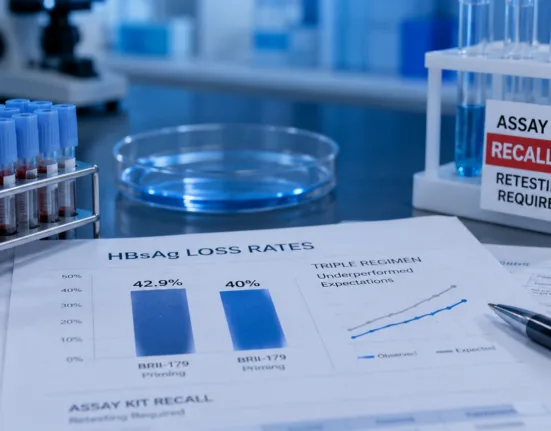
Brii Biosciences Limited reported topline end-of-treatment results from the Phase 2b ENRICH and ENHANCE studies evaluating BRII-179, elebsiran and pegylated interferon alfa in adults with chronic hepatitis B virus infection. The sequential ENRICH approach produced hepatitis B surface antigen loss in around 40% of participants, while the concurrent and shortened-interferon ENHANCE strategies were less convincing, leaving post-treatment durability and access to elebsiran manufacturing technology as the decisive next tests.
Why the ENRICH results strengthen the case for sequencing immune priming before antigen reduction
The most important finding is not simply the headline HBsAg loss rate. It is the apparent separation between sequential and concurrent treatment strategies, which gives Brii Biosciences Limited a clearer hypothesis for how BRII-179 may contribute to a functional cure regimen.
ENRICH evaluated BRII-179 as an initial immune-priming therapy before participants received elebsiran and pegylated interferon alfa. HBsAg loss reached 42.9% among 98 participants receiving five BRII-179 doses once every three weeks and 40% among 50 participants receiving seven doses once every two weeks. The similarity between the two schedules suggests that increasing BRII-179 dosing frequency did not materially improve the end-of-treatment response.
BRII-179 is a recombinant protein-based immunotherapy designed to expose the immune system to the Pre-S1, Pre-S2 and S surface antigens of hepatitis B virus. Elebsiran uses small interfering ribonucleic acid technology to reduce viral RNA transcripts and suppress HBsAg production. Pegylated interferon alfa provides an additional immune-stimulating component.
The sequence is therefore biologically deliberate. BRII-179 is intended to prepare or identify a responsive immune system before elebsiran reduces the antigen burden and interferon pushes the immune response further. The ENRICH results support the view that these mechanisms may work better when deployed in a defined order rather than administered simultaneously.
That interpretation remains provisional because the topline disclosure did not establish how much of the observed effect was independently attributable to BRII-179. Nevertheless, consistency with the earlier ENSURE cohort involving BRII-179-experienced participants makes the immune-priming hypothesis more credible than it was after a single exploratory dataset.
Why end-of-treatment HBsAg loss cannot yet be treated as a confirmed functional cure
The approximately 40% HBsAg loss rate is clinically interesting, but it is not equivalent to a 40% functional cure rate. A durable functional cure requires continued HBsAg loss and control of hepatitis B virus DNA after treatment has stopped, generally across a defined follow-up period and without continued antiviral medication.
Some participants who lose HBsAg during combination therapy may experience antigen rebound after elebsiran or pegylated interferon alfa is withdrawn. End-of-treatment measurements can therefore capture a strong pharmacological response without proving that the immune system has established lasting control.
This distinction has become increasingly important as chronic hepatitis B drug development advances. Several antigen-reducing agents can produce major declines in circulating HBsAg, but a smaller proportion of participants maintain full antigen loss after treatment. Regulators, clinicians and payers are likely to judge a finite regimen by durable off-treatment outcomes rather than the deepest response recorded while every component remains active.
Brii Biosciences Limited has acknowledged that post-treatment follow-up is required. The eventual durability results will determine whether ENRICH represents a genuine functional cure strategy or a powerful but temporary method of suppressing detectable antigen.
The timing of relapse will also matter. A modest decline from the end-of-treatment rate could still support further development, particularly in patients who begin with higher HBsAg levels. A substantial fall during follow-up would weaken the argument that BRII-179 creates durable immune control and could force another redesign of the regimen.
What the weaker ENHANCE results reveal about concurrent therapy and interferon duration
ENHANCE provides the less flattering but equally useful half of the development story. Its concurrent triple-combination cohort produced HBsAg loss in 25.5% of 98 participants, compared with 10.2% among 49 participants receiving pegylated interferon alfa control therapy.
The triple regimen therefore showed activity beyond the interferon control. However, it did not improve on the 29.7% HBsAg loss previously observed in comparable ENSURE cohorts receiving elebsiran and pegylated interferon alfa without concurrent BRII-179. That finding undermines the assumption that adding BRII-179 to every stage of therapy would automatically increase efficacy.

One possible explanation is that BRII-179 requires time to generate or reveal an immune response before aggressive antigen reduction begins. Concurrent administration may not provide the same priming window, or it may expose participants who are unlikely to respond to additional treatment without first identifying their immunological profile.
The shortened-interferon strategy also disappointed. ENHANCE Part A-2 administered BRII-179 and elebsiran during the first 24 weeks, followed by elebsiran and pegylated interferon alfa for another 24 weeks. This approach generated HBsAg loss in 22.5% of 80 participants.
That result suggests that a full 48-week interferon course may be necessary to maximise HBsAg loss within this treatment architecture. It also creates a commercial challenge. Pegylated interferon alfa is associated with tolerability burdens, laboratory monitoring and treatment discontinuation risks that make extended therapy less attractive than a shorter finite regimen.
The failure to shorten interferon exposure means ENRICH may deliver higher efficacy at the cost of greater regimen complexity and duration. Any phase 3 programme will need to show that the clinical benefit justifies that burden.
How trial design and population selection could influence the apparent ENRICH advantage
The ENRICH results are supported by relatively substantial Phase 2b cohorts, but the absence of complete data limits interpretation. The topline announcement did not provide comprehensive baseline characteristics, statistical comparisons, discontinuation rates, treatment adherence or detailed safety results.
Cross-study comparisons with ENSURE are also inherently imperfect. Differences in participant characteristics, HBsAg distribution, prior treatment, laboratory methods and clinical-site behaviour can influence outcomes even when the protocols appear broadly similar.
Baseline HBsAg is particularly important because lower antigen levels are consistently associated with a greater probability of functional cure. Brii Biosciences Limited reported encouraging ENRICH subgroup findings among participants with baseline HBsAg between 1,000 and 3,000 international units per millilitre, a population generally considered more difficult to treat.
A meaningful response in this higher-antigen subgroup could differentiate BRII-179 from development programmes that concentrate their strongest results among participants starting below 1,000 international units per millilitre. However, the size of the subgroup, confidence intervals and durability of its responses have not yet been disclosed.
The forthcoming scientific presentation must show whether ENRICH improved outcomes broadly or whether the overall rate was driven by a narrower set of highly responsive participants. That difference will shape patient selection, trial enrolment criteria and the eventual commercial addressable population.
Why competing hepatitis B programmes have raised the regulatory benchmark for Brii Bio
The development environment has changed significantly since Brii Biosciences Limited began testing its combination strategy. GSK has reported phase 3 results for bepirovirsen showing a 19% functional cure rate across the overall eligible population and 26% among participants with baseline HBsAg of 1,000 international units per millilitre or less.
Those results cannot be directly compared with ENRICH because bepirovirsen’s figures measure sustained off-treatment functional cure, while the current ENRICH disclosure measures HBsAg loss at the end of therapy. The populations, treatment components and protocols also differ.
Nevertheless, the phase 3 evidence establishes a more demanding external benchmark. A new chronic hepatitis B regimen will increasingly be expected to demonstrate not only HBsAg loss, but durable viral control, manageable treatment duration and a safety profile suitable for a large population that may otherwise remain stable on inexpensive oral antivirals.
ENRICH could ultimately exceed that benchmark if much of its approximately 40% end-of-treatment response persists. It could also support a precision-treatment model in which BRII-179 identifies immunological responders before they receive a resource-intensive curative regimen.
The competitive weakness is complexity. BRII-179, elebsiran and pegylated interferon alfa create a multi-product, sequential and predominantly injectable treatment pathway. Bepirovirsen is also injectable, but its six-month finite course may prove easier to position if approved. Brii Bio must therefore demonstrate that additional complexity produces a clearly superior probability of durable cure.
Why the safety disclosure is encouraging but insufficient for late-stage decisions
No new safety concerns were identified in ENRICH or ENHANCE, which is reassuring given that all three components have previously entered clinical testing. However, a statement that no new concerns emerged does not provide enough detail to evaluate overall tolerability.
Pegylated interferon alfa can produce systemic adverse effects and laboratory abnormalities that limit its suitability for some patients. A 48-week exposure could amplify discontinuation risk, especially when combined with repeated administration of BRII-179 and elebsiran.
The complete dataset will need to show treatment-emergent adverse events, serious adverse events, laboratory changes, dose interruptions and discontinuations by study arm. It should also clarify whether the sequential schedule created cumulative tolerability issues or whether most participants completed the intended treatment course.
Safety will influence more than regulatory approval. Clinicians may be reluctant to move patients from well-tolerated oral nucleoside or nucleotide analogue therapy into a complex curative regimen unless the expected probability of durable cure is sufficiently high. BRII-179-based immune profiling could help manage that trade-off by identifying participants most likely to benefit before they receive the full combination.
How the elebsiran arbitration creates an unusually direct threat to Phase 3 development
The most immediate obstacle is not clinical. Brii Biosciences Limited has stated that it cannot invest in a phase 3 study involving elebsiran until its arbitration with Vir Biotechnology is satisfactorily resolved.
The dispute concerns alleged contractual breaches related to transferring elebsiran manufacturing technology to Brii Bio or its contractors. Brii Biosciences Limited is seeking performance of the technology-transfer obligations and damages, while the eventual outcome and timing remain uncertain.
This creates a development bottleneck because preliminary alignment with China’s Center for Drug Evaluation does not by itself provide a viable registrational programme. Phase 3 development requires reliable clinical supply, validated manufacturing processes, technology access and a credible path to commercial-scale production.
Even strong durability data may therefore fail to trigger immediate phase 3 initiation. A prolonged dispute could delay regulatory development, increase costs and allow competing functional cure programmes to move further ahead.
Brii Bio owns the intellectual property and manufacturing rights associated with BRII-179, giving it control over the immune-priming component. Its dependence on elebsiran remains the weaker link. The longer-term strategic question is whether BRII-179 could be combined with another antigen-reducing agent if access to elebsiran cannot be secured on workable terms.
What clinicians and regulators will need to see before ENRICH can support registration
The next major dataset must establish the proportion of participants who maintain HBsAg loss after treatment, the durability of hepatitis B virus DNA suppression and the number able to discontinue background nucleoside or nucleotide analogue therapy safely.
Regulators will also need clearer evidence that BRII-179 adds value beyond elebsiran and pegylated interferon alfa. A pivotal study should isolate the contribution of each component, use appropriate control groups and prospectively define the patient population most likely to benefit.
The ENRICH results have nevertheless resolved an important development question. Sequencing BRII-179 before antigen-reducing and interferon therapy appears more promising than administering all three products concurrently. Attempts to shorten interferon exposure also appear to sacrifice efficacy within the tested regimen.
Brii Biosciences Limited now has a preferred clinical strategy, but not yet a registrational package. Durable follow-up, complete safety data, regulatory agreement and resolution of the elebsiran manufacturing dispute will determine whether the programme advances from a persuasive Phase 2b signal into a credible late-stage functional cure candidate.