UpDoc has introduced an FDA-cleared software medical device that can interact directly with adults with type 2 diabetes and provide insulin-treatment instructions between conventional medical appointments. The platform gathers glucose readings, symptoms, meals and medication-adherence information before applying an insulin-management plan configured by a licensed healthcare professional.
The Palo Alto company is presenting the technology as an early example of agentic clinical artificial intelligence, meaning software that does more than summarise information or recommend what a clinician might do. Within predefined limits, the system can carry out parts of an existing treatment plan, communicate instructions to the patient and record the intervention for the care team.
That distinction makes UpDoc one of the more consequential digital-health launches of 2026. It also creates a risk that broad claims about an artificial intelligence-powered clinical operating system could obscure the much narrower scope of the actual regulatory clearance.
The FDA clearance applies to prescription insulin management for adults with type 2 diabetes. It does not authorise UpDoc to diagnose disease independently, formulate unrestricted treatment plans, manage type 1 diabetes or replace a physician across general medical care. The software acts inside a clinician-specified framework, making its immediate value less about creating an “AI doctor” and more about automating a repetitive but clinically important part of diabetes management.
What exactly did the FDA clear UpDoc to do for adults with type 2 diabetes?
The FDA cleared UpDoc as a Class II software medical device under the 510(k) pathway. The indicated use covers medication management for patients aged 18 and older who have already been diagnosed with type 2 diabetes.
A healthcare professional configures an individual treatment plan through a provider portal. That plan can include the insulin type, starting and maximum doses, the adjustment algorithm, glucose targets and safety protocols covering non-emergency hypoglycaemia, hyperglycaemia and related symptoms.
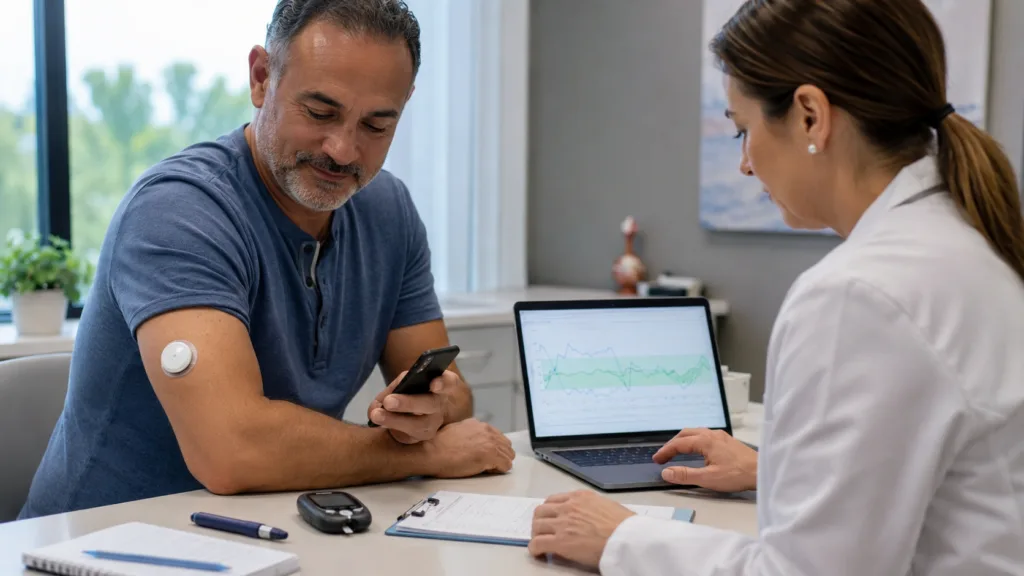
Patients interact with the platform through a mobile application. They can enter blood glucose results, meals, symptoms and medication-adherence data manually, through voice or text interactions, or through a compatible Bluetooth-enabled glucose meter or continuous glucose monitor.
UpDoc then calculates treatment instructions using cloud-based software and the parameters established by the clinician. The patient receives guidance on following the prescribed insulin plan, while the healthcare team can monitor reported data, adherence and treatment progress.
This is clinically meaningful automation, but it is not unrestricted artificial intelligence decision-making. The clinician defines the therapeutic boundaries, and the software applies deterministic insulin-dosing logic within those boundaries.
The platform is available only by prescription and is not indicated for people with type 1 diabetes. Its FDA documentation also does not describe general authority to initiate unrelated medications, diagnose new conditions or independently alter the broader clinical strategy.
Why is insulin titration a logical first use case for patient-facing clinical AI?
Insulin treatment often requires repeated adjustments before patients reach an appropriate dose. A physician may prescribe a starting regimen, but blood glucose patterns, meals, symptoms, adherence and episodes of low glucose can require changes over subsequent days or weeks.
Traditional healthcare delivery is poorly suited to this frequency. Patients may wait weeks or months between appointments, while clinicians lack the capacity to call every person repeatedly, review every reading and issue each incremental dose adjustment.
Some patients therefore remain on ineffective doses longer than necessary. Others modify insulin themselves without adequate support or stop treatment because the process feels burdensome and confusing.
A structured software system can address this gap by collecting data more frequently and applying a clinician-approved algorithm consistently. It does not need to wait for the next clinic appointment before identifying that glucose remains above target.
The workflow also has clearer boundaries than many areas of general medicine. Insulin adjustments can be based on measurable inputs, defined glucose ranges, predetermined maximum doses and explicit safety rules.
That does not make insulin management low risk. Excessive dosing can cause dangerous hypoglycaemia, while insufficient dosing can leave glucose uncontrolled. It does, however, provide a more controllable setting in which to test clinical automation than an open-ended system attempting to diagnose unfamiliar symptoms.
UpDoc’s first indication therefore reflects a sensible regulatory strategy. The company has started with a recurring decision that is important, measurable and capable of being constrained by physician-defined rules.
Does UpDoc use artificial intelligence to decide treatment or merely deliver a physician’s plan?
The answer lies between those descriptions. UpDoc uses patient-facing conversational technology to gather information and maintain engagement, while its clinical service applies treatment logic configured by the healthcare professional.
The patient may experience the platform as an intelligent clinical conversation. The system can ask about glucose readings, medication use, meals and symptoms, interpret structured responses and issue the next instruction.
However, the underlying insulin decision is not supposed to be an unconstrained output generated by a large language model. The dosing logic must remain within the prescribed treatment plan and safety parameters.
This separation is fundamental to the platform’s risk design. Large language models can produce variable responses and occasionally generate incorrect or unsupported information. Insulin dosing requires consistency, traceability and predictable calculation.
UpDoc’s architecture appears intended to use conversational artificial intelligence as the interface while reserving the safety-critical treatment calculation for a governed clinical service. In practical terms, the conversation may be flexible, but the medication adjustment should remain deterministic.
The company describes a physician-governed model in which the clinician prescribes and the artificial intelligence implements. Every intervention is expected to remain connected to the patient’s approved plan and documented for later review.
This is less dramatic than the idea of an autonomous digital doctor. It may also be a more credible route for introducing artificial intelligence into patient care without transferring the entire clinical decision to software.
Why does UpDoc’s 510(k) clearance require a more careful interpretation than its launch language?
UpDoc announced the clearance in June 2026, although the FDA issued the substantial-equivalence decision on December 23, 2025. The agency compared the software with the previously cleared d-Nav insulin-guidance system.
A 510(k) clearance means the FDA determined that the device was substantially equivalent to a legally marketed predicate for the specified use. It is not the same as a premarket approval demonstrating that a completely novel platform independently improves patient outcomes across multiple conditions.
The FDA’s decision summary did not identify a new clinical study as part of the clearance review. It stated that clinical studies were not applicable to the substantial-equivalence determination.
Instead, the review focused on software documentation, verification and validation, risk controls, cybersecurity, human factors and usability. The FDA reported that representative adults with type 2 diabetes and healthcare professionals could perform the device’s critical tasks without use-related errors that could compromise safety or treatment effectiveness.
The software was classified as having a major level of concern because insulin-dosing instructions can directly affect patient safety. That classification underscores why the device required substantial documentation even though it followed a predicate pathway.
UpDoc’s broader launch materials describe a platform capable of facilitating laboratory orders, coordinating care teams and supporting multiple clinical interventions. Those capabilities may form part of the company’s enterprise vision, but they should not all be treated as though they fall within the cleared indication.
The current regulatory claim is specific: provider-directed insulin management for adults with type 2 diabetes. Any expansion into other medications, diseases or clinical decisions may require additional evidence, regulatory review or carefully separated non-device functions.
What clinical evidence supports conversational AI for insulin management?
UpDoc’s founders previously led a small randomised clinical trial evaluating a voice-based conversational artificial intelligence application for basal insulin management. The study included 32 adults with type 2 diabetes who required initiation or adjustment of once-daily basal insulin.
Participants using the conversational system reached an optimal insulin dose in a median of 15 days, compared with more than 56 days for patients receiving standard care. The artificial intelligence group also recorded higher insulin adherence, at approximately 83 percent compared with 50 percent.
The study reported improvements in glucose control and diabetes-related emotional distress. These findings suggest that frequent automated interaction can help patients follow treatment and reach an effective dose faster than an appointment-dependent model.
However, the trial was conducted at four primary-care clinics within one academic medical centre and followed participants for eight weeks. Thirty-two patients are insufficient to characterise uncommon safety failures, long-term adherence or performance across diverse health systems.
The earlier trial should also not be interpreted as a complete clinical validation of every feature in UpDoc’s commercial platform. The final software includes a provider portal, patient application, cloud-based conversation service and clinical service operating under its cleared configuration.
The trial nevertheless provides a clinically relevant foundation. It supports the concept that conversational technology can improve insulin titration rather than functioning only as a reminder tool.
UpDoc’s deployments at major health systems will now need to establish whether those benefits persist in larger populations with different ages, languages, levels of digital literacy and medical complexity.
Can UpDoc reduce physician workload without creating a new layer of alerts and supervision?
Reducing clinician burden is central to the commercial argument for UpDoc. Chronic-disease care produces a continuous stream of glucose readings, refill requests, laboratory results, patient questions and treatment-adjustment needs.
Healthcare organisations cannot solve that workload simply by asking physicians to review more dashboards. Remote monitoring programmes have sometimes created additional administrative work because every data point generates an alert without completing the clinical action.
UpDoc is attempting to close that loop. The platform does not merely flag that glucose is outside the target range. It can apply the approved titration plan, communicate the resulting instruction to the patient and document the action.
That could reserve clinician attention for exceptions, complex decisions and patients whose results fall outside the permitted boundaries. It may also allow pharmacists, nurses and physicians to oversee larger populations without personally performing every routine adjustment.
The risk is that the system still produces substantial review work. Clinicians may need to examine unclear symptoms, conflicting data, missed readings, suspected hypoglycaemia and patients who stop responding.
Health systems will also need to decide who is accountable for monitoring escalations and how quickly staff must respond. An automated platform operating continuously could generate safety obligations outside normal clinic hours.
The commercial value will therefore depend on exception rates. When most patients remain within the configured pathway, automation may release capacity. When frequent cases require manual intervention, the software could become another inbox demanding attention.
How could inaccurate patient data affect automated insulin instructions?
UpDoc relies partly on information entered or transmitted by patients. That creates a vulnerability because the software cannot always determine whether a glucose reading, meal report or medication-adherence statement is correct.
A patient could enter the wrong value, use an incorrectly calibrated meter, misunderstand which insulin dose was taken or omit symptoms. Voice-based input may introduce transcription errors, while connected devices can encounter pairing, synchronisation or unit-conversion problems.
The FDA-authorised change-control plan requires data imported from alternative sources to match manually entered values exactly, with no tolerance for incorrect unit conversion. This is important because confusion between glucose units or insulin amounts could have severe consequences.
The system must also recognise when the available information is insufficient. A safe platform should pause automated titration and escalate the case when readings conflict, symptoms suggest an emergency or adherence cannot be established reliably.
Human factors remain crucial even when the algorithm performs correctly. Patients must understand the instructions, distinguish the software from emergency medical care and know when to contact a clinician rather than wait for the application.
Digital confidence may vary widely among adults with type 2 diabetes. Older patients, people with limited English proficiency and those unfamiliar with smartphones may require additional onboarding and support.
UpDoc’s change-control plan includes the potential addition of multilingual interfaces and alternative data-entry methods. These features could broaden access, but each expansion must preserve the same dosing accuracy and safety controls.
What does UpDoc’s predetermined change-control plan reveal about future product expansion?
The FDA authorised a predetermined change-control plan allowing UpDoc to make defined software modifications without submitting a new 510(k) for every qualifying update.
Permitted categories include adjusting certain default clinical values, changing the number of glucose readings used to calculate an average, updating maximum configurable doses and modifying recognised symptom definitions.
The company can also add references to newly approved insulin products or biosimilars, update dosing ranges in line with clinical guidelines and introduce meal-related dosing logic or sliding-scale features under the authorised framework.
User-interface changes, multilingual support and new methods for importing glucose or adherence information are also covered, provided they do not change the device’s core intended use or clinical decision-making.
This plan is strategically valuable because clinical software evolves faster than conventional medical hardware. Requiring a new regulatory submission for every interface or compatible-device update could slow improvement and integration.
The plan does not provide unlimited freedom. UpDoc must conduct automated unit, integration and regression testing, with a 100 percent pass-rate requirement across the specified modification categories.
Clinical experts must review relevant changes, while the system must preserve deterministic dosing logic, accuracy, response time and traceability. Modifications exceeding the authorised categories or materially affecting safety, effectiveness or intended use could still require another FDA submission.
This framework may become one of UpDoc’s most important assets. It gives the company a regulated mechanism for improving the platform while preventing the cleared product from becoming an uncontrolled, continuously changing artificial intelligence system.
Could UpDoc expand from insulin titration into broader chronic-disease management?
The company’s ambition clearly extends beyond type 2 diabetes. Its platform is designed around a general model in which physicians define treatment plans and artificial intelligence manages routine interventions between appointments.
Similar opportunities exist in hypertension, lipid management, anticoagulation and other chronic conditions where treatment changes can follow measurable parameters and established guidelines.
The regulatory challenge will increase as the decisions become less structured. Adjusting one medication according to a defined measurement is different from managing several interacting diseases, interpreting ambiguous symptoms or selecting a treatment without a predetermined plan.
Each expansion may require disease-specific safety architecture, clinical evidence and regulatory clearance. A platform-level clearance for insulin management should not be assumed to authorise unrestricted use across those settings.
Drug interactions and comorbidities will also complicate automation. Many patients with type 2 diabetes have cardiovascular disease, kidney impairment, obesity and several concurrent prescriptions.
UpDoc’s strongest expansion path may therefore involve additional tightly bounded workflows rather than a general-purpose medical agent. Success could come from automating numerous narrow clinical tasks, each with clear limits, rather than attempting to create one artificial intelligence system capable of practising medicine broadly.
That approach may sound less revolutionary, but it is more compatible with how healthcare evidence, liability and regulation operate.
Why are major health systems and healthcare investors backing the UpDoc model?
UpDoc has secured $18 million in seed financing from investors and strategic participants including the American Diabetes Association’s Innovation Fund, Mayo Clinic, Eli Lilly and Company, Cathay Innovation, Oxeon, Pear VC, Polaris Partners and Section 32.
The company is beginning deployments involving Cleveland Clinic, Allegheny Health Network and UCSF Health, with additional expansion planned. These organisations provide clinical credibility and access to real-world environments where workflow integration can be tested.
Health systems have a strong incentive to explore the technology. They face increasing chronic-disease populations, primary-care shortages and clinician burnout, while value-based reimbursement creates pressure to improve outcomes outside traditional visits.
A system that enables faster insulin optimisation could reduce long-term complications and avoidable utilisation. It may also create billable or contract-supported chronic-care services without requiring equivalent growth in clinical headcount.
For investors, UpDoc sits at the intersection of artificial intelligence, medical devices, enterprise software and chronic-disease management. FDA clearance differentiates it from consumer chatbots that provide health information without operating as regulated medical devices.
The company is privately held, so there is no public share-price reaction to assess. The oversubscribed seed round and strategic backing indicate strong institutional interest, but commercial success will depend on deployment economics, reimbursement and measurable patient outcomes.
Hospitals are unlikely to purchase the system indefinitely because it appears innovative. They will require evidence that it saves clinician time, improves glucose control, reduces adverse events and integrates with electronic health records without creating additional risk.
What cybersecurity, privacy and accountability risks accompany an AI platform connected to health records?
UpDoc’s enterprise model depends on integration with electronic health records and the handling of glucose measurements, symptoms, medication plans and patient conversations.
A cybersecurity failure could expose sensitive health information or interfere with treatment instructions. The FDA review therefore included cybersecurity considerations appropriate to the platform’s connectivity and data-handling capabilities.
The more important long-term issue may be accountability. When a clinician defines the plan, the artificial intelligence applies it and a patient follows the instruction, responsibility is distributed across several participants.
Health systems must establish who reviews automated interventions, who responds to exceptions and how software failures are investigated. Audit trails must show which data entered the system, which rule produced the instruction and whether the patient received or understood it.
Large language model interactions introduce another concern. The conversational layer must not improvise beyond the cleared clinical logic or present uncertain information as authoritative treatment guidance.
UpDoc’s physician-governed architecture is intended to contain that risk, but real-world performance will determine whether the boundary remains reliable across thousands of varied patient conversations.
Transparency will be essential. Patients should understand that they are communicating with software, that the system operates within a clinician-approved plan and that some circumstances require human or emergency care.
Can UpDoc move clinical AI beyond hype without weakening physician control?
UpDoc represents a more credible clinical artificial intelligence model than a general chatbot dispensing medical suggestions directly to consumers. It is prescription-only, integrated with clinicians, limited to a defined indication and supported by regulated software controls.
Its potential is significant because chronic-disease outcomes are often determined between appointments. Patients do not experience diabetes only during the few hours each year they spend with a physician.
Automating structured follow-up could help treatment respond to changing glucose patterns while reducing delays caused by limited clinical capacity. The earlier randomised study provides an encouraging indication that conversational artificial intelligence can accelerate insulin optimisation and improve adherence.
The present evidence does not justify describing UpDoc as an autonomous doctor. The FDA clearance is narrow, was obtained through substantial equivalence to an existing insulin-guidance system and did not rely on a new clinical study within the 510(k) review.
The platform’s most important innovation is not the use of a large language model. It is the attempt to divide clinical work into two layers: physician-controlled treatment strategy and software-executed routine intervention.
That model could become influential if health-system deployments show that it improves outcomes without increasing hypoglycaemia, alert burden or clinician liability. Poorly managed expansion, however, could turn a carefully bounded insulin tool into an overextended platform operating beyond its evidence.
UpDoc now has regulatory permission to automate a consequential part of type 2 diabetes care. Its next challenge is proving that tightly governed clinical artificial intelligence can scale without allowing convenience to outrun safety.
Key takeaways from UpDoc’s FDA-cleared clinical artificial intelligence platform
- UpDoc is FDA cleared to provide insulin-management instructions to adults with type 2 diabetes under a healthcare professional’s predefined treatment plan. The clearance does not authorise the platform to function as an unrestricted artificial intelligence doctor or manage type 1 diabetes.
- The software combines a patient application, provider portal, conversational agent and deterministic clinical service. Patients can enter glucose, meal, symptom and adherence data manually, by voice or text, or through supported monitoring devices.
- A previous 32-patient randomised study found that conversational artificial intelligence shortened the time required to reach an optimal basal-insulin dose and improved adherence, but larger and longer studies remain necessary.
- The 510(k) review relied on substantial equivalence, software validation, human factors, cybersecurity and risk controls rather than a new clinical trial. UpDoc’s real-world health-system deployments will need to demonstrate better outcomes and lower workload.
- The company’s physician-governed model may offer a practical route for clinical artificial intelligence by allowing software to execute bounded interventions rather than independently formulate the entire treatment strategy.