Imagion Biosystems Limited (ASX: IBX) has secured firm commitments for an AU$3.75 million placement to fund activation of a United States Phase 1b/2 trial of the MagSense HER2 Imaging Agent, a targeted iron oxide nanoparticle formulation designed to detect HER2-positive breast cancer in regional lymph nodes using magnetic resonance imaging. The financing follows a Study May Proceed notice for Investigational New Drug application 165081 from the United States Food and Drug Administration, with patient recruitment expected to begin in the third quarter of 2026 after site activation.
Why does the AU$3.75 million raise materially change Imagion Biosystems’ trial readiness?
The financing gives Imagion Biosystems the capital required to move from regulatory preparation into clinical execution. Receiving permission to conduct a trial does not automatically activate clinical sites, recruit patients or produce interpretable data. Contracts, ethics reviews, investigator training, imaging protocols, trial supplies, data systems and patient-screening processes must all be completed before the first participant can be enrolled.
That distinction is particularly important for Imagion Biosystems because its financial position had become increasingly constrained ahead of the regulatory decision. The diagnostics-focused developer reported AU$273,000 in cash at the end of March 2026 after recording an operating cash outflow of AU$1.28 million during the quarter. It also expected expenditure to rise as the MagSense HER2 clinical programme moved into its site-initiation phase.
The AU$3.75 million placement therefore removes an immediate obstacle to trial commencement and reduces the risk that an FDA milestone becomes stranded by a lack of operating capital. However, it should not be interpreted as confirmation that the entire clinical programme is fully financed. The trial is expected to run for approximately 18 to 24 months, while clinical costs are likely to increase as additional cohorts open, imaging activity expands and diagnostic-performance data are collected.
The financing is also divided into two tranches. Imagion Biosystems can issue approximately 49.3 million new shares to raise about AU$592,000 under its existing placement capacity, while the remaining approximately AU$3.2 million requires shareholder approval. The immediate funding is enough to advance activation work, but the larger tranche remains necessary for the broader clinical plan.
What must the MagSense HER2 Phase 1b/2 study prove beyond the earlier safety signal?
The development programme is moving forward with preliminary evidence rather than definitive diagnostic validation. Imagion Biosystems’ first-in-human Australian study enrolled 13 patients with HER2-positive breast cancer and found that the MagSense HER2 Imaging Agent appeared safe and tolerable, reached the lymphatic system and produced detectable changes on magnetic resonance imaging.
Those findings established proof of principle, but the evaluable dataset was small. Magnetic resonance images from eight participants were considered interpretable by blinded radiologists, with pathology agreeing with the imaging interpretation in seven cases. Three participants could not be evaluated because tumour involvement interfered with lymphatic drainage, while images from two others were affected by common magnetic resonance imaging artefacts.
These exclusions are not minor technical footnotes. They identify the practical challenges that the next trial must address. An imaging agent can demonstrate biological targeting and still fail commercially if too many scans are uninterpretable, if administration does not produce consistent lymphatic delivery or if results vary across scanners, sites and radiologists.
The United States study has consequently been divided into sequential stages. The first part will gather additional safety and pharmacokinetic information. A second cohort will evaluate the reduced dose, imaging schedule and optimal time between administration and scanning. A larger diagnostic-performance cohort will then compare MagSense findings with the clinical reference standard.
This structure allows Imagion Biosystems to refine the operating conditions before attempting a larger diagnostic analysis. It also means investors and clinicians should not treat the first patients dosed as evidence that the platform works at commercial scale. The important data will be the proportion of evaluable scans, sensitivity, specificity, reader agreement and concordance with pathology once the protocol has been optimised.
Could molecular MRI fill the gap between conventional imaging and invasive nodal pathology?
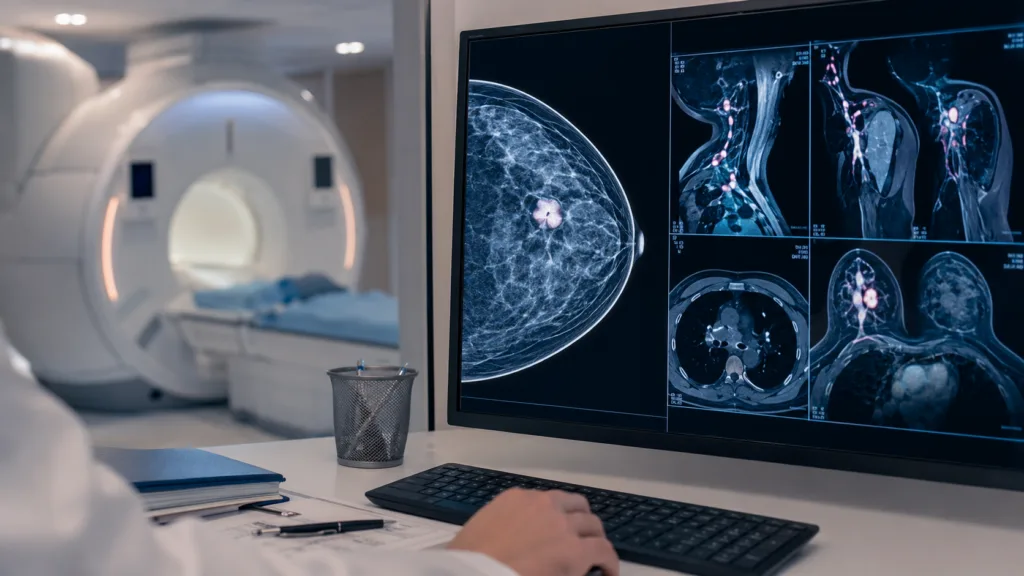
MagSense is being developed around a clinically meaningful problem in breast cancer staging. Conventional ultrasound and magnetic resonance imaging primarily assess lymph nodes through anatomical features such as size, shape, cortical thickness and internal structure. These features can identify suspicious nodes, but they do not directly establish whether HER2-positive tumour cells are present.
Pathological examination therefore remains central to determining whether breast cancer has spread into regional lymph nodes. Patients may undergo needle biopsy, sentinel lymph-node biopsy or surgical removal of lymphatic tissue, depending on their imaging findings, disease characteristics and treatment plan. These procedures generate tissue-level evidence but add invasiveness, cost and operational complexity.
The MagSense HER2 Imaging Agent is intended to add molecular specificity to magnetic resonance imaging. Its iron oxide nanoparticles are linked to an HER2-targeting component and are designed to create a measurable magnetic resonance signal after reaching lymph nodes. The aim is to distinguish nodes containing HER2-positive tumour cells from uninvolved tissue rather than relying solely on changes in anatomy.
The proposed value is not simply that MagSense avoids radioactive material. HER2-targeted positron emission tomography agents can provide information about receptor expression and heterogeneity across the body, but they require radionuclide production, specialised handling and positron emission tomography infrastructure. Magnetic resonance imaging is more widely installed and offers strong soft-tissue visualisation, potentially giving a molecular MRI agent a different operational position.
However, MagSense should not yet be presented as a substitute for pathology or positron emission tomography. The current programme is focused on regional nodal assessment in a defined HER2-positive breast cancer population. It has not demonstrated that it can replace tissue confirmation, perform whole-body staging or guide treatment decisions across the broader spectrum of HER2-low and HER2-heterogeneous disease.
Its commercial opportunity will depend on proving that molecular information obtained through magnetic resonance imaging is sufficiently accurate and actionable to change patient management. Producing an unusual image is scientifically interesting. Demonstrating that the image can reliably prevent unnecessary procedures, guide surgery or improve treatment planning is the higher clinical threshold.
Why will scanner standardisation, manufacturing consistency and site execution determine the outcome?
Multicentre imaging studies are vulnerable to variability that drug trials can sometimes avoid. Magnetic resonance imaging results can be affected by scanner manufacturer, magnetic-field strength, coil selection, image sequence, acquisition timing, patient positioning and interpretation methods. A molecular imaging agent must perform consistently across this environment if it is to become usable outside a small group of specialist centres.
Imagion Biosystems has worked on dose reduction and protocol optimisation before the United States trial. That work is intended to identify a dose and imaging window capable of producing sufficient contrast without creating unnecessary exposure or operational inconvenience. The study must now demonstrate that these conditions can be reproduced by different sites rather than only by teams deeply familiar with the technology.
The earlier Phase 1 experience also showed that biological delivery cannot be assumed in every patient. Tumour obstruction of lymphatic drainage prevented interpretable imaging in several participants. The Phase 1b/2 trial will need to determine how frequently this occurs, whether affected patients can be identified before administration and whether the limitation narrows the population for which MagSense could be clinically useful.
Manufacturing presents another layer of risk. Targeted nanoparticles are complex products whose performance can depend on particle size, coating, magnetic properties, antibody conjugation and batch consistency. Regulatory permission to begin the trial indicates that the submitted manufacturing and quality package was sufficient for clinical investigation. It does not remove the need to reproduce that quality as more trial material is manufactured and eventual commercial-scale processes are developed.
Patient recruitment is another potential constraint. The trial requires patients with HER2-positive breast cancer who meet detailed staging and treatment criteria, while study procedures must be coordinated with imaging, biopsy or surgery. Delays in site contracting, ethics review or patient identification could extend timelines even when the imaging agent itself is available.
What does the placement structure reveal about investor support and future financing pressure?
The successful placement shows that investors were willing to fund Imagion Biosystems after the FDA removed the immediate regulatory barrier to trial commencement. The timing is logical because the capital now supports a defined clinical programme rather than a regulatory submission whose outcome remained uncertain.
The terms also show that capital remains expensive for the micro-cap diagnostics developer. The new shares are priced at AU$0.012, representing a discount of approximately 24% to the preceding 10-day volume-weighted average price. Investors are also expected to receive one listed option for every two new shares, exercisable at AU$0.04 and expiring in December 2027.
If the full placement is completed, Imagion Biosystems will issue approximately 312.5 million new shares. Against a pre-placement base of about 490.6 million ordinary shares, that would increase the share count by roughly 64%. The free-attaching options create additional potential dilution, although they would also provide future capital if exercised.
The market’s initial response reflected that tension. Imagion Biosystems shares closed at AU$0.012 after the announcement, down 20% from the pre-halt closing price of AU$0.015. The decline does not negate the importance of securing trial funding, but it suggests investors are weighing the clinical opportunity against the size, discount and dilutive impact of the placement.
Further financing may be required before the full programme is completed, particularly if recruitment takes longer than planned or if Imagion Biosystems expands the study. A positive interim analysis could improve the developer’s negotiating position, support another capital raise or attract a strategic imaging partner. Weak or ambiguous results could make additional funding considerably more difficult.
Which milestones will show whether MagSense is becoming a viable diagnostics platform?
The first operational milestone will be activation of the clinical sites and enrolment of the first patient. That will demonstrate that the financing, regulatory package, investigator network and trial logistics have been converted into an active study. It will not, by itself, validate the imaging technology.
The initial safety cohort must show that the reduced-dose regimen is tolerable and behaves as expected. The following optimisation stage must identify a reproducible imaging window and demonstrate that different sites can obtain interpretable scans. The larger diagnostic cohort must then establish performance against pathology with enough statistical confidence to support discussions about a later pivotal study.
Clinicians will also watch the rate of non-evaluable examinations. A platform that performs well only after excluding patients with artefacts or disrupted lymphatic drainage may have a narrower role than anticipated. Reader-to-reader consistency will be equally important because interpretation cannot depend on a handful of specially trained radiologists.
Imagion Biosystems plans to incorporate quantitative imaging into the protocol and generate data that may support future artificial intelligence tools. This could eventually reduce subjective interpretation and standardise analysis, but the datasets generated during an early clinical programme will remain limited. Any artificial intelligence application will require independent development and validation rather than being assumed from the presence of quantitative images.
Commercial relevance will ultimately depend on whether MagSense changes care. The decisive question is whether targeted molecular MRI can identify nodal disease accurately enough to reduce invasive procedures, improve staging decisions or deliver useful information at a lower operational burden than competing approaches.
The AU$3.75 million raise gives Imagion Biosystems the opportunity to answer that question. It does not answer it in advance. The next phase of the MagSense HER2 programme will be determined by trial execution, evaluable imaging rates and pathology-confirmed diagnostic performance rather than by regulatory clearance or capital-market enthusiasm alone.