Vertex Pharmaceuticals Incorporated has secured United States Food and Drug Administration approval to expand CASGEVY, or exagamglogene autotemcel, to patients aged 2 years and older with sickle cell disease involving recurrent vaso-occlusive crises or transfusion-dependent beta thalassemia. The supplemental approval lowers the previous minimum age of 12 and makes the CRISPR-based cell therapy available across a substantially wider pediatric population.
Why the CASGEVY pediatric expansion represents more than a routine label change
Lowering the eligible age from 12 years to 2 years changes the point in the disease course at which clinicians can consider a potentially durable genetic intervention. Sickle cell disease and transfusion-dependent beta thalassemia begin causing complications well before adolescence, meaning the previous label required many patients to accumulate years of pain episodes, transfusion exposure, iron overload or progressive organ damage before becoming eligible for CASGEVY.
The expansion therefore moves gene editing closer to an early-intervention strategy rather than a late attempt to control an already advanced disease burden. For sickle cell disease, recurrent vaso-occlusive crises can affect the brain, lungs, kidneys and cardiovascular system over time. For transfusion-dependent beta thalassemia, the combination of chronic anemia, repeated transfusions and iron accumulation can impair growth and damage the heart, liver and endocrine system.
That clinical logic is compelling, but it does not yet prove that administering CASGEVY during early childhood will prevent decades of complications. The pediatric datasets remain small, follow-up is measured in months rather than decades, and the youngest patients included in clinical trials were 5 years old. The expanded indication creates the opportunity to test whether earlier gene editing changes the natural history of these disorders, but the long-term answer will depend on post-approval evidence.
What the pediatric CASGEVY data reveal and where extrapolation adds uncertainty
The sickle cell disease study included 11 treated patients aged 5 to under 12 years. Eight had sufficient follow-up to be included in the primary efficacy analysis, and all eight remained free from protocol-defined severe vaso-occlusive crises for at least 12 consecutive months during the first 24 months after treatment.
The transfusion-dependent beta thalassemia study included 15 treated patients in the same pediatric age range. Nine were evaluable for the primary efficacy endpoint, and eight achieved transfusion independence for at least 12 consecutive months. The median duration of transfusion independence among those responders was approximately 20 months at the time of analysis.
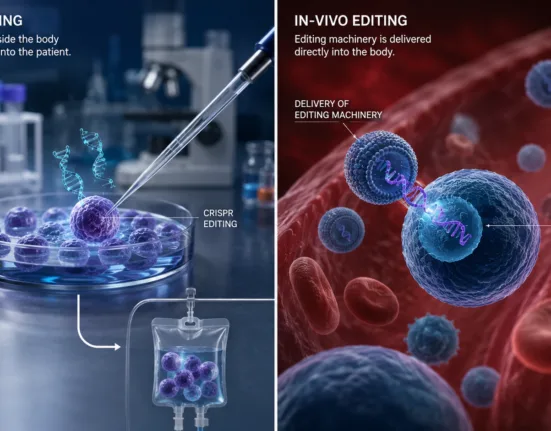
These results are consistent with the treatment effect previously observed in adolescents and adults, supporting the view that reactivating fetal hemoglobin can work across age groups. CASGEVY edits the erythroid-specific enhancer of the BCL11A gene in a patient’s own blood-forming stem cells. The edited cells produce higher levels of fetal hemoglobin, which can reduce red blood cell sickling in sickle cell disease and compensate for defective adult hemoglobin production in beta thalassemia.

However, the approval down to age 2 does not mean children aged 2 to under 5 were directly studied. The FDA allowed the evidence to be extrapolated from patients aged 5 and older, supported by the product’s biological characteristics and the consistency of response across age groups. That is a scientifically recognised regulatory approach, but it leaves uncertainty around cell collection, conditioning tolerance, recovery and long-term outcomes in very young children.
The distinction matters because eligibility language can sound broader than the underlying evidence. Clinicians will need to assess whether an individual child is physiologically able to complete stem cell mobilisation, apheresis, myeloablative conditioning and prolonged recovery. The updated label also recommends that patients with sickle cell disease weigh at least 12 kilograms before mobilisation because smaller patients may have difficulty yielding the minimum required cell dose.
How earlier CASGEVY treatment could alter the long-term burden of blood disorders
The strongest rationale for pediatric treatment is the possibility of intervening before disease-related damage becomes irreversible. Eliminating severe vaso-occlusive crises during childhood could reduce hospitalisations, school disruption, chronic pain exposure and cumulative injury to major organs. Achieving transfusion independence in beta thalassemia could reduce lifelong transfusion requirements and limit further iron accumulation.
Earlier intervention may also change how treatment choices are evaluated. Historically, a potentially curative approach such as allogeneic hematopoietic stem cell transplantation has been constrained by donor availability, graft-versus-host disease risk and transplant-related complications. CASGEVY uses the patient’s own cells, avoiding the need for a matched donor and eliminating graft-versus-host disease as a treatment risk.
Autologous treatment does not make the process low risk. CASGEVY still requires full myeloablative conditioning, generally using busulfan, to clear space in the bone marrow before the edited cells are infused. That preparation can cause profound cytopenias, infections, mucositis, bleeding risks, infertility and other serious complications.
The central clinical debate will therefore shift from whether gene editing is technically possible to when its expected long-term benefit justifies an intensive transplant-like procedure. Treating earlier may prevent damage, but younger patients may also have less accumulated disease and may be clinically stable on established therapies. Families and multidisciplinary teams will need to weigh an immediate, high-intensity intervention against the uncertain lifetime course of each child’s disease.
Why conditioning and treatment infrastructure remain bigger barriers than FDA eligibility
The expanded label does not transform CASGEVY into a conventional medicine that can be prescribed and administered during a routine clinic visit. Treatment begins with disease optimisation and stem cell mobilisation, followed by apheresis, patient-specific manufacturing, myeloablative conditioning, infusion and inpatient monitoring while blood counts recover.
This operational complexity restricts treatment to specialised centres with expertise in pediatric hematology, stem cell transplantation, intensive supportive care and cell therapy logistics. Vertex Pharmaceuticals Incorporated has activated more than 75 authorised treatment centres in the United States, but geographic availability does not automatically guarantee timely access. Capacity, referral pathways, insurer approval, manufacturing slots and the ability of families to remain near a treatment centre can all affect uptake.
Pediatric expansion may place additional strain on those systems. Younger children may require different collection strategies, age-specific supportive care, intensive family involvement and careful management of nutritional, developmental and fertility considerations. Treatment centres will need to determine how many younger patients they can manage without delaying care for adolescents and adults already moving through the referral process.
Reimbursement will remain equally important. A one-time therapy may offer long-term economic value by reducing crises, hospital admissions, transfusions and chronic treatment, but payers must fund the intervention before much of that value is observed. Administrative delays are particularly consequential for a personalised cell therapy because collection, manufacturing and conditioning must be carefully coordinated.
How the approval changes the competitive position of CASGEVY in gene therapy
CASGEVY now has a clear age-based advantage in sickle cell disease. LYFGENIA, the lentiviral vector-based gene therapy for sickle cell disease, remains approved for patients aged 12 years and older with a history of vaso-occlusive events. CASGEVY is therefore the only approved gene therapy available to younger children with recurrent sickle cell crises.
The therapies also use different genetic strategies. CASGEVY edits the BCL11A regulatory region to restore fetal hemoglobin production, while LYFGENIA introduces a modified beta-globin gene through a lentiviral vector. Both require autologous stem cell collection, myeloablative conditioning and reinfusion, meaning neither avoids the intensive treatment pathway that limits broad adoption.
Their safety profiles should not be treated as interchangeable. LYFGENIA carries a boxed warning concerning hematologic malignancy and requires long-term monitoring related to its integrating lentiviral vector. CASGEVY does not use a viral vector or carry the same boxed warning, but its prescribing information states that unintended off-target editing associated with genetic variation cannot be ruled out and that the clinical significance of such editing is unknown.
In transfusion-dependent beta thalassemia, the competitive picture is more nuanced because ZYNTEGLO is already approved for adult and pediatric patients who require regular red blood cell transfusions. CASGEVY’s distinction is that its label explicitly extends to age 2 and covers both transfusion-dependent beta thalassemia and sickle cell disease through the same CRISPR-based platform.
Treatment selection will consequently depend on more than headline efficacy rates. Centre experience, manufacturing performance, patient characteristics, safety considerations, reimbursement and confidence in the long-term evidence will influence decisions. The expanding range of genetic treatments also increases pressure to develop less toxic conditioning methods, which could ultimately have a greater effect on adoption than incremental differences between editing platforms.
What the wider pediatric label means for Vertex and CRISPR Therapeutics
The approval enlarges the commercial opportunity for Vertex Pharmaceuticals Incorporated while strengthening the clinical validation of CRISPR Therapeutics AG’s gene-editing platform. Vertex leads global development, manufacturing and commercialisation of CASGEVY, while CRISPR Therapeutics participates in the programme’s economics through a 40% share of net commercial profits or losses.
CASGEVY generated net product revenue of $42.9 million during the first quarter of 2026, compared with $14.2 million in the corresponding period of 2025. The 202% increase shows that the launch is progressing, but the therapy remains a relatively small contributor within Vertex Pharmaceuticals Incorporated’s multibillion-dollar portfolio.
Expanding the eligible population can support future growth, yet revenue will not rise in direct proportion to the number of newly eligible patients. Personalised manufacturing, treatment-centre throughput and the lengthy journey from referral to infusion produce a slower commercial curve than conventional drug launches. Revenue recognition can also be uneven because a small number of completed patient treatments can materially affect quarterly results.
The pediatric approval nevertheless strengthens CASGEVY as a strategic diversification asset for Vertex Pharmaceuticals Incorporated. It extends the biotechnology firm beyond cystic fibrosis, validates its ability to commercialise complex cell therapies and provides evidence that a CRISPR-based product can move from an initial approval into broader age groups and indications.
For CRISPR Therapeutics, the decision provides another important regulatory precedent for the durability and reproducibility of ex vivo gene editing. The larger question is whether the industry can translate that scientific validation into a scalable model. A therapy can demonstrate remarkable efficacy and still face slow uptake when delivery requires transplant infrastructure, extensive patient preparation and substantial upfront expenditure.
Which clinical and regulatory questions will determine the next phase of CASGEVY adoption
The most important evidence will come from longer follow-up. Patients treated with CASGEVY are expected to enter a long-term study that tracks safety and efficacy for up to 15 years. Investigators will watch whether freedom from severe vaso-occlusive crises and transfusions persists, whether edited stem cells remain stable and whether unexpected genomic or hematologic safety signals emerge.
Outcomes in children aged 2 to under 5 will receive particular scrutiny because approval in this group was based on extrapolation rather than direct clinical trial evidence. Real-world data will need to clarify mobilisation success, manufacturing reliability, conditioning tolerability, engraftment, developmental outcomes and the durability of fetal hemoglobin production in the youngest patients.
Regulators and clinicians will also watch whether earlier treatment produces measurable protection against organ damage. Crisis elimination and transfusion independence are meaningful endpoints, but the full case for treating very young children will be stronger if future studies show better neurological, cardiac, renal, pulmonary, growth and quality-of-life outcomes than prolonged conventional management.
The approval is therefore a major expansion of possibility rather than the end of the evidence-building process. CASGEVY can now be considered before years of cumulative disease burden have developed, but its impact will depend on whether specialised treatment systems can deliver it safely, equitably and at sufficient scale. The science has crossed the age barrier. Access, conditioning and long-term evidence are now the harder tests.