Suzhou Ribo Life Science Co., Ltd. and its subsidiary Ribocure Pharmaceuticals AB, together with Madrigal Pharmaceuticals, Inc., have nominated the first small interfering RNA drug candidate from their six-program metabolic dysfunction-associated steatohepatitis collaboration. The unnamed candidate will now enter IND-enabling studies, moving the program from discovery-stage selection toward the toxicology, manufacturing and regulatory work required before human clinical trials can begin.
Why does the first nominated siRNA candidate mark a meaningful transition for the partnership?
Candidate nomination is an important development threshold because it normally means researchers have moved beyond comparing exploratory molecules and selected a specific compound for formal development. The decision suggests that the partners have identified a candidate with a sufficiently promising combination of biological activity, liver targeting, durability and preliminary safety characteristics to justify a larger investment in regulatory-grade studies.
That distinction matters in small interfering RNA development. Early discovery programs can generate multiple molecules capable of reducing a target messenger RNA in laboratory models, but only a smaller group may demonstrate the pharmacological stability, tissue distribution and tolerability required for further development. Selecting one candidate therefore narrows the scientific strategy and begins converting a broad technology collaboration into a potential therapeutic asset.
The milestone was reached less than five months after the six-program licensing agreement was announced in February 2026. That pace indicates that at least part of the underlying discovery work was already sufficiently mature when the transaction was signed. It may also reflect an efficient division of responsibilities between Ribo’s RNA interference platform capabilities and Madrigal Pharmaceuticals’ expertise in MASH biology, clinical development and regulatory strategy.
However, candidate nomination remains an early achievement rather than evidence of clinical efficacy. Neither partner has disclosed the molecular target, dosing interval, potency data, animal-model results, safety findings or intended patient population. The absence of those details prevents meaningful conclusions about whether the program is broadly applicable across MASH or designed for a genetically defined subgroup.
How could liver-targeted gene silencing expand treatment beyond current MASH medicines?
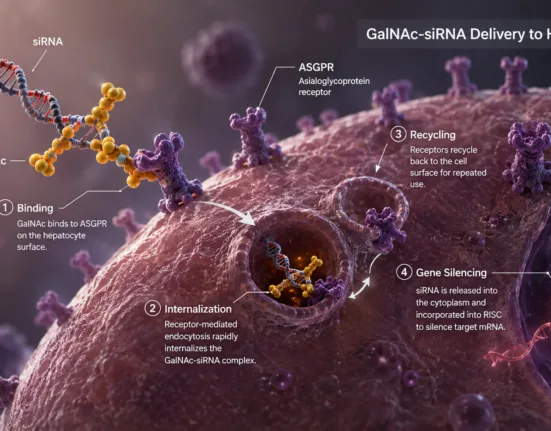
Small interfering RNA therapeutics are designed to reduce production of selected proteins by directing cellular machinery to degrade the messenger RNA that carries instructions for those proteins. When paired with liver-targeting delivery technology, the molecules can be concentrated in hepatocytes, making the modality particularly relevant to diseases driven by abnormal liver metabolism, inflammation and fibrosis.
This approach could add a new therapeutic layer to the MASH field. Rezdiffra, also known as resmetirom, activates thyroid hormone receptor beta in the liver and addresses several underlying features of the disease, including excess liver fat and metabolic dysfunction. Wegovy, or semaglutide, approaches the condition through weight reduction and broader metabolic improvement. An siRNA therapy could instead suppress a specific protein or biological pathway that contributes directly to disease development or fibrosis progression.
The attraction is precision. MASH is not a single-mechanism disorder, even when patients share similar biopsy findings or fibrosis stages. Genetics, insulin resistance, obesity, lipid metabolism, inflammatory signalling and fibrotic activity can contribute in different proportions. A targeted gene-silencing medicine could potentially address a disease driver that remains active despite weight loss, metabolic treatment or liver-directed oral therapy.
Yet precision can also narrow commercial and clinical applicability. A candidate aimed at a particular genetic variant may only be suitable for patients carrying that variant. Development would then require reliable testing, clear prevalence estimates and evidence that suppressing the selected target produces a clinically meaningful benefit. A biologically interesting target is not automatically a commercially viable drug target, especially when the eligible population is fragmented or difficult to identify in routine liver care.
What does the milestone reveal about Madrigal Pharmaceuticals’ broader pipeline strategy?
Madrigal Pharmaceuticals is attempting to evolve from a business centred on one successful medicine into a multi-asset MASH company. Rezdiffra remains the foundation of that strategy, but the pipeline now includes oral metabolic candidates, combination opportunities, genetically targeted programs and assets designed for patients at different stages of liver disease.
The Ribo collaboration contributes six preclinical siRNA programs to that expansion. Madrigal Pharmaceuticals received exclusive worldwide rights to develop, manufacture and commercialise the compounds, while Ribo became eligible for a $60 million upfront payment, potential development and commercial milestones across the programs and royalties on future sales. The structure gives Madrigal Pharmaceuticals control over downstream development while retaining access to Ribo’s discovery and delivery expertise.
Commercial success with Rezdiffra provides an important advantage. Madrigal Pharmaceuticals reported first-quarter 2026 net sales of $311.3 million and more than 42,250 patients receiving the medicine by the end of March. That growing treatment base gives the biopharmaceutical developer relationships with hepatologists, gastroenterologists, endocrinologists, payers and specialty pharmacies that could eventually support additional MASH products.
The strategy is therefore not simply to replace Rezdiffra with a later-generation drug. It is to position Rezdiffra as a foundation around which complementary therapies may be developed. This could extend Madrigal Pharmaceuticals’ reach into genetically defined disease, more advanced fibrosis, patients with incomplete responses and combination regimens intended to produce deeper or more durable benefits.
The risk is rising pipeline complexity. Managing multiple preclinical programs, combination studies, regulatory discussions and commercial expansion requires substantial capital and operational discipline. The company must determine which programs deserve accelerated investment and which should be discontinued before development costs escalate. A broad pipeline creates optionality, but it can also dilute focus if scientific prioritisation is not rigorous.
Why is combining an siRNA therapy with Rezdiffra attractive but operationally difficult?
The scientific logic for combination treatment is that MASH involves several overlapping biological processes. A therapy that improves liver fat and metabolic function may not fully suppress genetically driven injury, inflammatory activity or fibrotic signalling. Combining mechanisms could therefore improve the probability of resolving steatohepatitis, reducing fibrosis or preventing progression to cirrhosis.
Rezdiffra offers Madrigal Pharmaceuticals an established liver-directed treatment on which to build. An siRNA candidate could theoretically reduce a disease-promoting protein while resmetirom continues to address lipid metabolism and broader liver health. Such a combination may be particularly relevant for patients who experience partial improvement but retain significant fibrosis or other risk factors.
Clinical development will nevertheless be demanding. Madrigal Pharmaceuticals would need to establish the independent contribution of the investigational siRNA, determine whether the combination provides a meaningful advantage over Rezdiffra alone and show that any additional benefit justifies greater treatment complexity. Trial designs may need monotherapy, combination and control groups, increasing enrolment requirements and development costs.
Safety interpretation may also become more difficult. Rezdiffra and an siRNA candidate would operate through different mechanisms, but both ultimately affect liver biology. Regulators will examine liver enzyme changes, off-target effects, immune reactions and any evidence that combining the products introduces risks not observed with either agent separately.
Patient convenience will influence eventual adoption. Rezdiffra is taken orally once daily, while liver-targeted siRNA drugs are commonly administered by injection at intervals determined by their pharmacological durability. Infrequent dosing could be attractive, but adding an injectable medicine to an oral regimen may create access, administration and adherence considerations. The combination must deliver a sufficiently clear benefit to overcome those practical barriers.
Which preclinical, manufacturing and regulatory risks could still derail the siRNA program?
The immediate IND-enabling phase will test whether the nominated candidate can support a credible first-in-human application. This work generally includes repeat-dose toxicology, safety pharmacology, assessment of off-target gene effects, dose selection, manufacturing process development and production of material meeting clinical-quality standards.
Translation from animal models remains a major challenge in MASH. Rodent models can reproduce selected features such as liver fat, inflammation or fibrosis, but they do not fully capture the metabolic diversity and long disease course seen in people. Strong reductions in a biomarker or histological feature may not translate into durable clinical improvement.
Target biology creates another risk. Silencing a disease-associated gene can produce unintended physiological consequences if the encoded protein also serves a beneficial function in another pathway. The partners must show that the intended level and duration of suppression can alter disease biology without creating unacceptable effects elsewhere in the liver or body.
Manufacturing is equally important. Oligonucleotide medicines require consistent chemical synthesis, purification, conjugation and analytical control. Process changes made during development can affect product quality or pharmacological behaviour. Scaling production for larger clinical studies and potential commercial demand must therefore be considered well before pivotal development.

The regulatory pathway is not yet defined. Existing MASH approvals have relied on accelerated pathways supported by improvements in liver histology, with confirmatory studies intended to establish longer-term clinical benefit. A genetically targeted siRNA could potentially use similar intermediate endpoints, but regulators may require evidence linking target suppression to histological improvement and eventual reductions in liver-related outcomes.
The partners have not disclosed when an investigational application could be submitted. Immediate initiation of IND-enabling studies indicates forward movement, but toxicology findings, manufacturing delays or changes to the selected molecule could alter the timeline. First-in-human dosing should not be assumed until a regulatory filing has been accepted and the supporting studies have been completed successfully.
How might approved GLP-1 therapy and a changing MASH market affect future positioning?
The MASH treatment environment has changed considerably since Rezdiffra became the first approved medicine for the disease in 2024. Wegovy subsequently received a U.S. MASH indication for adults with moderate to advanced fibrosis, bringing a widely recognised GLP-1 medicine into the same treatment setting.
This creates a more competitive but also more clinically developed market. GLP-1 therapy may be attractive for patients whose MASH occurs alongside obesity, type 2 diabetes or cardiovascular risk. Rezdiffra offers a differentiated oral and liver-directed mechanism. Future siRNA candidates will need to demonstrate where they fit relative to both approaches rather than entering a market with no pharmacological alternatives.
A targeted siRNA could occupy a distinct position if it produces strong antifibrotic effects, works in genetically defined high-risk patients or complements existing therapy. It could also become valuable for individuals who cannot tolerate GLP-1 treatment, do not achieve sufficient weight loss or continue to show progressive liver disease despite metabolic improvement.
However, the bar for development is rising. As approved therapies become embedded in clinical practice, experimental candidates must show more than statistical improvement against placebo. Developers may increasingly need to establish added value against active background treatment, which can make trials longer and more expensive.
Payers will also ask whether genetic testing, injectable administration and combination use produce enough additional benefit to justify higher total treatment costs. A precision medicine model can support premium value when patient selection is clear and outcomes are compelling. Without those elements, a specialised siRNA could struggle to compete with established products that already have broad physician familiarity.
What evidence will clinicians, regulators and industry watchers need to see next?
The most important next disclosure will be the identity and biological rationale of the selected target. That information will determine whether the candidate addresses a broad MASH pathway or a narrower genetic population. It will also allow researchers to assess the strength of existing human genetic evidence and the potential consequences of long-term target suppression.
Preclinical data will need to demonstrate more than successful delivery to the liver. The program should show substantial and durable messenger RNA reduction, corresponding protein suppression, improvement in relevant disease features and an acceptable safety margin across dose levels. Evidence from more than one disease model would improve confidence, although no preclinical package can remove the uncertainty of human translation.
The eventual first-in-human trial design will reveal the development strategy. Early studies may focus on safety, pharmacokinetics and target engagement in healthy volunteers or selected patients. For a genetically targeted program, enrolment criteria and diagnostic testing could become central from the beginning.
Industry observers will also watch whether this candidate remains a monotherapy program during early development or moves rapidly toward combination testing with Rezdiffra. Starting with monotherapy may provide cleaner evidence of biological activity, while combination development may better reflect the commercial strategy. The sequence chosen will indicate how confidently Madrigal Pharmaceuticals views the target and how quickly it intends to build a multi-mechanism treatment model.
For now, the candidate nomination is a credible sign of execution within a large and ambitious licensing partnership. It confirms that the collaboration has produced a development candidate and is progressing toward regulatory-enabling work. It does not yet establish safety, clinical activity or differentiation, but it moves the Ribo and Madrigal Pharmaceuticals alliance closer to the point where those questions can begin to be answered.