The theoretical appeal of small interfering RNA has always been extraordinary. Once scientists know the sequence of a messenger RNA involved in disease, they can design a complementary RNA molecule capable of directing cellular machinery to destroy that transcript before the corresponding protein is made. The problem was never primarily whether RNA interference worked inside a cell. It was getting a fragile, negatively charged RNA molecule out of the bloodstream, into the correct tissue, through the cell membrane, out of the endosome and into the cytoplasm in sufficient quantity to engage the RNA-induced silencing complex.
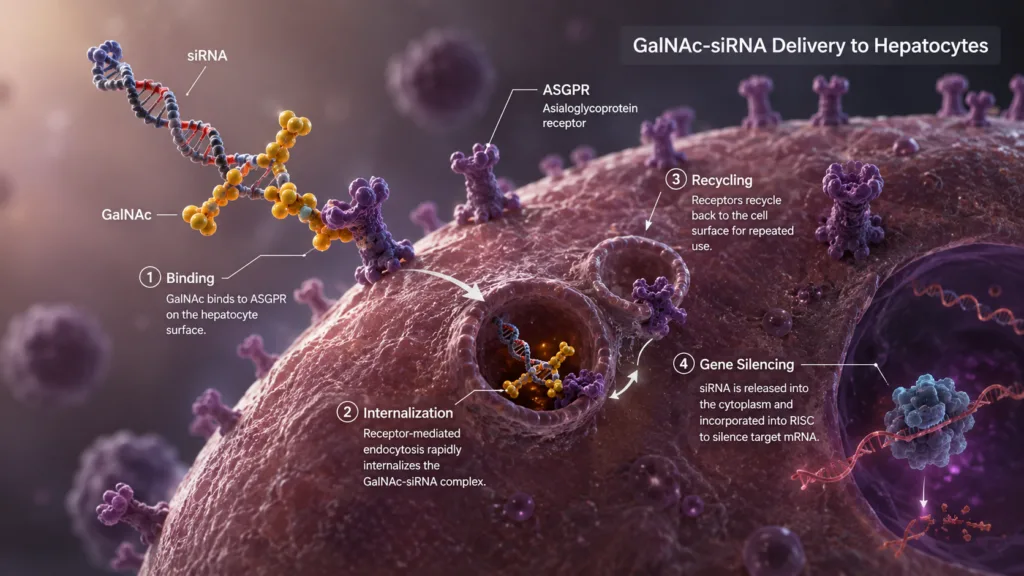
The liver became the first organ where drug developers solved enough of those barriers simultaneously, and one small sugar ligand explains much of that success. N-acetylgalactosamine, better known as GalNAc, binds with very high affinity to the asialoglycoprotein receptor expressed densely on hepatocytes. Conjugating a multivalent GalNAc cluster directly to an siRNA allows the liver’s own receptor-recycling system to pull the therapeutic molecule out of circulation and into hepatocytes, creating one of the most productive targeting mechanisms in modern nucleic-acid medicine.
Why was delivery such a serious problem for the first generation of siRNA drugs?
Naked siRNA behaves poorly as a systemic medicine. It can be degraded by nucleases, is sufficiently small to undergo rapid renal clearance and does not naturally cross lipid cell membranes efficiently because RNA carries strong negative charge.
Even after a cell takes up an RNA molecule, another barrier appears. Most material entering through receptor-mediated uptake becomes trapped inside endosomes and is eventually routed toward lysosomal degradation. To silence a gene, siRNA has to escape from those vesicles into the cytoplasm, where one strand can load into the RNA-induced silencing complex and guide sequence-specific cleavage of its target messenger RNA.
Early developers therefore relied heavily on lipid nanoparticles and other delivery vehicles to protect RNA and promote uptake. Patisiran established that an intravenously administered lipid-nanoparticle siRNA could become an approved systemic medicine, but GalNAc subsequently provided a substantially simpler architecture for targets produced by hepatocytes.
Instead of encapsulating the siRNA inside a large nanoparticle, chemists can attach the targeting ligand directly to a chemically stabilized oligonucleotide. The resulting medicine can often be administered by subcutaneous injection and exploit a receptor the liver already uses continuously.
What makes the asialoglycoprotein receptor unusually good at delivering RNA?
ASGPR is expressed at extremely high density on hepatocytes and undergoes rapid recycling. After binding an appropriate GalNAc ligand, the receptor internalizes its cargo through clathrin-mediated endocytosis and can return to the hepatocyte surface within roughly minutes to participate in another uptake cycle. Reviews estimate receptor numbers in the hundreds of thousands to around a million per hepatocyte, creating an enormous molecular intake system.
This scale partly compensates for one of RNA therapeutics’ least efficient steps: endosomal escape. Only a tiny fraction of internalized oligonucleotide may successfully escape into the cytoplasm, but if hepatocytes continuously internalize enormous numbers of GalNAc-siRNA molecules, even a very low percentage can produce sufficient cytoplasmic exposure for potent silencing.
The receptor is also strongly concentrated in the cell type drug developers often want to reach. This combination of abundance, rapid recycling and tissue specificity is difficult to reproduce elsewhere in the body.
GalNAc therefore succeeds not because it has solved endosomal escape completely, but because hepatocyte biology provides so much efficient uptake that the system can tolerate extremely inefficient escape.
Why can a short exposure produce months of gene silencing?
RNA interference is catalytic rather than stoichiometric in the same way as many conventional receptor-blocking drugs. Once the antisense strand of an siRNA is loaded into the silencing complex, that complex can repeatedly recognize and cleave additional copies of the same messenger RNA.
Chemical stabilization allows modern siRNA molecules to persist within hepatocytes for prolonged periods, extending pharmacological activity well beyond the time during which large concentrations remain in plasma. This is one reason some GalNAc-siRNA medicines can be administered monthly, quarterly or even less frequently depending on the target protein’s biology.
Inclisiran provides a particularly visible example because its dosing schedule moves to twice yearly after initial and three-month doses. The pharmacological effect is produced by hepatic PCSK9 silencing rather than continuously high circulating concentrations of the drug itself.
Durability depends on several components: persistence of active siRNA inside cells, efficiency of RISC loading, turnover of the target messenger RNA and the half-life of the protein whose production has been suppressed.
Why has GalNAc produced so many liver-directed RNA medicines?
The liver manufactures numerous circulating proteins whose functions extend throughout the body. That means a therapy does not necessarily need to deliver RNA to a diseased organ directly if the pathogenic protein originates predominantly in hepatocytes.
This principle has supported RNAi programmes targeting transthyretin, aminolevulinate synthase 1, glycolate oxidase, PCSK9 and other proteins. The underlying diseases can involve nerves, cardiovascular risk or systemic biochemical abnormalities even though the drug itself is delivered mainly to liver cells.
GalNAc therefore turns hepatocytes into something resembling a pharmacological control panel. Silence the hepatic gene, and production of a circulating disease-driving protein can fall throughout the body.
That opportunity is particularly powerful when the liver is the dominant source of the protein. It becomes much less useful when the disease gene must be changed inside neurons, skeletal muscle, lung epithelium or another inaccessible tissue.
Why is getting RNA out of the liver so much harder?
Extrahepatic tissues rarely provide an equivalent to the ASGPR-GalNAc axis. A useful targeting receptor must be abundant, accessible from the bloodstream, preferentially expressed on the desired cells, rapidly internalized and capable of recycling repeatedly.
The blood-brain barrier blocks many systemic delivery vehicles before they can reach neurons. Lung delivery must contend with mucus, alveolar clearance and diverse epithelial populations. Solid tumors have irregular vasculature, high interstitial pressure and dense extracellular matrices. Immune cells can be difficult to transfect efficiently without activating them unintentionally.
Even identifying a cell-specific receptor does not guarantee success. A receptor present at tens of thousands of copies per cell and recycling slowly can bring in dramatically less oligonucleotide than millions of rapidly cycling ASGPR molecules on a hepatocyte.
This is why delivery rather than sequence design remains one of the central competitive advantages in RNA biotechnology. Designing an siRNA against a messenger RNA can be relatively straightforward; building a drug capable of putting enough of it into the correct cytoplasm is not.
Why is endosomal escape still a problem even in the liver?
Internalization is not the same as productive delivery. When an ASGPR receptor pulls a GalNAc-siRNA molecule into a hepatocyte, the cargo initially enters an endosomal compartment. Much of it can remain trapped and progress toward degradation rather than reaching the cytoplasm.
Historical quantitative analyses suggested productive escape may represent a tiny fraction of total cellular uptake. GalNAc succeeds partly because the uptake process operates at such enormous scale that a small escaped fraction remains pharmacologically useful.
Improving escape could therefore increase potency dramatically or reduce the amount of oligonucleotide required per dose. Researchers are exploring new chemistry, peptide conjugates, polymers, lipid systems and other approaches intended to destabilize endosomal membranes selectively without damaging the entire cell.
The safety problem is obvious. A molecule highly effective at disrupting biological membranes may not distinguish an endosome from other membranes unless its activity is tightly controlled.
Could GalNAc deliver therapies other than siRNA?
Yes, and that may ultimately make the platform more important than the RNAi products that initially validated it. GalNAc conjugation can be applied to several types of oligonucleotide because the ligand primarily solves the cellular-address problem rather than dictating what the nucleic-acid cargo does after reaching the cell.
Antisense oligonucleotides can use GalNAc targeting to alter RNA processing or reduce gene expression in hepatocytes. RNA editors are beginning to exploit the same pathway, attaching ADAR-recruiting oligonucleotides to GalNAc so they can reach liver cells efficiently. Other programmable RNA technologies can potentially reuse the same delivery route.
This modularity creates an important platform advantage. Once hepatocyte delivery is sufficiently understood, developers can change the sequence and intracellular mechanism while preserving much of the delivery architecture.
A 2026 study continues to illustrate how researchers are optimizing even the GalNAc ligand itself, modifying its chemical architecture to increase hepatic selectivity and gene-silencing durability relative to established designs.
Does the success of GalNAc mean the RNA-delivery problem has been solved?
Only for a particularly favorable organ. The extraordinary productivity of liver-directed RNA medicines can create the illusion that oligonucleotide delivery is now routine, but the disparity between hepatic and extrahepatic development tells a different story.
The liver contains fenestrated vasculature, highly accessible hepatocytes and one of biology’s most efficient receptor systems for targeted uptake. Most other tissues provide none of those advantages simultaneously.
This makes GalNAc both a triumph and a reminder of the remaining problem. It demonstrated that when drug chemistry is matched with the right cell biology, RNA medicines can silence human genes powerfully, selectively and for surprisingly long periods after simple subcutaneous administration.
The next RNA revolution depends on finding similarly effective delivery solutions elsewhere. A ligand that reaches skeletal muscle, a nanoparticle capable of selectively transfecting immune cells or a system that crosses the blood-brain barrier as efficiently as GalNAc reaches hepatocytes could unlock disease targets far larger than the current liver-focused portfolio.
For now, the liver remains RNA medicine’s privileged organ. The reason is not that its genes are easier to silence. It is that GalNAc found a biological door that happens to be wide open, extraordinarily numerous and constantly revolving.