bioAffinity Technologies, Inc. reported on July 7, 2026, that second-quarter sales volume for its CyPath Lung diagnostic increased by more than 200% from the same period a year earlier and by more than 30% from the first quarter of 2026. The number of physician offices ordering the sputum-based lung cancer test increased by 155% year over year, providing early evidence that commercial use is expanding beyond initial trial customers. :contentReference[oaicite:0]{index=0}
The growth represents an important commercial milestone for the small diagnostics company, but the figures require careful interpretation. bioAffinity Technologies did not disclose the number of tests sold during the quarter or the corresponding revenue, while CyPath Lung remains a laboratory-developed test that has not received clearance from the United States Food and Drug Administration and is not intended to be used as a standalone diagnostic. :contentReference[oaicite:1]{index=1}
The central question is therefore whether rising physician orders can develop into durable clinical adoption, broader insurance coverage and a commercially sustainable diagnostic business. For CyPath Lung to move beyond an emerging niche product, bioAffinity Technologies will need to generate larger prospective datasets, demonstrate that test results change patient management and secure enough capital to finance continued clinical development and national commercialization.
What does the latest CyPath Lung sales growth reveal about physician adoption?
bioAffinity Technologies said nearly 3,000 CyPath Lung tests have been performed since the commercial launch. The company attributed the second-quarter growth to greater use among existing customers as well as the addition of new ordering practices across pulmonology clinics, lung nodule programmes, academic medical centres, community hospitals and United States Department of Veterans Affairs facilities. :contentReference[oaicite:2]{index=2}
Repeat ordering is potentially more significant than the headline percentage increase. A newly introduced diagnostic can generate initial orders through sales demonstrations, physician curiosity or limited evaluations, but sustained use generally requires clinicians to believe that the results provide information not already available from imaging, risk models or routine follow-up.
The company indicated that physicians who initially tried CyPath Lung were continuing to order it for additional patients. That pattern may suggest the test is beginning to enter pulmonary nodule management workflows, although detailed retention rates, average tests per practice and geographic concentration were not disclosed. :contentReference[oaicite:3]{index=3}
The low starting base must also be considered. Growth of more than 200% can appear dramatic when earlier commercial volumes were small, and percentage growth alone does not establish that the test has reached the scale needed to cover laboratory, sales, clinical development and corporate expenses. The more useful indicators in future quarters will be absolute test volume, recognised CyPath Lung revenue, repeat-order frequency and the number of consistently active physicians.
How is CyPath Lung designed to help evaluate indeterminate pulmonary nodules?
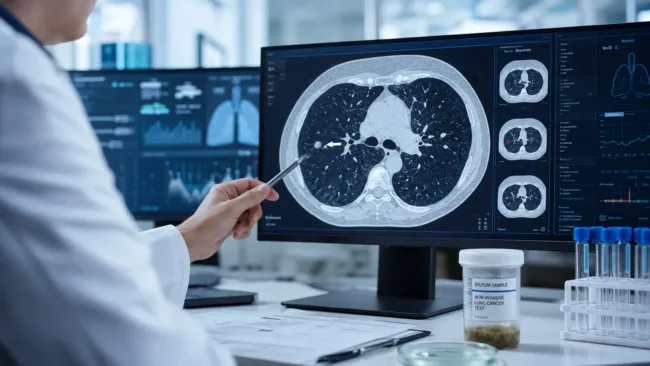
CyPath Lung is a non-invasive diagnostic test that analyses sputum collected from patients considered at elevated risk of lung cancer. The test uses automated flow cytometry, a fluorescent porphyrin and proprietary artificial intelligence to identify cell populations and biological characteristics associated with malignancy. :contentReference[oaicite:4]{index=4}
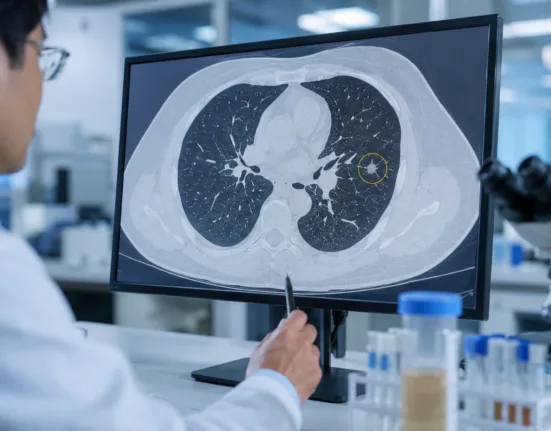
The intended clinical opportunity emerges after a pulmonary nodule is detected through low-dose computed tomography screening or incidentally during another imaging procedure. Many lung nodules are benign, but imaging alone may not immediately determine which patients have cancer and which can be monitored safely.
Clinicians must balance the danger of delaying a cancer diagnosis against the risks of unnecessary procedures. Bronchoscopy, needle biopsy and surgery can provide definitive information, but they may expose patients to bleeding, pneumothorax, infection, anaesthesia complications and substantial healthcare costs.
CyPath Lung is positioned between imaging and invasive investigation. A result indicating lower malignancy risk could support surveillance in an appropriate patient, while a higher-risk result could strengthen the case for expedited diagnostic work-up. The test does not replace computed tomography, pathology or clinical judgement, and its results must be assessed alongside imaging features, smoking history, age, symptoms and other risk factors.
How strong is the clinical evidence supporting the CyPath Lung diagnostic?
A peer-reviewed study published in 2023 evaluated the use of automated flow cytometry and machine learning to detect early-stage lung cancer in sputum. In the subgroup of high-risk participants with small indeterminate nodules measuring less than 20 millimetres, CyPath Lung demonstrated 92% sensitivity, 87% specificity, 88% accuracy and a 99% negative predictive value. :contentReference[oaicite:5]{index=5}
Sensitivity describes the proportion of cancer cases correctly identified, while specificity reflects the proportion of non-cancer cases correctly classified. Negative predictive value indicates the likelihood that a negative result is genuinely negative within the population studied.
The reported 99% negative predictive value is commercially and clinically attractive because one of the largest unmet needs in pulmonary nodule management is identifying patients who may avoid invasive procedures. However, negative predictive value depends heavily on cancer prevalence in the tested population and cannot automatically be applied to every clinic, screening programme or patient group.
The subgroup results also require validation in a substantially larger, prospectively followed population. Diagnostic performance observed in a controlled study may change when a test is introduced across multiple centres with different patient demographics, sputum quality, imaging practices and prevalence of lung disease.
CyPath Lung should therefore be viewed as a promising adjunctive test supported by encouraging early clinical evidence rather than as a definitive rule-out test. The latest sales data demonstrate growing physician interest, but commercial use does not substitute for the larger evidence base generally required for guideline inclusion, comprehensive reimbursement or regulatory clearance.
Why is bioAffinity Technologies conducting a 2,000-patient longitudinal study?
bioAffinity Technologies began a prospective longitudinal study in March 2026 that is designed to enrol as many as 2,000 high-risk patients with pulmonary nodules measuring from six millimetres to less than 30 millimetres. The study is expected to include Veterans Affairs medical centres, military hospitals, academic institutions and private clinical sites, with patients followed for as long as two years or until a definitive cancer or non-cancer diagnosis is established. :contentReference[oaicite:6]{index=6}
The larger trial is intended to assess the sensitivity and specificity of the underlying FlowPath Lung research assay across a broader and more clinically representative population. FlowPath Lung uses the same core technology and procedures as the commercially available CyPath Lung test, but the different name distinguishes the investigational assay used within the study. :contentReference[oaicite:7]{index=7}
This trial could become one of the most important value drivers for the diagnostic. A well-designed longitudinal study may show whether an initial CyPath Lung result accurately predicts the eventual diagnosis, whether performance remains consistent across different institutions and whether the test provides value in nodules of varying sizes and clinical risk.
The involvement of federal healthcare facilities may also be commercially relevant. Veterans and military populations can have meaningful exposure to smoking, burn pits and other occupational respiratory hazards, creating a need for improved lung cancer detection and pulmonary nodule assessment.
Nevertheless, a 2,000-patient study will require substantial time, funding and operational discipline. Patient recruitment may be difficult because eligible individuals must have appropriate nodules, provide usable sputum samples and remain available for follow-up until a definitive outcome is established.
Could CyPath Lung reduce unnecessary biopsies without delaying cancer diagnosis?
The commercial argument for CyPath Lung depends on its ability to improve decisions in patients whose imaging results are inconclusive. A diagnostic that merely repeats information already available from computed tomography would offer limited clinical or economic value.
A useful adjunctive test must demonstrate that it can identify a lower-risk group in which surveillance is reasonable while preserving sufficient sensitivity to avoid missing early cancers. It must also identify a higher-risk group in which clinicians are more likely to recommend positron emission tomography, bronchoscopy, biopsy or surgical evaluation.
bioAffinity Technologies has highlighted individual case reports in which CyPath Lung contributed to the detection of Stage 1A lung cancer or supported decisions to avoid invasive procedures. Such cases illustrate possible applications, but they cannot establish effectiveness because favourable outcomes are more likely to be reported than unsuccessful or ambiguous cases. :contentReference[oaicite:8]{index=8}
Prospective clinical utility evidence will ultimately be more persuasive than case studies. Payers and guideline committees will want to know how often CyPath Lung changes physician decisions, whether those changes are appropriate and whether using the test reduces total diagnostic costs without worsening cancer outcomes.
What does the laboratory-developed test status mean for patients and clinicians?
CyPath Lung is marketed through Precision Pathology Laboratory Services as a laboratory-developed test performed in a laboratory certified under the Clinical Laboratory Improvement Amendments. The test has not been cleared or approved by the United States Food and Drug Administration. :contentReference[oaicite:9]{index=9}
Laboratory-developed tests can be offered clinically without going through the same premarket review process required for many distributed diagnostic devices. This pathway can allow innovative tests to reach patients earlier, but it places greater responsibility on clinicians, laboratories and payers to evaluate the available analytical and clinical evidence.
The regulatory environment has also changed repeatedly. A federal court vacated the United States Food and Drug Administration’s 2024 laboratory-developed test rule, and the agency subsequently restored the relevant regulatory language to its earlier form. The result is that laboratory-developed tests remain subject to a complex framework involving laboratory oversight, state requirements and evolving federal policy. :contentReference[oaicite:10]{index=10}
For bioAffinity Technologies, the laboratory-developed test route supports current commercialization while the company builds additional clinical evidence. However, broader adoption could eventually require an FDA-cleared version, particularly if the company seeks inclusion in national guidelines, widespread payer coverage or distribution beyond its own laboratory network.
Will insurance coverage determine whether CyPath Lung can scale nationally?
Insurance coverage for CyPath Lung varies, and some commercial insurers or Medicare Advantage plans may require prior authorisation. Precision Pathology Laboratory Services states that it cannot guarantee full or partial reimbursement, meaning patients may face deductibles, co-insurance or the entire cost when coverage is denied. :contentReference[oaicite:11]{index=11}
Reimbursement uncertainty can slow adoption even when physicians believe a test is useful. Pulmonologists may hesitate to order a new diagnostic if patients could receive unexpected bills, while laboratories may experience delayed payments, claims denials and higher administrative costs.
A stronger clinical utility dossier could improve the reimbursement position. Evidence showing that CyPath Lung safely reduces bronchoscopies, biopsies, imaging procedures or prolonged surveillance could support a compelling health-economic argument for payers.
Published economic modelling has suggested that a sputum-based diagnostic used after a positive low-dose computed tomography result could create value by improving risk classification and reducing unnecessary downstream procedures. Modelled savings, however, depend on assumptions about test accuracy, pricing, clinical behaviour and the proportion of invasive procedures avoided. :contentReference[oaicite:12]{index=12}
What are the financial risks behind bioAffinity Technologies’ commercial expansion?
CyPath Lung revenue increased by approximately 114% to $361,000 in the first quarter of 2026, while unit sales increased by 146% from the corresponding period of 2025. Total company revenue nevertheless declined from approximately $1.9 million to $1.4 million after bioAffinity Technologies discontinued lower-margin pathology services and redirected resources towards CyPath Lung. :contentReference[oaicite:13]{index=13}
The company reported a first-quarter net loss of approximately $3.6 million and used about $3.2 million of cash in operating activities. Cash and cash equivalents stood at approximately $3.1 million at March 31, 2026, and management stated that substantial doubt existed about the company’s ability to continue as a going concern without additional funding or significantly higher revenue. :contentReference[oaicite:14]{index=14}
bioAffinity Technologies subsequently completed a $3.2 million equity offering in June 2026, selling shares or pre-funded warrants at approximately $0.80 each. The financing provided additional operating capital but also increased the number of shares and created dilution for existing investors. :contentReference[oaicite:15]{index=15}
The company’s shares were trading near $0.83 on July 7, 2026, with a market capitalisation of approximately $3.7 million. The small valuation, recent equity issuance and elevated trading volume indicate that investor sentiment remains highly speculative despite the positive commercial update.
For shareholders, faster CyPath Lung growth is encouraging but must be compared with the company’s cash requirements. Commercial expansion, the longitudinal clinical trial, laboratory operations, product development and regulatory work could require further capital before diagnostic revenue becomes sufficient to fund the business.
What could convert record test growth into a sustainable diagnostics business?
The next stage of development requires bioAffinity Technologies to prove that the second-quarter momentum is repeatable. Continued sequential volume growth, increasing revenue per quarter and a higher proportion of physicians placing recurring orders would provide stronger evidence of commercial durability.
The company must also broaden its geographical reach without allowing sales and marketing costs to increase faster than test revenue. First-quarter selling, general and administrative expenses rose to approximately $3.2 million as bioAffinity Technologies added personnel and support services for CyPath Lung commercialization. :contentReference[oaicite:17]{index=17}
Clinical execution will be equally important. Progress in the 2,000-patient longitudinal study, expansion of participating sites and transparent reporting of enrolment could improve confidence that the company is building the evidence needed for broader clinical acceptance.
Reimbursement, regulatory strategy and laboratory capacity will determine how quickly physician interest translates into scale. Even strong diagnostic performance may not produce a successful product if ordering is complicated, patients face uncertain costs or the company cannot process and report tests efficiently.
What is the expert assessment of bioAffinity Technologies’ CyPath Lung update?
The July 7 sales update provides an encouraging signal that CyPath Lung is gaining traction among pulmonologists and healthcare institutions. Growth among existing users is particularly important because repeat ordering suggests the test may be providing actionable information in real clinical practice.
However, this remains an early commercialization story. Absolute quarterly test volumes and revenue were not disclosed, the test has not received FDA clearance, reimbursement is inconsistent and the company continues to operate with significant financial constraints.
The clinical concept is credible. A non-invasive sputum test that helps distinguish malignant from benign pulmonary nodules could address an important gap between imaging surveillance and invasive diagnosis. The published performance data, particularly the high negative predictive value reported in patients with small nodules, justify further evaluation.
The decisive evidence will come from larger prospective studies and real-world clinical utility data rather than sales growth percentages alone. If the longitudinal study confirms robust performance and shows that CyPath Lung safely changes patient management, the test could become a valuable component of lung cancer screening and pulmonary nodule assessment.
For now, bioAffinity Technologies has demonstrated growing demand but not yet commercial maturity. The opportunity is meaningful, but success will depend on converting early physician enthusiasm into validated clinical utility, reliable reimbursement, sustainable revenue and a financing structure capable of supporting the company through its next development stage.