Pierre Fabre Laboratories and Iktos have entered into a collaborative agreement to discover and develop novel small-molecule drug candidates in oncology using Iktos’ generative AI platform. The collaboration will integrate Iktos’ machine learning-driven drug design with Pierre Fabre’s preclinical development capabilities to accelerate early-stage oncology pipeline innovation. The agreement includes upfront and milestone-based payments, with both parties contributing to candidate selection and progression.
Why Pierre Fabre’s alliance with Iktos matters for oncology innovation in Europe
This partnership signals a decisive evolution in how mid-sized European pharmaceutical firms are adapting to AI-native R&D models in oncology. Unlike big pharma’s sprawling, multi-platform AI strategies, Pierre Fabre Laboratories is selectively embedding AI where it has the highest leverage: the design and optimization of small molecules against high-value cancer targets.
The oncology pipeline today remains a bottleneck-intensive environment. Even targeted therapies with known mechanisms suffer from long optimization cycles, poor predictive validity of early assays, and frequent attrition during IND-enabling studies. By integrating Iktos’ in silico molecule generation with automated chemical synthesis and high-content screening, Pierre Fabre is attempting to compress this cycle and improve the fidelity of early candidate selection.
This is not just about being faster—it’s about being smarter earlier. For a company that generated €520 million in oncology revenues in 2024, with over 88% coming from international markets, Pierre Fabre is under pressure to maintain relevance in competitive categories like NSCLC and solid tumors driven by rare genetic alterations. AI-powered early discovery is now seen as a strategic hedge against that risk.
What Iktos brings to the table that traditional CROs and AI vendors don’t
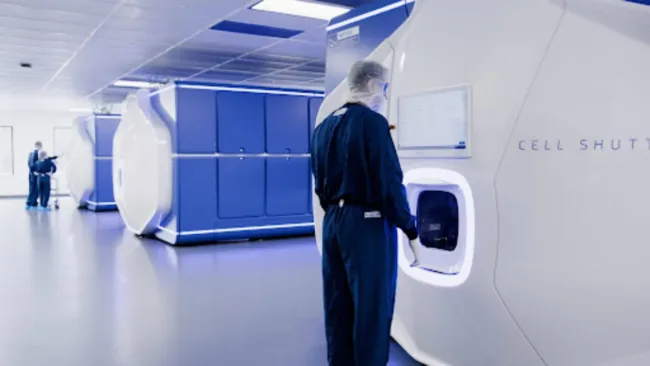
Founded in 2016, Iktos has quietly built a reputation as one of the few AI platforms that delivers both in silico design and real-world execution. Its proprietary generative AI models go beyond molecular generation to suggest compounds optimized for synthetic accessibility, potency, and multi-parametric success criteria. But what sets Iktos apart is its integration of automated chemistry robotics and biologically relevant testing environments.
In 2024, Iktos strengthened this capability with the acquisition of Synsight, a specialist in cellular imaging and high-content biological screening. This bolstered the biological feedback loop critical to refining AI design models. In essence, Iktos is now able to close the full loop: design → make → test → learn → redesign, all within an accelerated, AI-enhanced framework.
Industry observers note that while many AI companies can generate molecules, few can validate them in-house and iterate meaningfully within compressed timelines. This is what makes Iktos attractive as a partner to companies like Pierre Fabre Laboratories that may lack in-house robotics or AI capacity but have therapeutic domain expertise and clinical trial infrastructure.
The quiet race to dominate AI-native small-molecule oncology is heating up
The Pierre Fabre–Iktos tie-up is entering a crowded but still loosely defined race in AI-enabled drug discovery for oncology. Competitors like Exscientia, Insilico Medicine, Relay Therapeutics, and Recursion Pharmaceuticals have all claimed strong pipelines or platform partnerships, but real-world validation has been uneven.
Exscientia’s most advanced AI-designed asset entered Phase 2 trials only in 2023, nearly a decade after the company’s founding. Recursion, while backed by substantial capital and data, has faced challenges in translating phenotypic screening to clinical hits. Insilico, though recently announcing promising anti-fibrosis data, remains largely in early clinical stages.
What Pierre Fabre and Iktos are attempting is less headline-grabbing but potentially more practical: using a hybrid AI-plus-chemist framework to improve the odds of success at the earliest stages of drug design. The lack of fanfare around this deal, including the decision to keep the oncology target undisclosed, may actually indicate a more execution-focused approach rather than a venture-fueled technology showcase.
Where this fits into Pierre Fabre’s broader oncology R&D roadmap
Pierre Fabre Laboratories has been steadily building a precision oncology portfolio over the past five years, with assets targeting EGFR, MET, RAF, and EBV-driven pathways. Among its more advanced programs:
PFL-241 and PFL-721 are mutant-selective EGFR inhibitors being developed for NSCLC
PFL-002 targets MET genetic alterations in solid tumors
Exarafenib, a pan-RAF inhibitor, aims to address RAS/RAF-driven tumors
These efforts are complemented by collaborations with Vernalis Ltd. (early discovery) and RedRidge Bio (biparatopic antibody development). However, the firm has acknowledged the need to further diversify its early-stage assets and strengthen its hit-to-lead pipeline.
Enter Iktos. This collaboration is clearly positioned to serve that upstream gap—designing new candidates that can be rapidly triaged for preclinical advancement, particularly in under-explored molecular targets where Pierre Fabre lacks legacy chemical libraries or rapid synthesis capacity.
Strategically, this also aligns with the company’s long-term R&D shift: in 2024, Pierre Fabre allocated 60% of its €219 million R&D budget to targeted oncology therapies. Bringing AI design into the mix may allow it to generate more candidates without proportionally increasing headcount or cycle time.
The regulatory horizon for AI-designed drugs remains cautiously conservative
Despite growing adoption of AI tools in discovery, regulators are not yet treating AI-designed drugs differently in terms of data requirements, clinical endpoints, or approval pathways. There is no regulatory shortcut.
From a clinical development standpoint, any molecule generated by Iktos’ platform will still need to clear the same toxicology and pharmacokinetic hurdles as a traditional compound. The advantage lies in upstream de-risking—not regulatory fast-tracking.
That said, regulatory watchers suggest that agencies like the EMA and FDA are beginning to engage with AI-derived discovery frameworks more seriously, especially when such platforms include closed-loop validation like robotic synthesis and preclinical screening. If such programs deliver strong data in first-in-human trials, it could build institutional confidence in these methodologies, paving the way for more flexible design-of-experiment strategies in early-stage development.
But that remains speculative. For now, the real payoff is speed to preclinical candidate—not shortcut to approval.
What could derail the partnership—and what to watch for in 2026–2027
The key execution risk in this collaboration is integration. AI platform success depends on clear alignment between molecule design, medicinal chemistry, biological assay interpretation, and decision-making frameworks. If Pierre Fabre’s internal teams are not fully embedded into Iktos’ iterative design-test cycles, candidates may be discarded too early or progressed too late.
Another concern is the platform’s ability to address novel targets, especially those lacking well-characterized binding pockets or with limited biological tractability. AI is only as good as the data it’s trained on—and in oncology, that data can be sparse, biased, or inconsistent across modalities.
Industry observers will be watching for any disclosure in the next 12–18 months that suggests the joint team has moved a molecule into IND-enabling studies. That would be a tangible marker that the platform is producing viable hits.
If that happens, it may serve as a model for other privately held pharma companies in Europe to adopt similar AI-native discovery frameworks—particularly those in dermatology, rare diseases, and autoimmune conditions where Pierre Fabre also operates.
A quiet but credible bet on oncology drug design efficiency
This collaboration does not promise moonshots. It promises iteration, acceleration, and optimization—three things mid-sized pharmaceutical companies desperately need if they are to remain competitive without the scale advantages of global giants.
By choosing Iktos, Pierre Fabre is signaling that it wants not just more molecules, but better ones, faster. And for oncology patients waiting on the next breakthrough, speed and specificity may matter more than scale.
If the partnership delivers, it could redefine the playbook for AI adoption in early discovery—less about technology-first disruption, and more about quiet R&D modernization that compounds over time.