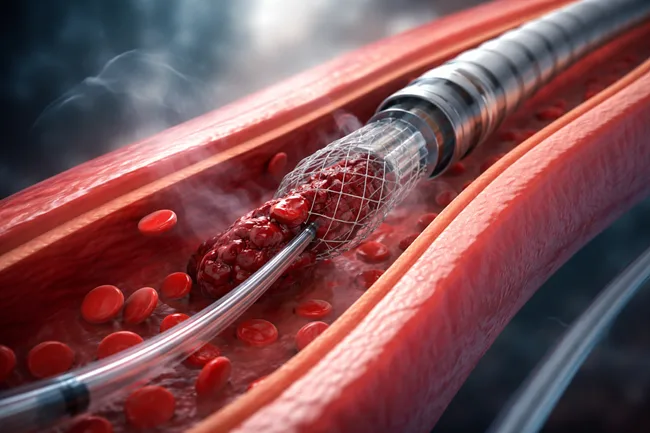
Emboline Inc. has received United States Food and Drug Administration 510(k) clearance for the Emboliner Embolic Protection System for use during transcatheter aortic valve replacement, moving a device built around full cerebral and systemic embolic protection into the United States market. The system is designed to capture material released during TAVR before that debris travels toward the brain, kidneys and other organs.
The clearance follows PROTECT H2H, the first randomized head-to-head comparison between Emboliner and Boston Scientific’s established Sentinel cerebral protection system. In the trial, clinical outcomes at 30 days were almost identical, but Emboliner captured substantially more debris and achieved higher technical placement success. That combination creates an unusual commercial story because the device demonstrated mechanical superiority on debris capture without demonstrating a statistically superior stroke outcome.
Why does TAVR create an embolic-protection problem?
Transcatheter aortic valve replacement involves advancing equipment through the vasculature and manipulating a heavily diseased aortic valve. Calcification, tissue fragments, thrombus and other material can become dislodged during the procedure and enter the circulation.
The brain is the most feared destination because embolic material can cause stroke. Yet particles can also travel to kidneys and other organs, creating the rationale for protection extending beyond the cerebral circulation.
TAVR outcomes have improved dramatically, making complications that were once accepted as part of treating very high-risk patients increasingly important as the procedure expands into younger and lower-risk populations. When mortality falls and hospital stays shorten, preventing low-frequency but devastating events such as stroke becomes even more central to procedural quality.
How is Emboliner different from Sentinel?
Sentinel uses filters positioned to protect major arteries supplying the brain. Its design established cerebral embolic protection as a recognized adjunct to TAVR, but it does not filter the entire arterial circulation.
Emboliner is designed as a circumferential filter positioned in the aortic arch so material can be captured before reaching both cerebral and systemic circulation. Emboline argues that this broader design provides “full-body” protection rather than focusing only on selected vessels supplying the brain.
The engineering argument is intuitive: if debris released during TAVR can travel anywhere downstream, capturing more of it before it leaves the aorta might reduce injury outside the brain as well as potentially reduce cerebral embolization. Clinical medicine, however, requires more than an intuitive mechanism.
What did PROTECT H2H actually show?
The randomized study enrolled more than 500 patients undergoing TAVR across sites in the United States, Germany and Brazil. At 30 days, the composite endpoint including death, stroke and severe acute kidney injury occurred in approximately 4.9% of Emboliner patients and 5.0% of Sentinel patients. Stroke occurred in 2.0% and 2.1%, respectively.
Those results established non-inferiority rather than superiority on the key clinical endpoints. The important difference emerged when investigators examined captured debris. Emboliner captured a median 93 particles larger than 150 microns versus 31 for Sentinel, and total particle counts were approximately 1,575 versus 801.
Technical success also favoured Emboliner, with successful positioning in roughly 96% of cases compared with about 87% for Sentinel. That result is notable because trial operators already had experience with Sentinel whereas Emboliner was new to them.

Why has embolic protection remained controversial despite an obvious rationale?
Previous randomized evidence has not established that routine cerebral embolic protection significantly lowers overall stroke rates during TAVR. The large PROTECTED TAVR trial enrolled 3,000 patients and found stroke in 2.3% of patients receiving Sentinel versus 2.9% without protection, a difference that was not statistically significant. Disabling stroke occurred less frequently in the protection group, but the primary endpoint was negative.
That history sets a high bar for Emboline. Demonstrating that a filter captures substantially more physical debris is mechanistically persuasive, yet physicians and hospitals ultimately care about clinically meaningful outcomes.
PROTECT H2H was not powered to establish whether Emboliner’s additional systemic debris capture reduces kidney injury, cognitive decline or other organ complications. Investigators themselves acknowledged that limitation.
Could full-body protection create value even without a lower stroke rate?
Possibly, but the argument will require additional evidence. Embolic injury does not always produce an obvious clinical stroke. Smaller cerebral lesions can appear on imaging without immediate dramatic symptoms, and systemic emboli may affect organs in ways that are difficult to measure during short follow-up.
If broader filtration reduces subclinical cerebral injury, renal injury or other downstream complications, Emboliner could establish value that is not captured fully by conventional 30-day stroke endpoints. Future studies could therefore become important in demonstrating whether higher debris capture is merely an engineering measurement or a clinically meaningful surrogate.
The commercial argument may also rely partly on procedural confidence. Physicians may prefer a device that protects more vascular territory if it can be deployed safely without meaningfully increasing complexity, even before superiority on rare clinical outcomes is definitively established.
Does higher technical success matter commercially?
Ease of use often determines whether an adjunctive device becomes routine. TAVR procedures are increasingly standardized, and operators may resist technologies that add meaningful time, vascular access complexity or procedural failure risk.
A roughly nine-percentage-point difference in successful positioning between Emboliner and Sentinel therefore deserves attention. If that advantage persists outside the trial, it could support adoption independently of debris-count data.
The complication profile will remain important. PROTECT H2H reported no significant difference in major bleeding or vascular complications between the two systems, suggesting that wider filtration was not purchased at the price of an obvious access-site safety penalty in the randomized study.
Can Emboline compete with an established structural-heart supplier?
Boston Scientific has substantial commercial reach, hospital contracting relationships and an installed position in interventional cardiology. Emboline is a much smaller privately held company, making commercialization a very different challenge from obtaining regulatory clearance.
The company secured $20 million in growth capital earlier in 2026 specifically to support Emboliner commercialization. That capital can help fund inventory, field support, physician training and expansion of the sales organisation, but nationwide structural-heart commercialization can require significant resources.
This creates several possible strategic paths. Emboline could build an independent specialist franchise, partner with a larger cardiovascular company or eventually become an acquisition target if adoption validates the technology. The value of the platform could also extend beyond TAVR if full-body embolic protection proves useful in other transcatheter procedures that generate debris.
What should hospitals watch as commercial use begins?
The first measure is straightforward procedural adoption. Hospitals will want to know whether Emboliner can be integrated without adding unacceptable time, training or vascular-access burden and whether technical success in routine practice resembles the pivotal trial.
The second is the accumulating real-world outcome evidence. If stroke rates remain similar to existing protection but kidney outcomes, imaging findings or other measures show advantages, the full-body concept becomes much more compelling. If greater debris capture never translates into patient benefit, purchasing decisions may remain heavily influenced by price and workflow.
The device has therefore cleared one question and exposed another. FDA clearance validates Emboliner as a marketable embolic protection system, and PROTECT H2H establishes that it can perform at least comparably to Sentinel on short-term clinical endpoints while capturing markedly more debris. Whether that additional captured material represents prevented clinical harm is now the central question Emboline must answer in the market.