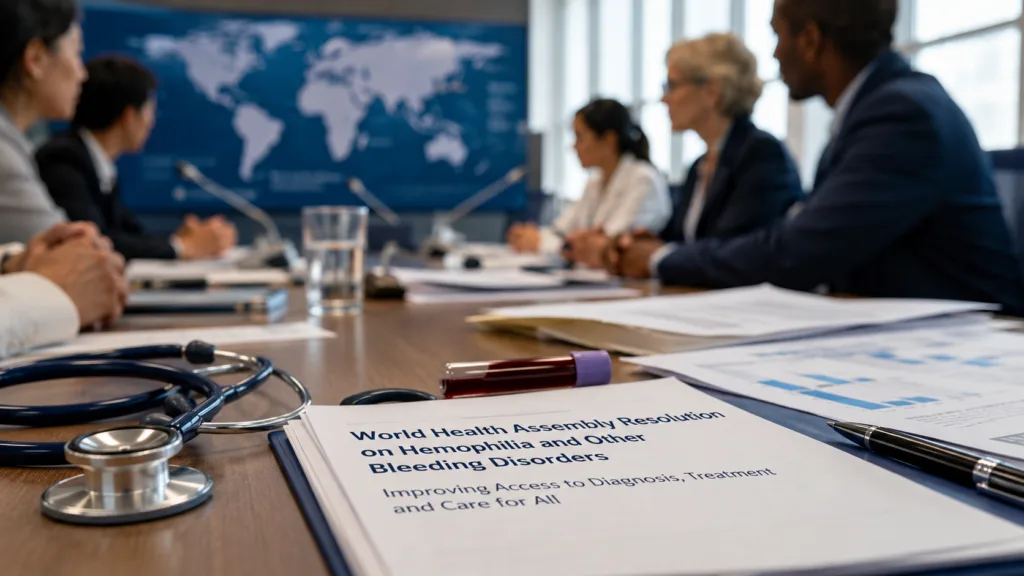
The unanimous adoption of a World Health Assembly resolution on hemophilia and other inherited bleeding disorders has placed rare bleeding conditions more firmly on the global health policy agenda, creating a new test for whether international recognition can translate into earlier diagnosis, wider treatment access and stronger national care systems.
The 79th World Health Assembly adopted the resolution on Global Action to Advance Health Equity for People with Hemophilia and Other Bleeding Disorders on May 22, 2026, after earlier approval by the World Health Organization Executive Board. The World Federation of Hemophilia described the move as a historic development for people with inherited bleeding disorders, particularly because the resolution calls attention to persistent gaps in diagnosis, treatment availability and comprehensive care.
The significance lies not just in the diplomatic language of the resolution, but in what it could trigger across healthcare systems. Hemophilia care has changed rapidly over the past decade, with factor replacement therapies, extended half-life products, non-factor therapies, prophylaxis models and gene therapy creating a more advanced treatment landscape. Yet access to these innovations remains highly uneven. A patient in a well-resourced market may receive regular prophylaxis and specialist monitoring, while another patient in a lower-resource setting may still face delayed diagnosis, untreated joint bleeds, disability or life-threatening complications.
That gap is the real story. The World Health Assembly resolution does not approve a drug, fund a national program or force immediate reimbursement reform. What it does is create a global policy reference point that governments, patient organisations, clinicians and industry stakeholders can use to push bleeding disorders higher on national health agendas.
Why does the World Health Assembly resolution matter for hemophilia care?
A World Health Assembly resolution is not a symbolic press release. It is an official World Health Organization policy instrument adopted by Member States to set priorities, guide national health strategies and request action from governments and the WHO Secretariat. In practical terms, it gives hemophilia and other bleeding disorders a stronger place in policy conversations that often focus on higher-prevalence non-communicable diseases, infectious diseases or maternal and child health.
That matters because hemophilia has historically suffered from a visibility problem. The condition is severe, expensive to manage and often disabling when untreated, but it affects a relatively small patient population compared with diabetes, cardiovascular disease or cancer. This makes it easy for national health systems, especially those under budget pressure, to delay investment in specialist diagnosis, registries, treatment centres and prophylaxis programs.
The new resolution reframes inherited bleeding disorders as a health equity issue. That is important language. It shifts the conversation away from rare disease as a niche clinical category and toward the broader question of whether patients should face lifelong disability or premature death because of where they are born, whether they are diagnosed early, or whether their health system can finance modern treatment.
The resolution also reflects the growing recognition that bleeding disorders include more than severe hemophilia A and hemophilia B. Von Willebrand disease, rare clotting factor deficiencies, platelet function disorders and bleeding disorders affecting women and girls often remain underdiagnosed or misunderstood. This broader framing could help national programs move beyond a narrow view of hemophilia care and toward more inclusive bleeding disorder strategies.
How could the resolution improve diagnosis and national treatment systems?
The first potential impact is diagnosis. Many people with inherited bleeding disorders remain undiagnosed or are diagnosed late, particularly in low- and middle-income countries. Without laboratory capacity, trained clinicians and referral pathways, patients may be treated only after major bleeding events, surgery-related complications or repeated joint damage.
The World Federation of Hemophilia has emphasised that the resolution could help increase diagnosis rates and improve treatment and care. That is a critical starting point because treatment access cannot be planned properly without knowing how many patients exist, where they live and what type of bleeding disorder they have.
National registries could become one of the most important follow-through areas. A country that has no reliable bleeding disorder registry cannot accurately forecast demand for factor concentrates, non-factor therapies, laboratory services, physiotherapy or specialist care. Stronger data systems also matter for procurement, reimbursement and long-term health economics.
The resolution’s emphasis on national health policy inclusion could therefore encourage governments to build structured programs rather than relying on fragmented charity, emergency treatment or hospital-by-hospital decision-making. For patients, this could mean earlier diagnosis, clearer referral pathways and a better chance of receiving prophylaxis before irreversible joint damage occurs.
What does this mean for treatment access, prophylaxis and newer therapies?
The most commercially sensitive part of the resolution is its relevance to treatment access. Hemophilia therapy has moved far beyond episodic treatment of bleeds. The global standard in advanced care settings increasingly focuses on prophylaxis, home treatment, personalised dosing, joint preservation and quality of life.
However, prophylaxis is only meaningful when medicines are consistently available. In countries where factor concentrates are scarce or unaffordable, patients may still receive treatment only when a bleed occurs. That reactive model is clinically damaging and economically inefficient over time because repeated bleeds can lead to chronic joint disease, disability, lost productivity and higher downstream healthcare costs.
The resolution could strengthen the case for governments to expand access to safe and effective therapies, including existing clotting factor concentrates and newer treatment options. Non-factor therapies such as bispecific antibodies have already changed the treatment conversation in hemophilia A, particularly for patients with inhibitors, while gene therapies have opened a more ambitious but more complex debate around one-time treatment, durability, eligibility and pricing.
This does not mean the resolution will immediately accelerate reimbursement for high-cost therapies. Health ministries will still face budget constraints, procurement hurdles and competing priorities. But the policy environment matters. Once bleeding disorders are recognised as a global health equity priority, patient groups and clinicians have a stronger basis to argue that prophylaxis and comprehensive care are not luxury interventions, but core components of responsible long-term management.
Why are women and girls central to the next phase of bleeding disorder policy?
One of the most important aspects of the global bleeding disorder conversation is the growing focus on women and girls. For decades, hemophilia was often discussed primarily as a male disease because severe hemophilia typically affects males. That framing left many women with bleeding symptoms under-recognised, particularly carriers with low factor levels, patients with von Willebrand disease, and women experiencing heavy menstrual bleeding, postpartum bleeding or procedure-related bleeding.
A stronger global framework could help shift this. Bleeding disorders in women are often misattributed to gynaecological causes without adequate haematology evaluation. This can delay diagnosis for years and expose patients to avoidable complications. Public awareness, clinician education and better integration between haematology, obstetrics, gynaecology and primary care could become practical areas for implementation.
This is where the resolution’s health equity framing becomes especially relevant. Equity is not only about geography or income. It is also about gender, awareness and clinical recognition. A national bleeding disorder strategy that ignores women and girls would miss a major part of the undiagnosed patient population.
What are the implications for pharma and medtech companies?
For pharma and medtech companies active in hemophilia, diagnostics, specialty care infrastructure and rare disease services, the resolution is not an immediate commercial catalyst, but it is a meaningful policy signal. It indicates that bleeding disorder care is gaining international legitimacy as a public health priority rather than remaining solely within specialist haematology circles.
For companies developing factor therapies, non-factor products, gene therapies, diagnostics or digital monitoring tools, the bigger opportunity may come from health-system strengthening. More diagnosis means larger identified patient populations. Better registries mean clearer demand forecasting. More national policy attention can support more structured procurement and reimbursement frameworks.
At the same time, the resolution may increase scrutiny on affordability. If health equity is the central theme, companies will face pressure to show how innovation can reach patients beyond wealthy markets. The industry’s challenge is therefore not only to develop better therapies, but to build pricing, access and partnership models that work in countries where healthcare budgets are far more constrained.
This is where public-private collaboration could become important. Humanitarian aid, tiered pricing, pooled procurement, capacity-building programs and local treatment centre development may all become part of the broader access conversation.
What could stop the resolution from becoming real-world progress?
The main risk is implementation failure. Global resolutions can create momentum, but they do not automatically change clinical practice. Without national funding, data collection, procurement reform and trained care networks, the resolution could remain an advocacy milestone rather than a patient-level breakthrough.
The second risk is uneven adoption. Countries with existing hemophilia programs may use the resolution to refine care, while under-resourced systems may struggle to act without external technical and financial support. That could preserve the same access gap the resolution is trying to address.
The third risk is that the conversation becomes too focused on advanced therapies while basic care remains unavailable for many patients. Gene therapy and novel biologics are important, but millions of patients worldwide still need reliable diagnosis, safe clotting factor access, physiotherapy, emergency care protocols and long-term monitoring.
A balanced implementation agenda will therefore need to connect innovation with basics. The future of bleeding disorder care cannot be built only around premium therapies. It also needs laboratories, treatment centres, registries, trained clinicians and patient education.
Can global policy recognition reshape bleeding disorder care?
The World Health Assembly resolution gives hemophilia and other bleeding disorders a stronger institutional platform at a time when the treatment landscape is becoming more advanced but also more unequal. Its real test will be whether governments turn recognition into national strategies that improve diagnosis, expand prophylaxis, strengthen data systems and make safe therapies more consistently available.
For the bleeding disorder community, this is a meaningful policy victory. For healthcare systems, it is a reminder that rare diseases are not rare to the patients living with them. For the pharma and medtech sectors, it is a signal that innovation alone will not define the next phase of hemophilia care. Access, affordability and implementation will matter just as much.
The resolution is best understood as a starting line, not a finish line. If Member States act on it, hemophilia and inherited bleeding disorder care could move closer to a more equitable global model. If they do not, the gap between what modern medicine can offer and what most patients can actually receive will remain painfully wide.