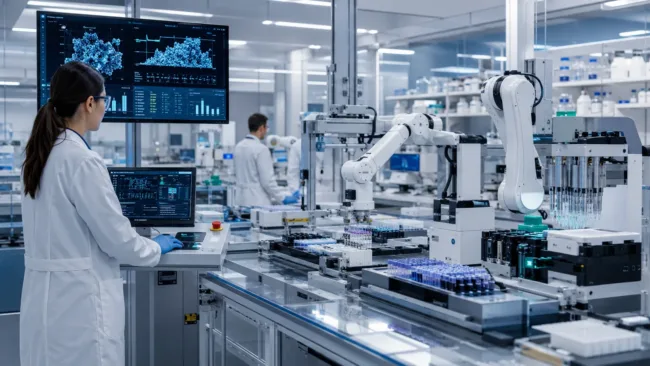
Basler AG has introduced a configurable GMSL vision system aimed at improving laboratory automation, data acquisition, and image handling in life sciences workflows. The system positions the German machine vision specialist deeper inside automated laboratory environments where imaging speed, integration simplicity, and reliable data capture are becoming central to diagnostics, drug discovery, sample handling, and quality control.
Why Basler’s configurable vision system matters for automated laboratory workflows
The significance of Basler’s GMSL vision system lies less in the release of another camera interface and more in what it represents for laboratory automation. Automated labs increasingly depend on imaging systems that can identify samples, monitor liquid handling, read labels, inspect consumables, guide robotic movement, and generate traceable visual data without slowing down the workflow. In that environment, machine vision is no longer a peripheral add-on. It is becoming part of the core operating layer of modern laboratory infrastructure.
Basler’s focus on a configurable system is important because many laboratories do not operate with one standard automation architecture. A clinical diagnostics lab may prioritize throughput and traceability. A drug discovery lab may need high-quality imaging across varied assays. A contract research organization may need flexible systems that can be adapted across client programs. A medical device or biopharma quality control lab may be more concerned with repeatability, audit trails, and integration into existing validated workflows. A one-size-fits-all imaging setup rarely fits all these needs cleanly.
The GMSL approach also speaks to a recurring problem in automation: the gap between technical capability and deployable reliability. Laboratories often want higher-speed imaging, multi-camera configurations, and AI-ready data streams, but they also face limits around space, cabling, validation, software compatibility, and maintenance burden. A vision system that promises matched hardware and software components, easier commissioning, and configuration support is therefore targeting an adoption barrier that has slowed many automation programs. The opportunity is clear, but the risk is equally clear. Laboratory operators will judge the system not only on imaging performance, but also on how easily it can be integrated, maintained, documented, and supported over several years.

How GMSL could change imaging architecture inside automated labs
Gigabit Multimedia Serial Link technology has gained attention because it can transmit high volumes of image and video data over longer distances while supporting compact embedded architectures. That matters in automated laboratory environments because vision modules are often distributed across instruments, robotic systems, sample stations, conveyor paths, and inspection points. As automation density increases, cabling complexity, signal integrity, latency, and component footprint become practical constraints rather than engineering footnotes.
For laboratory automation designers, the potential appeal of GMSL is that it can support high-bandwidth image transfer from cameras to embedded processing systems without forcing bulky or fragmented connectivity designs. This is particularly relevant where multiple cameras need to operate in synchronized workflows. In a high-throughput setting, one camera may inspect a sample tube, another may verify barcode identity, another may check liquid level, and another may monitor robotic positioning. If these systems cannot communicate quickly and reliably, the automation workflow becomes vulnerable to bottlenecks or errors.
Basler’s system also appears aligned with the broader industry shift toward embedded vision, where image capture and processing move closer to the instrument or automation platform rather than relying entirely on external computing infrastructure. That is a useful direction for laboratories trying to build faster, smaller, and more modular systems. However, embedded vision introduces its own complexity. Developers must manage hardware compatibility, processing loads, software drivers, thermal constraints, and long-term component support. This is why Basler’s emphasis on a complete system rather than a standalone camera is strategically relevant. The market is not only buying imaging hardware. It is buying reduced integration risk.
Why laboratory automation needs better imaging and data handling
Laboratory automation is moving beyond simple task replacement. Earlier automation efforts often focused on reducing repetitive manual steps such as pipetting, sample sorting, or plate handling. The next phase is more data-intensive. Automated systems are expected to detect anomalies, produce structured records, support quality documentation, and feed analytics engines that can improve decision-making over time. Vision systems sit at the intersection of these demands because they generate both operational evidence and usable data.
In diagnostics and life sciences workflows, imaging can support sample identification, contactless detection, process verification, object tracking, and documentation. These functions are especially valuable when laboratories are under pressure to increase throughput while reducing manual inspection. A human operator can miss a label mismatch, liquid handling deviation, or consumable placement issue during repetitive work. A well-calibrated vision system can detect such deviations consistently, provided it is properly designed, validated, and maintained.
The unresolved issue is not whether vision can add value. It is whether laboratories can trust the system under real-world operating conditions. Lighting changes, sample variability, reflective surfaces, condensation, barcode damage, reagent color differences, and mechanical drift can all affect imaging performance. For regulated workflows, false positives and false negatives are not just technical inconveniences. They can create operational delays, require investigation, or affect confidence in the automated process. Basler’s system will therefore need to prove reliability across the messy reality of laboratory environments, not only in controlled demonstrations.
What this reveals about the convergence of lab automation and industrial machine vision
Basler’s move also reflects the wider convergence between industrial machine vision and life sciences automation. Technologies originally associated with factory inspection, robotics, logistics, and quality assurance are increasingly being adapted for medical diagnostics, bio-imaging, laboratory workflows, and pharmaceutical production support. This convergence is logical because both industrial and laboratory environments need repeatable, high-speed, image-based decision-making.
The difference is that laboratories often operate under tighter scientific and regulatory expectations. In industrial inspection, a camera may confirm whether a part meets dimensional tolerances. In a laboratory workflow, the imaging system may help support chain of custody, sample identity, assay quality, or process documentation. The technical function may look similar, but the consequences of failure are different. This makes software stability, auditability, support life, and validation documentation more important in life sciences than in many general industrial applications.
Basler’s machine vision background gives it credibility in this setting because the company already understands cameras, lenses, illumination, software, and system integration. The challenge is whether that capability can be translated into laboratory-specific value. Laboratory automation buyers are not only evaluating camera specifications. They are asking whether a system can fit into regulated workflows, reduce downtime, lower integration effort, and support reproducibility. That is where the commercial test will sit.
How the system could support AI-assisted laboratory analysis
The GMSL vision system also fits into a larger trend: the growing interest in AI-assisted laboratory analysis. AI models need consistent, high-quality image data to perform reliably. If image capture varies too much across devices, lighting setups, or workflow conditions, downstream analytics can become less dependable. A configurable but standardized vision system could help laboratories improve data consistency, especially where multiple imaging points feed into automated interpretation or quality control processes.
This matters for applications such as automated microscopy, sample classification, defect detection, liquid level analysis, label verification, and anomaly detection. In each case, the imaging system is not merely recording an image. It is creating the raw material for a decision. As AI tools become more common in diagnostics and drug discovery workflows, the quality of image acquisition becomes a strategic issue. Poor input data can undermine even sophisticated algorithms.
However, AI readiness should not be confused with clinical or operational readiness. A vision system may support data capture for AI workflows, but laboratories still need validated models, defined performance thresholds, human oversight where required, and clear accountability when automated decisions affect workflow outcomes. The stronger Basler’s system is at producing consistent data, the more useful it could become in AI-enabled lab environments. Yet the full value will depend on the surrounding software, workflow design, and validation strategy.
Why scalability and maintenance may decide adoption
For automation vendors and laboratory operators, the most attractive promise of a complete vision system is reduced integration friction. A modular solution with compatible cameras, cabling, lighting, software support, and enablement packages can shorten development cycles and reduce the number of suppliers involved in troubleshooting. That matters because laboratories often have limited tolerance for prolonged commissioning or unstable automation rollouts.
Scalability is especially important for instrument makers and automation platform developers. A prototype vision setup may work well in a single lab or development environment, but commercial deployment requires repeatability across multiple installations. If each installation needs extensive manual tuning, custom wiring, or software rework, the economics deteriorate quickly. Basler’s system could appeal to original equipment manufacturers and automation developers if it reduces the variability between prototype and production-scale deployment.
Maintenance is another key issue. Laboratory instruments often remain in service for years, and life sciences customers value component availability and support continuity. A vision system that is difficult to replace, update, or service can become a long-term liability. Basler’s positioning around system-level compatibility and support may help address that concern, but buyers will still want clarity around lifecycle management, driver support, replacement paths, and compatibility with future embedded computing platforms.
What investors and industry observers should watch next
Basler AG is not a pure-play life sciences company, but the laboratory automation push could strengthen its exposure to higher-value machine vision applications. Recent company momentum adds context to the product strategy. The German machine vision specialist has raised its 2026 financial outlook after a strong start to the year, and its share price has also shown significant recent momentum. For investors, the laboratory automation angle is therefore part of a broader question: can Basler convert a cyclical recovery in machine vision demand into more durable growth through specialized, higher-margin applications?
The opportunity is attractive because laboratory automation is not a passing trend. Staffing constraints, throughput pressure, diagnostics demand, and the need for reproducible workflows are all pushing laboratories toward more automated systems. Imaging is likely to remain a core layer of that transition. If Basler can become a trusted supplier for embedded vision in laboratory automation, the addressable market could extend beyond cameras into systems, software, consulting, and long-term platform support.
The risk is that machine vision remains a competitive field with pressure from camera manufacturers, embedded computing vendors, robotics suppliers, and integrated laboratory automation companies. Some customers may prefer fully bundled systems from automation vendors rather than assemble vision architectures from specialist components. Others may prioritize cost over configurability. Basler’s success will depend on proving that its system reduces total integration burden, not just that it offers strong technical specifications.
Why this announcement is incremental but strategically useful
Basler’s GMSL vision system is best viewed as an incremental technology launch with strategic relevance rather than a disruptive standalone event. The components of machine vision, cameras, connectivity, lighting, software, and embedded processing are well established. What changes is the packaging of these elements into a more integrated architecture for applications where speed, data volume, and reliability matter.
That distinction is important. In life sciences, many meaningful advances are not dramatic breakthroughs. They are practical improvements that make automation easier to deploy, scale, and maintain. A configurable GMSL vision system may not transform laboratory automation overnight, but it could remove some of the friction that keeps imaging-heavy automation from moving faster.
The real test will be adoption by laboratory automation developers, diagnostics instrument makers, and high-throughput life sciences facilities. If the system reduces commissioning time, supports multi-camera workflows, improves image data reliability, and fits into regulated operating environments, it could become a useful building block for next-generation lab automation. If integration remains complex or application-specific customization remains heavy, the value proposition may be narrower.
For now, Basler’s move reinforces a larger industry signal. The future automated lab will not be defined only by robots, liquid handlers, or software dashboards. It will increasingly depend on vision systems that can see, verify, record, and support decisions at machine speed. Basler is positioning itself for that layer of the laboratory automation stack, and that may be where some of the most important efficiency gains are quietly built.