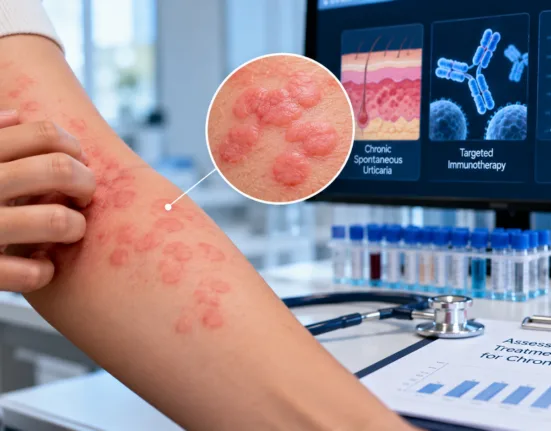
Bambusa Therapeutics has reported preliminary proof-of-concept results for BBT001 from 17 adults with moderate-to-severe atopic dermatitis enrolled in an ongoing randomized, double-blind and placebo-controlled Phase 1 trial. Twelve participants received 450 milligrams of intravenous BBT001 once every two weeks during a four-week treatment period, while five received placebo, with the company reporting rapid improvements in skin disease severity and itch alongside sustained pharmacodynamic activity.
The results provide Bambusa with its first efficacy signal in patients rather than healthy volunteers, moving BBT001 beyond a pharmacokinetic and biomarker story. However, the evidence remains preliminary, the efficacy measures were exploratory rather than primary endpoints, and the very small placebo group means the reported effect sizes cannot yet establish the company’s claim that BBT001 could become a best-in-disease treatment.
BBT001 is an investigational, half-life-extended bispecific antibody designed to inhibit interleukin-4 receptor alpha and interleukin-31 signalling. Bambusa’s development strategy is intended to combine broad suppression of Type 2 inflammation with more direct control of the signalling associated with itch, while eventually allowing subcutaneous maintenance dosing as infrequently as once every three months. onvincing is the rapid EASI improvement reported in only 17 atopic dermatitis patients?
Bambusa reported a placebo-adjusted Eczema Area and Severity Index reduction of 35.56% at Week 1, 61.10% at Week 2, 63.46% at Week 4 and 78.95% at Week 6. The company also reported nominal p-values of 0.0012 at Week 1 and less than 0.0001 at Weeks 2, 4 and 6, based on a mixed model for repeated measures. d and magnitude of the reported EASI separation are notable for a four-week proof-of-concept cohort. The treatment effect did not appear to plateau immediately after the treatment period, and Bambusa said responses continued to deepen among patients with sufficient follow-up. The company also reported placebo-adjusted differences in EASI-75 response of 45 percentage points at Week 4 and 64 percentage points at Week 6.
Those figures require disciplined interpretation. The disclosed EASI-50 and EASI-75 values are placebo-adjusted differences, not the complete responder rates for each study arm. The company has not yet supplied the full individual treatment-arm results, participant-level trajectories, missing-data handling or a detailed explanation of how the exploratory analyses were controlled.
The baseline characteristics were also uneven. Participants receiving BBT001 began with a mean EASI score of 34.64, compared with 29.06 for placebo, while mean affected body surface area was 62.58% in the BBT001 arm and 47.60% in the placebo arm. Mean baseline itch scores were also higher in the treatment group. These imbalances do not invalidate the finding, but they add uncertainty because a 12-patient treatment arm and five-patient control arm cannot reliably balance every disease characteristic through randomization. tically significant result can emerge from a small study when the apparent treatment effect is large and consistent. It does not, however, protect against effect-size inflation, instability caused by one or two participants, or a less impressive result when the therapy is tested across a larger and more heterogeneous population.
Could dual IL-4Rα and IL-31 inhibition distinguish BBT001 from approved eczema biologics?
The scientific rationale behind BBT001 is commercially relevant because Bambusa is combining two pathways that have already been validated separately.
Dupilumab inhibits IL-4 receptor alpha, affecting both IL-4 and IL-13 signalling, and has become an established systemic biologic across several Type 2 inflammatory diseases. Nemolizumab targets the IL-31 receptor alpha pathway and is approved in the United States for moderate-to-severe atopic dermatitis in patients aged 12 years and older when topical prescription therapies do not provide adequate control. Other approved biologics include tralokinumab and lebrikizumab, while oral Janus kinase inhibitors offer another systemic treatment class. s proposition is that one bispecific molecule could provide stronger control of both inflammatory skin lesions and itch than agents focused predominantly on one part of the disease biology. The preliminary data support continued investigation of that hypothesis, particularly because itch reduction was reported as early as the first day after dosing and appeared to deepen over time.
The company reported placebo-adjusted reductions in the Peak Pruritus Numerical Rating Scale of 29% at Week 1, 35% at Week 2, 41% at Week 4 and 43% at Week 6. It also reported sustained reductions in thymus and activation-regulated chemokine and immunoglobulin E, biomarkers associated with Type 2 inflammatory activity. ndings do not establish that BBT001 is superior to dupilumab, nemolizumab or any other therapy. There was no active comparator, and differences in patient selection, baseline severity, treatment duration, endpoint definitions and statistical methods make comparisons with separate trials unreliable.
Bambusa will eventually need to show that dual targeting provides more than a theoretically attractive mechanism. Clinicians and payers will look for a meaningful advantage in lesion control, itch relief, onset, durability, tolerability or dosing burden, rather than accepting mechanistic novelty as sufficient differentiation.
Why is the move from intravenous dosing to a quarterly subcutaneous regimen the critical commercial test?
The preliminary patient results were generated using 450 milligrams of intravenous BBT001 once every two weeks. That regimen is useful for establishing biological activity and controlling early exposure, but it is not the administration model Bambusa is positioning as BBT001’s long-term commercial proposition.
The company is developing both intravenous and subcutaneous formulations and plans to test maintenance dosing intervals extending to once every three months. Earlier healthy-volunteer data indicated a BBT001 half-life of approximately 33 days, while the patient study reportedly produced pharmacokinetic findings consistent with that earlier observation. ged half-life supports the possibility of less frequent dosing, but it does not prove that quarterly administration will maintain clinical control. Bambusa must establish the subcutaneous dose required to achieve adequate exposure, determine whether skin and itch responses persist across the full interval and show that disease does not rebound before the next injection.
The company must also demonstrate that its high-concentration subcutaneous formulation can be manufactured consistently and administered at a practical injection volume. Bispecific antibodies can present additional development and manufacturing complexities involving molecular stability, aggregation, yield, immunogenicity and comparability between formulations.
Successful quarterly dosing would provide an important differentiator in a market where many biologics are administered every two or four weeks. Fewer injections could reduce treatment burden and improve persistence, but payers may still require evidence that the longer interval does not trade convenience for weaker control toward the end of each dosing cycle.
What does the preliminary BBT001 safety disclosure establish, and what remains unknown?
Safety and tolerability are the primary endpoints of the ongoing Phase 1 programme, but Bambusa’s latest announcement provided only a high-level safety summary. The company said BBT001 was well tolerated, reported no cases of conjunctivitis and described treatment-emergent anti-drug antibodies as infrequent, low-titre and without apparent neutralizing activity. articipants were included in the preliminary safety evaluation, with a median follow-up of 71 days after the first dose and a range of 33 to 165 days. That follow-up provides an initial opportunity to identify acute tolerability issues, but the cohort is too small to characterize less common adverse events or establish the longer-term consequences of inhibiting two immune pathways simultaneously.
The announcement did not provide complete counts for treatment-emergent adverse events, treatment-related adverse events, serious adverse events, infections, injection reactions, laboratory abnormalities, discontinuations or dose interruptions. The absence of conjunctivitis in 12 treated patients is encouraging but cannot demonstrate that the risk has been eliminated.
Larger trials will also need to evaluate whether the extended half-life creates challenges if an adverse effect occurs, since drug exposure may persist for a prolonged period. Longer-acting therapies can improve convenience, but the same pharmacokinetic durability can limit how quickly exposure declines after treatment is stopped.
Can Bambusa compete in a crowded atopic dermatitis market without head-to-head evidence?
Atopic dermatitis is no longer a market defined by a single dominant systemic option. Dermatologists now have access to several targeted biologics, oral Janus kinase inhibitors and an expanding range of topical agents, with treatment selection influenced by patient age, disease severity, speed of response, comorbidities, safety considerations, dosing preference, insurance coverage and previous treatment history.
This means BBT001 does not merely need to outperform placebo. By the time it could reach the market, the therapy may need to compete against established prescribing habits, mature safety databases, broad reimbursement arrangements and biologics with multiple approved indications.
Bambusa’s potential competitive package combines dual pathway inhibition, rapid itch reduction, deep lesion improvement and infrequent maintenance dosing. The current readout makes that package credible enough to test, but it does not yet demonstrate that all four attributes can be delivered through the same commercially practical subcutaneous regimen.
The company is privately held and raised approximately $90 million in a Series A financing announced in February 2025. It later completed an oversubscribed Series A-2 round at what it described as a higher valuation, although the amount was not disclosed. The financing provides evidence of institutional support, but the broader programme, including multiple Phase 2 studies and later registrational trials, will require substantial additional capital. iminary BBT001 data could improve Bambusa’s position in future financing, licensing or strategic discussions because human proof-of-concept generally carries more value than preclinical differentiation alone. Any transaction value would still depend on the completeness of the dataset, intellectual-property protection, manufacturing readiness and whether the effect remains visible in the subcutaneous cohorts.
Which BBT001 clinical milestones will determine whether the early efficacy signal is durable?
Bambusa plans to present the full results at a future medical conference and advance BBT001 into a Phase 2b study in moderate-to-severe atopic dermatitis. That study is expected to evaluate maintenance dosing intervals extending to once every three months. any also expects additional topline intravenous data during the first half of 2027 from biologic-naïve and biologic-experienced atopic dermatitis patients treated for 12 weeks. Separate data are expected from patients with chronic spontaneous urticaria receiving 14 weeks of treatment.
A credible Phase 2b programme will need enough participants to evaluate multiple doses and establish a reliable dose-response relationship. It should measure conventional regulatory endpoints such as EASI-75 and validated Investigator’s Global Assessment responses, alongside clinically meaningful itch improvement, rescue-medication use, treatment discontinuations and maintenance of disease control.
The inclusion of biologic-experienced patients will be particularly informative. Early-stage studies often begin with treatment-naïve participants because interpretation is cleaner, but commercially important patients may have already received dupilumab, tralokinumab, lebrikizumab, nemolizumab or a Janus kinase inhibitor. BBT001’s value could rise materially if it retains meaningful activity in patients whose disease was inadequately controlled by existing targeted therapies.
Subcutaneous results will matter more than further intravenous efficacy confirmation because they will test the formulation intended for broader use. Bambusa must show comparable pharmacokinetics and pharmacodynamics, acceptable injection tolerability and sustained efficacy across the proposed maintenance interval.
The 17-patient readout moves BBT001 from an interesting antibody-engineering concept to a clinically credible development candidate. It does not yet make the molecule best in disease. That judgment will depend on whether Bambusa can reproduce the early skin and itch responses in a larger population, provide a complete safety dataset and translate short-course intravenous activity into durable, practical subcutaneous treatment given only a few times each year.