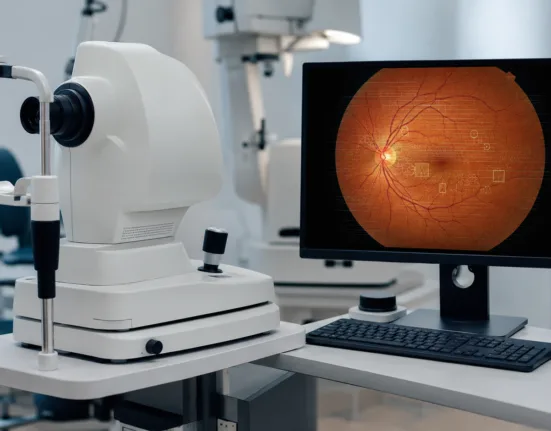
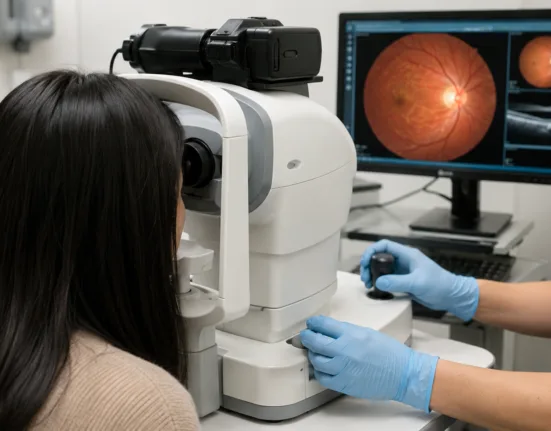
AEYE Health has published peer-reviewed results from three prospective pivotal studies supporting AEYE-DS, its United States Food and Drug Administration-cleared autonomous artificial intelligence system for detecting more-than-mild diabetic retinopathy in adults with diabetes who have not previously been diagnosed with diabetic retinopathy. The studies evaluated the algorithm using both the portable Optomed Aurora retinal camera and the desktop Topcon NW400, with diagnostic decisions compared against multi-expert grading by an independent reading center.
Across the three studies, AEYE-DS produced sensitivity of approximately 92% to 93% and specificity ranging from about 89% to 94%, while more than 99% of images were analyzable. The results add peer-reviewed evidence behind clearances the company had already obtained and strengthen the argument that autonomous diabetic eye screening can be performed outside conventional ophthalmology practices using staff without specialist retinal-imaging training.
The findings do not establish that use of AEYE-DS improves long-term visual outcomes, reduces blindness or replaces comprehensive eye care. Instead, they address a narrower but commercially important question: whether an autonomous system can accurately identify patients who meet the threshold for more-than-mild diabetic retinopathy and should therefore move into appropriate eye-care pathways.
What did the three AEYE-DS pivotal studies show about diagnostic sensitivity and specificity?
The publication combines evidence from three prospective clinical studies that tested AEYE-DS under different hardware configurations. AEYE-1 used the Topcon NW400 desktop fundus camera, while AEYE-2 evaluated a subset of patients using the handheld Optomed Aurora. AEYE-3 provided an additional prospective evaluation centered on the portable system.
In AEYE-1, the system achieved sensitivity of approximately 93% and specificity of around 91% for detecting more-than-mild diabetic retinopathy. AEYE-2 reported sensitivity of approximately 92% and specificity of 94%, while AEYE-3 produced sensitivity of roughly 93% and specificity of about 89%. All three datasets exceeded the predefined performance goals described by investigators.
High negative predictive values were another relevant feature of the studies. In AEYE-1, the negative predictive value approached 99%, reflecting the system’s ability to identify patients unlikely to have more-than-mild disease in the study population. Negative predictive value is nevertheless influenced by disease prevalence, so it should not be interpreted as a fixed property that will necessarily remain identical in every clinical setting.
The reference standard was based on Early Treatment Diabetic Retinopathy Study grading performed through multi-expert review at an independent reading center. That is important because autonomous diagnostic performance needs to be compared against a sufficiently rigorous human reference rather than a single clinician’s unblinded judgment.
Why does greater than 99% imageability matter almost as much as diagnostic accuracy?
An AI diagnostic can have strong sensitivity and specificity yet still perform poorly operationally if a large proportion of patients produce images that cannot be analyzed. Imageability therefore becomes especially important when retinal screening is moved into primary-care offices, community clinics, pharmacies or mobile settings where operators may have limited ophthalmic experience.
AEYE-DS achieved imageability above 99% across the three trials. In practical terms, investigators were able to obtain analyzable exams for almost all participants, substantially reducing the need to refer patients simply because the technology failed to produce a result. The system also showed high repeatability and reproducibility across operators and camera configurations.
Pharmacologic dilation was avoided for the large majority of participants. In AEYE-1, approximately 88% of participants did not require dilation, while roughly 90% avoided it in the handheld-camera study. That characteristic matters commercially because dilation lengthens appointments, creates additional clinical workflow requirements and can make screening less convenient for patients.
The one-image-per-eye workflow is another operational differentiator. Reducing the number of required retinal images lowers acquisition time and may simplify training for non-specialist personnel, although real-world performance will still depend on the quality of implementation across different health systems.
Can AEYE-DS actually be called autonomous if no ophthalmologist interprets every screening exam?
The cleared workflow is autonomous because AEYE-DS analyzes the retinal images and generates a diagnostic screening result without requiring a specialist to interpret each examination. The intended use is to detect more-than-mild diabetic retinopathy in adults with diabetes who have not already been diagnosed with diabetic retinopathy. A positive result can then trigger referral into appropriate eye care.
That represents an important distinction from conventional teleophthalmology, where retinal photographs are captured in one location and subsequently interpreted by an ophthalmologist or trained reading service. Teleophthalmology can be effective, but it creates a dependency on remote specialist capacity and may delay results. Autonomous AI can potentially provide the screening decision at the same encounter.
The system is not a general autonomous ophthalmologist. Its clearance applies to a defined screening indication and patient population, and it should not be interpreted as diagnosing every retinal disease visible on an image. Patients with symptoms, known diabetic retinopathy or other ocular conditions may require different pathways.
The distinction between screening and diagnosis of broader eye disease also matters for patient communication. A negative AEYE-DS result addresses the specific condition covered by the device’s intended use; it does not establish that the eyes are free from glaucoma, macular degeneration, retinal tears or other pathology.
Why could portable-camera compatibility change the economics of diabetic eye screening?
One of the persistent barriers to diabetic-retinopathy screening is not simply the availability of ophthalmologists but the difficulty of getting patients into eye-care appointments. Diabetes management often occurs in primary-care practices or endocrinology clinics, creating an opportunity to perform retinal screening during a visit the patient is already attending.
A portable camera changes the capital and space requirements of that strategy. Traditional tabletop fundus cameras require dedicated physical space and may be less convenient for small practices, mobile services or community health programs. A handheld system can potentially be moved between rooms, sites or temporary screening environments.
Hardware flexibility also allows larger health systems to deploy different camera formats without changing the underlying diagnostic software. The published studies reported broadly similar performance using the handheld and desktop devices, which supports a model in which the camera can be selected according to site needs rather than forcing every location into a single hardware configuration.
The economic argument still depends on reimbursement, staffing costs and patient volume. A screening tool can be clinically effective while remaining unattractive to providers if purchasing, software fees or workflow changes are not offset by reimbursement or quality-measure benefits. AEYE Health therefore has to sell a service-delivery proposition as much as an algorithm.
Does the evidence prove autonomous screening will reduce diabetic blindness?
Not yet. The pivotal studies primarily establish diagnostic performance relative to an expert reference standard, not long-term patient outcomes. They do not directly show that deploying AEYE-DS reduces progression to proliferative diabetic retinopathy, prevents macular edema or lowers rates of visual impairment.
Clinical impact depends on what happens after screening. A patient with a positive autonomous result must receive appropriate referral, attend an eye-care appointment and undergo any necessary diagnostic evaluation or treatment. An accurate screening program that identifies disease but fails to connect patients with follow-up care will have limited effect on outcomes.
This is why workflow integration could become as important as algorithmic accuracy. Electronic health record connectivity, automated referral processes, quality-measure tracking and communication with ophthalmology networks may determine whether autonomous screening actually closes care gaps. Health systems with fragmented referral infrastructure may struggle even with a technically excellent screening device.
Further real-world evidence could help establish whether deployment increases completion of annual diabetic eye examinations, shortens time to specialist review and identifies more patients at treatable stages. Those outcomes would strengthen the health-economic case beyond the current validation data.
What do the study population and demographic results say about AI generalizability?
The studies enrolled adults with diabetes across multiple clinical sites and included substantial representation of African-American, White and Hispanic participants. In AEYE-1, for example, the population was approximately 29% African-American, 39% White and 29% Hispanic or Latino. Investigators reported no statistically significant effect of sex, race, ethnicity, age, hemoglobin A1c or diabetes duration on sensitivity or specificity in the analyzed datasets.
That is useful because generalizability is a major concern with medical artificial intelligence. Algorithms trained or validated on narrow populations may perform differently when deployed in communities with different demographics, disease prevalence or imaging characteristics. Prospective multisite validation provides stronger evidence than retrospective testing against a curated image library.
The data do not eliminate the need for post-market surveillance. Real-world populations can differ from clinical-study cohorts in image quality, comorbid eye disease, operator behavior and frequency of advanced pathology. Continuous performance monitoring therefore remains important as adoption expands.
Algorithm updates create an additional regulatory and quality-control issue. Medical AI developers need processes ensuring that changes to software do not introduce unintended shifts in performance. The commercial value of an autonomous system depends on maintaining consistency after deployment, not merely achieving strong results in the studies supporting clearance.
Why the peer-reviewed publication matters even though AEYE-DS was already FDA-cleared
Regulatory clearance establishes that a device has met the requirements necessary for marketing for its stated indication. Peer-reviewed publication serves a different purpose by making study methods, patient characteristics and performance measures available for scientific scrutiny. For clinicians and health-system procurement teams, that additional transparency can materially influence adoption.
The publication also allows the AEYE-DS proposition to be evaluated on more than headline accuracy figures. Readers can examine confidence intervals, disease prevalence, demographics, repeatability and study design, all of which matter when determining whether an autonomous diagnostic is appropriate for routine care.
AEYE Health now faces the classic medical-device challenge of converting regulatory and clinical validation into repeated clinical use. The technology has demonstrated that novice operators can obtain analyzable images with both portable and tabletop cameras and that the software can classify more-than-mild diabetic retinopathy with high sensitivity and specificity.
The harder test is implementation at scale. If primary-care networks can integrate the exam into existing diabetes visits, obtain reimbursement, connect positive patients with ophthalmology and maintain performance across diverse real-world sites, AEYE-DS could make diabetic-eye screening considerably less dependent on specialist capacity. The peer-reviewed data make that proposition more credible, but the size of the eventual clinical impact will be determined outside the pivotal trial environment.