
Align Technology, Inc. (Nasdaq: ALGN) has introduced a series of software and workflow innovations across the Align Digital Platform, including updates to Align Oral Health Suite, Invisalign Outcome Simulator Pro, ClinCheck treatment planning software, iTero Design Suite and Invisalign Smile Architect. Announced on July 23, 2026, the additions are intended to connect oral-health assessment, patient education, orthodontic simulation, restorative design and treatment delivery more closely, although availability varies by market and remains subject to applicable regulatory requirements.
The release is strategically more important than a conventional software refresh. Align Technology is attempting to make its scanners, clear aligners, diagnostic applications, treatment-planning software and computer-aided design tools function as a single clinical and commercial ecosystem rather than as separate products purchased for isolated tasks.
That model could strengthen the company’s position inside dental practices by increasing the number of workflows that begin or remain within Align Technology’s software environment. The harder question is whether visually impressive simulations and AI-assisted design features can produce measurable improvements in clinical efficiency, treatment acceptance, case quality or practice economics outside selected early-user settings.
How do Align Technology’s new tools connect diagnosis, simulation and treatment delivery?
The latest updates cover several stages of the dental treatment pathway. Align Oral Health Suite is gaining a multimodal integration with Align X-ray Insights and a gumline visualisation tool, giving doctors additional ways to discuss findings such as interproximal caries, possible gum recession and periodontal changes with patients.
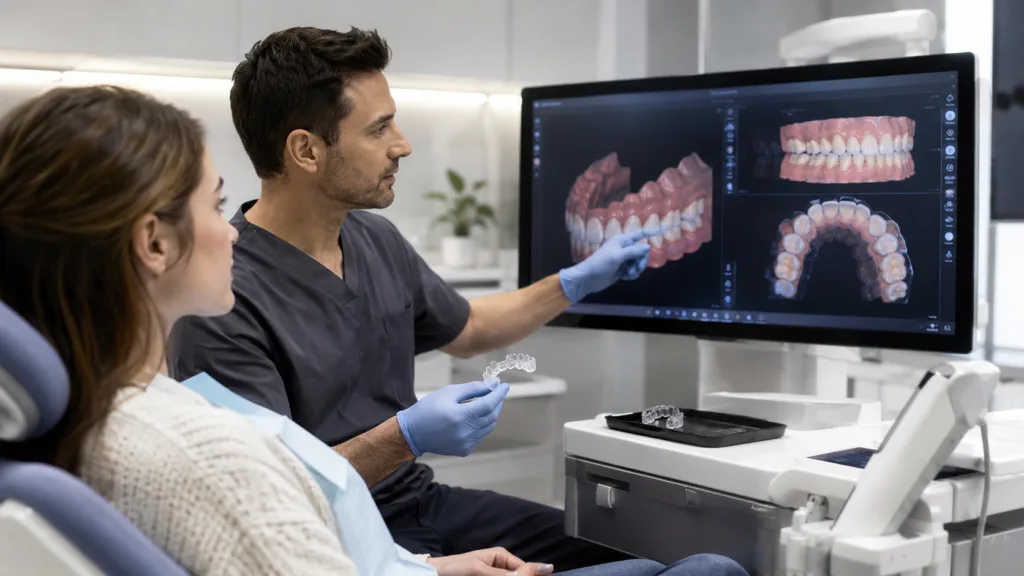
Invisalign Outcome Simulator Pro is being expanded with Arch controls and an Occlusogram that can illustrate alternative arch arrangements and bite contacts. The tool is designed to show potential Invisalign treatment outcomes using personalised facial and dental visualisations rather than relying only on static models or verbal explanations.
ClinCheck software is also receiving a 3D Tissue Animation feature that simulates how facial soft tissue could appear at the end of Invisalign treatment. Align Technology said the tool may support discussions involving facial profile, lip support, smile aesthetics and the relationship between tooth movement and surrounding tissue.
On the restorative side, iTero Design Suite is being enhanced with AI-assisted crown and bridge design and a new splint-design feature. Invisalign Smile Architect is gaining a preferences template and a Dual Flex prescription option intended to simplify treatment plans that combine tooth movement with restorative procedures.
Individually, none of these capabilities completely changes digital dentistry. Their strategic value comes from their placement within a connected workflow. A patient could theoretically move from scanning and radiographic review to oral-health discussion, orthodontic simulation, ClinCheck planning and restorative design without the practice repeatedly exporting data to unrelated systems.
That degree of integration can reduce friction for clinicians, but it can also deepen dependency on a single technology supplier. Once staff have been trained, patient records have accumulated and restorative workflows have been configured around one platform, changing scanner, software or aligner providers becomes more operationally demanding.
Why does 3D Tissue Animation improve patient conversations without guaranteeing clinical accuracy?
The new 3D Tissue Animation feature is likely to attract attention because facial appearance is often central to orthodontic consultations. Patients may understand a treatment proposal more readily when potential changes are presented through a personalised image rather than through technical measurements or generic examples.
For clinicians, the feature could provide another way to frame treatment goals and explain how tooth position may interact with smile aesthetics, lip posture and facial balance. It may be particularly relevant when a patient’s expectations extend beyond tooth alignment to broader aesthetic outcomes.
The important word, however, is “potential”. The feature is a simulation and should not be interpreted as a guaranteed representation of the patient’s post-treatment appearance. The July 23 disclosure did not provide prospective validation results, prediction-error measurements, external testing data or performance analysis across different ages, facial anatomies and treatment types.
Soft-tissue response can be influenced by numerous factors that are not reducible to planned tooth movement alone. A visualisation may therefore be clinically useful as a communication and planning aid while still differing from the eventual outcome.
This distinction is important for informed conversations. A highly realistic simulation may increase patient confidence, but realism can also make an estimated result appear more certain than it is. Clinicians will need to communicate the model’s limitations clearly rather than allowing the image to become an implied promise.
The same caution applies to Invisalign Outcome Simulator Pro. Align Technology referenced an internal comparison covering accepted ClinCheck treatment plans from 9.6 million general-practitioner patients in cases where the simulator was used and where it was not used. The scale of that dataset is notable, but the disclosure does not establish that simulator use independently caused greater treatment acceptance or better clinical outcomes because it was not presented as a randomised prospective study.
Can Align X-ray Insights support dental detection without replacing professional judgement?
The integration of Align X-ray Insights into Align Oral Health Suite moves Align Technology further into computer-aided detection and diagnostic workflow support. The software uses artificial intelligence to analyse two-dimensional dental radiographs and highlight findings that may warrant clinical attention.
Align Technology previously described the system as a computer-aided detection product intended to assist doctors with radiographic analysis, documentation, patient communication and treatment planning. The company has also stated that the software should be used alongside a doctor’s evaluation and should not be solely relied upon to make or confirm a diagnosis.
That limitation should remain central to how the new integration is understood. Highlighting a suspected area on an X-ray is not the same as independently diagnosing disease. The clinician must assess image quality, patient history, symptoms, examination findings and other available evidence before determining whether treatment is required.
The patient-engagement opportunity is nevertheless clear. Radiographs can be difficult for non-specialists to interpret. Colour overlays, tooth charting, gumline visualisation and comparisons with intraoral scans may help doctors explain why an area is being monitored or why a restorative or periodontal intervention is being discussed.
The commercial attraction is equally apparent. Better communication may increase treatment acceptance, encourage patients to proceed with previously deferred care and allow practices to present orthodontic and restorative needs within one consultation.
Evidence supporting those effects remains relatively early. Align Technology previously reported favourable responses from a limited survey of 24 European doctors using Align X-ray Insights, including reported improvements in patient communication and trust. Such feedback is useful for product development, but it is not equivalent to independently validated evidence showing improved diagnostic accuracy, patient outcomes or practice revenue across broader clinical populations.
Why are restorative workflows becoming more important to Align Technology’s growth strategy?
Align Technology built its scale around clear aligners, but its long-term platform strategy increasingly extends into general dentistry and restorative care. That expansion gives the company more opportunities to engage patients and clinicians before, during and after orthodontic treatment.
The iTero Design Suite updates illustrate this direction. AI-assisted crown, bridge and splint design could allow practices to reduce some manual design work and move more restorative production chairside. A clinic equipped with compatible milling or three-dimensional printing equipment could potentially scan, design and manufacture selected restorations or appliances within a shorter workflow.
Invisalign Smile Architect addresses a related opportunity. Many adult patients require both orthodontic movement and restorative work. The order of treatment can materially affect tooth proportions, spacing, gingival relationships and the amount of restorative intervention required.
A connected planning tool may help dentists visualise different sequencing options before beginning treatment. The preferences template and Dual Flex prescription option could also make repeat planning decisions easier to standardise across cases.
The commercial significance lies in expanding the value of the installed iTero scanner beyond impression replacement. A scanner used for oral-health assessment, orthodontic simulation, Invisalign case submission, restorative design, patient monitoring and laboratory collaboration becomes more central to daily practice operations.
That does not mean adoption will be automatic. Chairside restorative workflows require equipment, materials, staff training, maintenance and enough procedure volume to justify the investment. Practices must also determine whether automated designs reduce labour and turnaround times without increasing remakes or compromising clinical control.
What do the latest innovations reveal about Align Technology’s platform economics?
Align Technology’s strategy increasingly resembles an ecosystem model in which hardware adoption supports software use, software engagement supports Invisalign case submissions and each additional workflow raises the practical cost of moving to another supplier.
The company said its technology served approximately 299,500 doctor customers and had supported about 22.8 million Invisalign patients by the time of the July announcement. Its first-quarter filing separately indicated that approximately 23 million people had been treated with Invisalign by March 31, 2026.
Align Technology reported first-quarter 2026 revenue of $1.04 billion, representing year-on-year growth of 6.2%. Clear Aligner revenue increased 7.4% to $856 million, while shipments rose 6.7% to a record 685,700 cases. Imaging Systems and CAD/CAM Services revenue grew only 0.9% year on year to $184.1 million and fell 12.1% from the previous quarter, partly reflecting the seasonal nature of capital-equipment purchases.
Those figures explain why software integration matters. Align Technology does not need every new feature to generate a separately identifiable subscription fee. A tool can be economically valuable if it increases scanner utilisation, strengthens doctor retention, supports more Invisalign submissions or encourages practices to adopt additional restorative capabilities.
The risk is that frequent software announcements create more perceived complexity than practical value. Dental practices do not purchase technology merely because functions are technologically possible. They adopt tools when implementation is straightforward, staff can use them reliably and the workflow produces a clear clinical or financial return.
Align Technology will therefore need to demonstrate more than feature availability. Measures such as active usage, treatment-plan completion rates, scanner productivity, restorative-case growth, doctor retention and incremental aligner submissions would provide a clearer picture of whether the connected-platform strategy is influencing behaviour.
How should investors interpret the announcement before second-quarter results?
Align Technology shares closed at $168.24 on July 23, down 2.45% during a weak broader market session. The stock had declined about 5.7% over the preceding five trading sessions but was almost unchanged from its June 23 close, indicating that investor sentiment remained mixed rather than decisively negative.
The shares were approximately 19.2% below their 52-week high of $208.31, while remaining almost 38% above the 52-week low of $122. The company’s market capitalisation stood at roughly $12 billion.
The July 23 decline should not automatically be attributed to the product announcement because the wider market also fell sharply. Investors are more likely to treat these software releases as evidence of long-term platform development than as an immediate revenue catalyst.
The more consequential event is Align Technology’s second-quarter earnings release scheduled for July 29, 2026. Management previously projected second-quarter revenue of $1.04 billion to $1.06 billion and reaffirmed expectations for full-year revenue growth of 3% to 4%, mid-single-digit clear-aligner volume growth and a non-GAAP operating margin of approximately 23.7%.
Investors will be watching whether international clear-aligner growth remains resilient, North American volumes improve and Imaging Systems and CAD/CAM Services revenue rebounds sequentially. Commentary on iTero Lumina demand, software adoption and general-dentist engagement could provide a clearer commercial context for the newly announced platform capabilities.
What must Align Technology prove before these tools materially influence adoption?
The latest innovations strengthen Align Technology’s argument that it is becoming a broader digital-dentistry company rather than remaining primarily an Invisalign manufacturer. The platform now reaches further into radiographic review, oral-health communication, facial visualisation, orthodontic planning, restorative sequencing and chairside design.
The immediate benefit may be greatest for existing Align Technology customers that already use iTero scanners and Invisalign workflows. Adding functionality inside an established interface can be easier than persuading practices to purchase and integrate an entirely new system.
Broader commercial impact will depend on three tests. Align Technology must show that clinicians use the new features after the launch period, that practices gain measurable workflow or economic benefits, and that patient-facing simulations remain appropriately framed as decision-support tools rather than guaranteed predictions.
Regulatory availability will also shape adoption because the company has cautioned that products and features may differ across markets. A connected global platform cannot be commercially uniform when diagnostic software, treatment-planning functions and dental devices face different local requirements.
The July 23 announcement therefore represents an important platform-development signal, but not yet proof that the new functions will accelerate revenue or improve clinical outcomes. The strongest validation will come from sustained doctor utilisation, independent evidence, broader authorised availability and financial results showing that Align Technology’s growing digital ecosystem is producing more than attractive chairside demonstrations.

