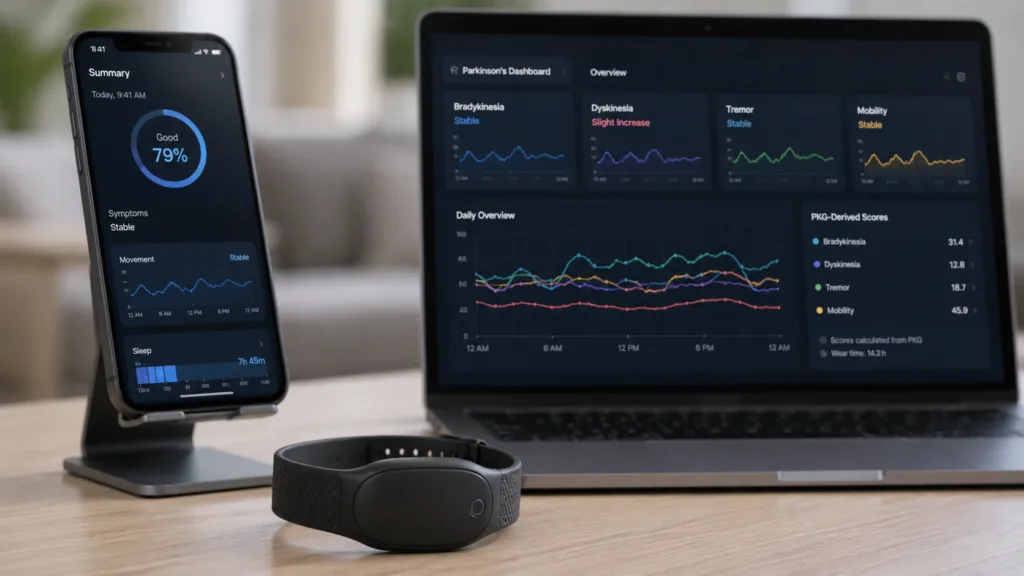
Empatica has received US Food and Drug Administration 510(k) clearance for its Health Monitoring Platform for Parkinson’s Disease Monitoring, transforming the company’s 2025 acquisition of PKG Health from a digital-health expansion strategy into a regulated US clinical-care offering. The system combines wearable hardware, remote monitoring infrastructure and movement-disorder analysis intended to give clinicians objective information on Parkinson’s symptoms outside the brief observation window of an office visit.
FDA records identify the traditional 510(k) submission as K260374 and list the cleared configuration as including the Empatica Health Monitoring Platform for Parkinson’s Disease Monitoring, EmbracePlus, EmbraceMini, Empatica Care, PKG Monitor by Empatica and the Care Portal. FDA received the submission on February 5, 2026 and issued its substantial-equivalence decision on August 14, with Empatica announcing the clearance five days later.
The regulatory decision is notable because Parkinson’s disease symptoms fluctuate over time. Tremor, bradykinesia, dyskinesia and treatment-related motor fluctuations may look different during a scheduled consultation than during a patient’s normal day, making longitudinal monitoring an attractive complement to conventional assessment. Empatica is attempting to turn that problem into a connected-care model in which wearable-derived information gives neurologists a broader view of symptom patterns between appointments.
What did FDA actually clear in the Empatica Parkinson’s system?
FDA classifies the primary device under the neurological category of tremor transducers, with product code GYD and additional product codes covering related functionality. The agency determined the system to be substantially equivalent through the traditional 510(k) process, meaning it should be described as FDA cleared rather than FDA approved.
The platform brings together Empatica wearable devices with digital measures originating from PKG Health’s movement-disorder technology. Empatica acquired PKG Health in 2025 after the companies had previously collaborated on digital endpoints for tremor and movement disorders in clinical research. The acquisition brought algorithms for assessing movement-related features such as bradykinesia, dyskinesia and tremor into Empatica’s broader monitoring environment.
Empatica’s wider technology base already includes FDA-cleared physiological and neurological monitoring applications. Its EmbraceMini obtained a separate 510(k) clearance for sleep assessment in December 2025, while earlier versions of the company’s Health Monitoring Platform have been cleared for physiological monitoring and sensor-derived measurements.
The Parkinson’s clearance therefore represents an expansion of an existing regulatory platform rather than Empatica’s first encounter with FDA. Strategically, that matters because companies building software-enabled medical devices often gain leverage when new clinical applications can be layered onto established hardware, cloud infrastructure and regulatory-quality systems instead of being constructed independently.
Why can continuous monitoring add information that a Parkinson’s clinic visit misses?
Parkinson’s disease management frequently depends on evaluating how symptoms respond across a medication cycle. A patient may experience periods when treatment provides good motor control, periods when the medication effect wears off and periods of excessive movement associated with therapy. A consultation provides only a short sample from that broader pattern.
Wearable monitoring attempts to extend observation into daily life. Instead of relying entirely on a patient remembering when symptoms occurred or on the clinician observing the patient during one appointment, objective movement data can be collected across longer periods.
That does not mean an algorithm replaces neurological examination. Wearables cannot capture every clinically important element of Parkinson’s disease, and a numerical motor measure must still be interpreted in the context of symptoms, medication history, cognition, falls, sleep, autonomic effects and patient priorities.
The stronger proposition is complementary. Continuous data may identify patterns that help a clinician decide whether further evaluation or treatment adjustment should be considered, especially when a patient’s experience varies considerably across the day.
PKG-derived measures have already accumulated clinical and research use before becoming part of Empatica. The company said at the time of the acquisition that the technology had been represented in more than 70 peer-reviewed studies and deployed in more than 150 hospitals and clinical sites across Europe, Australia and the United States. Those figures come from Empatica and do not mean FDA independently validated every study or every historical use, but they indicate that the movement-analysis technology was not beginning from a purely experimental base.
How did the PKG Health acquisition change Empatica’s clinical strategy?
Before acquiring PKG Health, Empatica was best known for wearable monitoring and digital biomarkers used heavily in research, including applications involving epilepsy, sleep and physiological data collection. Buying PKG Health gave the company a much more disease-specific neurological capability.
The logic of the acquisition was straightforward: PKG Health supplied established Parkinson’s movement-analysis algorithms, while Empatica supplied modern wearable devices, remote data infrastructure and experience deploying digital-health technology across trials and care environments. The combination could therefore create a more scalable Parkinson’s product than either technology in isolation.
The regulatory sequence since the deal shows how quickly Empatica attempted to convert that strategic thesis into clinical products. The company obtained European Medical Device Regulation certification for Parkinson’s monitoring in January 2026, making the technology available for clinical use in Europe and the United Kingdom while the US version remained investigational pending FDA review. The August 510(k) decision now removes that specific US regulatory barrier.
This is an important difference from digital-health acquisitions that remain primarily research businesses. Clinical-trial tools can generate valuable revenue and evidence, but clearance for routine patient monitoring opens a separate channel involving neurologists, health systems and potentially remote-care programmes.
The acquisition also strengthens Empatica’s position with pharmaceutical developers. A technology used in clinical care and in drug studies can potentially provide continuity between trial endpoints and post-launch disease monitoring, although specific use as an endpoint in a registration programme would still depend on the relevant trial and regulatory context.
Could Parkinson’s wearables meaningfully change treatment decisions?
The clinical value of remote monitoring will ultimately depend on whether additional data lead to better decisions rather than simply more data. Neurologists already face information overload, and continuous monitoring can become counterproductive if systems produce large volumes of poorly prioritized signals.
The more useful model is likely one that compresses raw sensor data into clinically interpretable trends. Parkinson’s monitoring is particularly suitable for this because clinicians often want to understand when bradykinesia, dyskinesia or tremor occurs, how long it persists and whether patterns correspond with medication timing.
Objective monitoring could also help when patient recall is uncertain. Motor fluctuations occurring across several days may be difficult to reconstruct accurately during an appointment, while caregivers may observe patterns differently from patients themselves.
However, the technology still needs to prove value inside real workflows. An FDA-cleared measurement does not automatically establish that using the measurement improves long-term outcomes, reduces hospitalization, prevents falls or lowers total cost of care. Those are separate clinical and health-economic questions.
Adoption will therefore depend on how easily reports can be interpreted, how frequently clinicians need to review them, whether reimbursement supports monitoring and whether patients consistently wear and maintain the devices.
Why does this clearance matter beyond Empatica?
Sensor-based digital health technologies have spent years moving from research-grade activity trackers toward medical devices intended to provide clinically meaningful measurements. Parkinson’s disease is one of the more compelling areas for that transition because motor symptoms are inherently dynamic and measurable through movement sensors.
Empatica’s clearance illustrates how the sector is evolving from selling standalone wearables toward integrated systems combining hardware, disease-specific algorithms, patient-facing infrastructure and clinician portals. The competitive advantage increasingly lies in the quality of the complete monitoring chain rather than the wrist sensor alone.
For pharmaceutical companies, this trend may create more mature digital endpoints and decentralized data-collection options. For healthcare providers, it offers the possibility of following chronic neurological disease between appointments. For patients, the attraction is a care model that potentially reflects what happens during ordinary life rather than only what happens during a short clinic encounter.
The constraints remain significant. Wearable adherence, algorithm performance across diverse patient populations, cybersecurity, interoperability and reimbursement will influence real-world uptake. Clinicians will also need confidence that additional information changes management often enough to justify the time required to review it.
Empatica now has something more concrete with which to test those questions. By combining PKG Health’s Parkinson’s monitoring heritage with its own wearable platform and securing FDA clearance, the company has moved the technology from a predominantly research and investigational story toward regulated US clinical deployment.
That does not make continuous monitoring a substitute for the neurologist. It makes it a potential extension of the neurologist’s observation window, and the commercial success of Empatica’s Parkinson’s platform will depend on whether that longer window consistently provides information worth acting on.